 Add to Chrome
 Add to Firefox
 Add to Edge
SPEGC: Continual Test-Time Adaptation via Semantic-Prompt-Enhanced Graph Clustering for Medical Image Segmentation
Mar 12, 2026
In medical image segmentation tasks, the domain gap caused by the difference in data collection between training and testing data seriously hinders the deployment of pre-trained models in clinical practice. Continual Test-Time Adaptation (CTTA) aims to enable pre-trained models to adapt to continuously changing unlabeled domains, providing an effective approach to solving this problem. However, existing CTTA methods often rely on unreliable supervisory signals, igniting a self-reinforcing cycle of error accumulation that culminates in catastrophic performance degradation. To overcome these challenges, we propose a CTTA via Semantic-Prompt-Enhanced Graph Clustering (SPEGC) for medical image segmentation. First, we design a semantic prompt feature enhancement mechanism that utilizes decoupled commonality and heterogeneity prompt pools to inject global contextual information into local features, alleviating their susceptibility to noise interference under domain shift. Second, based on these enhanced features, we design a differentiable graph clustering solver. This solver reframes global edge sparsification as an optimal transport problem, allowing it to distill a raw similarity matrix into a refined and high-order structural representation in an end-to-end manner. Finally, this robust structural representation is used to guide model adaptation, ensuring predictions are consistent at a cluster-level and dynamically adjusting decision boundaries. Extensive experiments demonstrate that SPEGC outperforms other state-of-the-art CTTA methods on two medical image segmentation benchmarks. The source code is available at https://github.com/Jwei-Z/SPEGC-for-MIS.

TEC-Net: Vision Transformer Embrace Convolutional Neural Networks for Medical Image Segmentation
Jun 07, 2023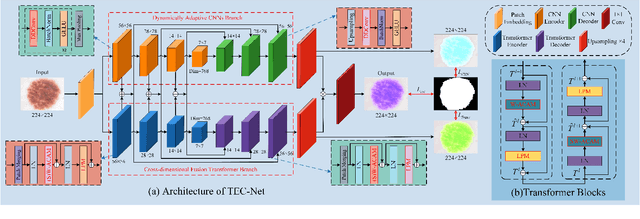
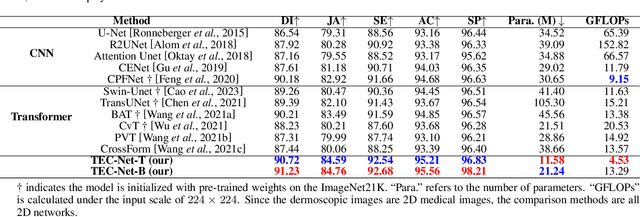
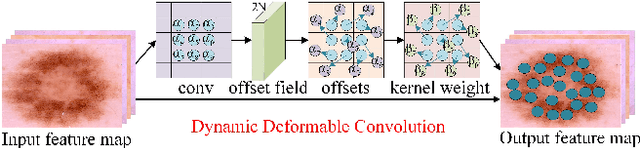
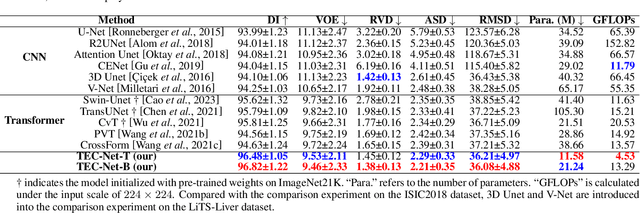
The hybrid architecture of convolution neural networks (CNN) and Transformer has been the most popular method for medical image segmentation. However, the existing networks based on the hybrid architecture suffer from two problems. First, although the CNN branch can capture image local features by using convolution operation, the vanilla convolution is unable to achieve adaptive extraction of image features. Second, although the Transformer branch can model the global information of images, the conventional self-attention only focuses on the spatial self-attention of images and ignores the channel and cross-dimensional self-attention leading to low segmentation accuracy for medical images with complex backgrounds. To solve these problems, we propose vision Transformer embrace convolutional neural networks for medical image segmentation (TEC-Net). Our network has two advantages. First, dynamic deformable convolution (DDConv) is designed in the CNN branch, which not only overcomes the difficulty of adaptive feature extraction using fixed-size convolution kernels, but also solves the defect that different inputs share the same convolution kernel parameters, effectively improving the feature expression ability of CNN branch. Second, in the Transformer branch, a (shifted)-window adaptive complementary attention module ((S)W-ACAM) and compact convolutional projection are designed to enable the network to fully learn the cross-dimensional long-range dependency of medical images with few parameters and calculations. Experimental results show that the proposed TEC-Net provides better medical image segmentation results than SOTA methods including CNN and Transformer networks. In addition, our TEC-Net requires fewer parameters and computational costs and does not rely on pre-training. The code is publicly available at https://github.com/SR0920/TEC-Net.
Medical Image Segmentation Using Deep Learning: A Survey
Sep 28, 2020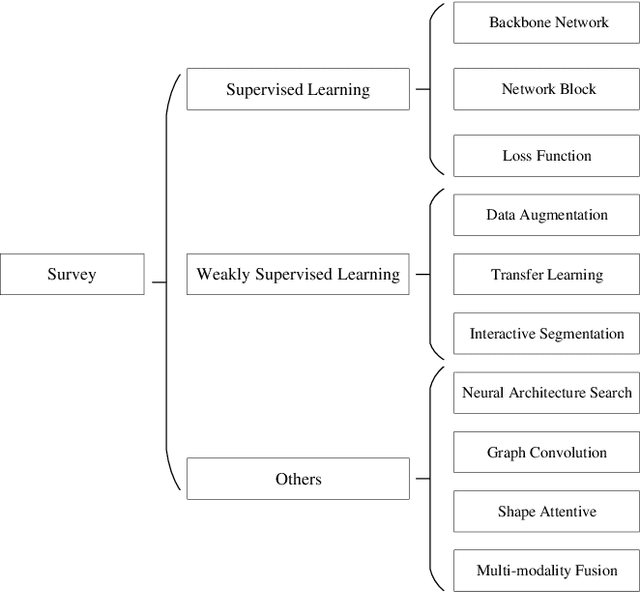
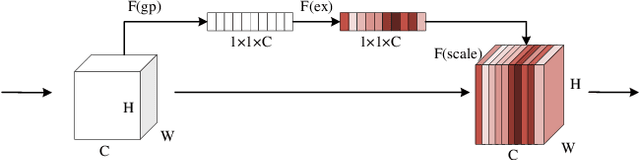
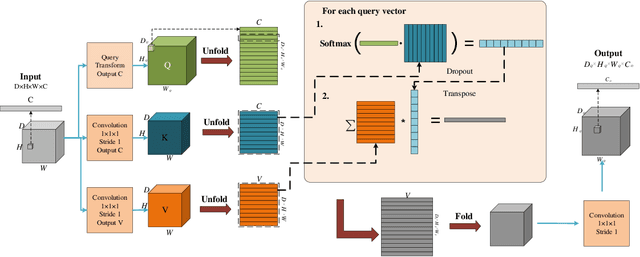
Deep learning has been widely used for medical image segmentation and a large number of papers has been presented recording the success of deep learning in the field. In this paper, we present a comprehensive thematic survey on medical image segmentation using deep learning techniques. This paper makes two original contributions. Firstly, compared to traditional surveys that directly divide literatures of deep learning on medical image segmentation into many groups and introduce literatures in detail for each group, we classify currently popular literatures according to a multi-level structure from coarse to fine. Secondly, this paper focuses on supervised and weakly supervised learning approaches, without including unsupervised approaches since they have been introduced in many old surveys and they are not popular currently. For supervised learning approaches, we analyze literatures in three aspects: the selection of backbone networks, the design of network blocks, and the improvement of loss functions. For weakly supervised learning approaches, we investigate literature according to data augmentation, transfer learning, and interactive segmentation, separately. Compared to existing surveys, this survey classifies the literatures very differently from before and is more convenient for readers to understand the relevant rationale and will guide them to think of appropriate improvements in medical image segmentation based on deep learning approaches.