 Add to Chrome
 Add to Firefox
 Add to Edge
Shieldstral
Jul 28, 2026
We introduce Shieldstral, a 3B-parameter policy-adaptive multimodal safety classifier that matches or outperforms models nearly 7$\times$ its size on text safety benchmarks and sets a new state of the art on multimodal safety classification. Shieldstral formulates content moderation as a binary question-answering task. This simple formulation unifies diverse moderation tasks into a single yes/no problem, enabling heterogeneous safety datasets with divergent taxonomies to be consolidated under one training framework. We present the data construction recipe, covering curation and generation of approximately 54.1M samples and a fine-grained evaluation set to evaluate policy adaptability. Together, these enable a small adaptive model to match or outperform much larger models.

Robostral Navigate
Jul 24, 2026Deploying navigation systems at scale requires a recipe that minimizes sensor assumptions, generalizes across robot embodiments, and trains efficiently. Yet, today's best systems depend on depth sensors, multi-camera rigs, or pre-built maps, limiting the hardware they support and increasing deployment cost. We introduce Robostral Navigate, an 8B vision-language model built around this scalability objective. The model consumes only a stream of monocular RGB images - the most ubiquitous sensor across robotic platforms and predicts waypoints by pointing to the next target location in the current camera view. Operating purely in image space, rather than robot-specific coordinates, makes the policy naturally robust to changes in camera intrinsics and scene scale, enabling deployment across wheeled, legged, and aerial robots without recalibration. We generate 2.4 million trajectories across 350k simulated scenes to reduce the reliance on real-world data collection and scale easily. We further introduce a prefix-caching training recipe that packs entire episodes into single training sequences, reducing training tokens by 22x and cutting training time from months to days. A tree-based attention mask prevents conditioning on previous ground-truth actions, encouraging visually grounded action prediction, and reinforcement learning is used to further improve exploration and recovery capabilities. On the Room-to-Room and Room-Across-Room in Continuous Environments (R2R-CE and RxR-CE) benchmarks, Robostral Navigate sets a new state of the art. On R2R-CE, it achieves a 77.4% success rate, surpassing the best monocular method by 10.5 points and the strongest depth- or multi-camera system by 5.3 points despite using only a single RGB camera. On RxR-CE, it reaches 75.1% success rate, outperforming all monocular baselines.
Entropic Projection Alignment: Estimating, Explaining, and Improving Model Performance Under Distribution Shift
May 29, 2026We propose a unified framework for addressing three key challenges of distribution shift: (1) estimating a model's performance on an unlabeled target domain, (2) explaining the shift by identifying the features responsible, and (3) improving the target domain performance. Our method, Entropic Projection Alignment (EPA), aligns the source distribution to the target by matching carefully selected moments while simultaneously minimising the KL divergence from the source. This formulation yields a unique closed-form solution for importance weights, achieving robustness through implicit variance control. Drawing on domain adaptation theory, we establish that moment matching is sufficient for reliable estimation and adaptation, avoiding the need for full density ratio recovery. Extensive experiments, together with strong theoretical guarantees, demonstrate that EPA consistently outperforms state-of-the-art baselines while offering substantial computational efficiency.
ShapShift: Explaining Model Prediction Shifts with Subgroup Conditional Shapley Values
Apr 13, 2026Changes in input distribution can induce shifts in the average predictions of machine learning models. Such prediction shifts may impact downstream business outcomes (e.g. a bank's loan approval rate), so understanding their causes can be crucial. We propose \ours{}: a Shapley value method for attributing prediction shifts to changes in the conditional probabilities of interpretable subgroups of data, where these subgroups are defined by the structure of decision trees. We initially apply this method to single decision trees, providing exact explanations based on conditional probability changes at split nodes. Next, we extend it to tree ensembles by selecting the most explanatory tree and accounting for residual effects. Finally, we propose a model-agnostic variant using surrogate trees grown with a novel objective function, allowing application to models like neural networks. While exact computation can be intensive, approximation techniques enable practical application. We show that \ours{} provides simple, faithful, and near-complete explanations of prediction shifts across model classes, aiding model monitoring in dynamic environments.
Voxtral TTS
Mar 26, 2026We introduce Voxtral TTS, an expressive multilingual text-to-speech model that generates natural speech from as little as 3 seconds of reference audio. Voxtral TTS adopts a hybrid architecture that combines auto-regressive generation of semantic speech tokens with flow-matching for acoustic tokens. These tokens are encoded and decoded with Voxtral Codec, a speech tokenizer trained from scratch with a hybrid VQ-FSQ quantization scheme. In human evaluations conducted by native speakers, Voxtral TTS is preferred for multilingual voice cloning due to its naturalness and expressivity, achieving a 68.4\% win rate over ElevenLabs Flash v2.5. We release the model weights under a CC BY-NC license.
Voxtral Realtime
Feb 11, 2026We introduce Voxtral Realtime, a natively streaming automatic speech recognition model that matches offline transcription quality at sub-second latency. Unlike approaches that adapt offline models through chunking or sliding windows, Voxtral Realtime is trained end-to-end for streaming, with explicit alignment between audio and text streams. Our architecture builds on the Delayed Streams Modeling framework, introducing a new causal audio encoder and Ada RMS-Norm for improved delay conditioning. We scale pretraining to a large-scale dataset spanning 13 languages. At a delay of 480ms, Voxtral Realtime achieves performance on par with Whisper, the most widely deployed offline transcription system. We release the model weights under the Apache 2.0 license.
Ministral 3
Jan 13, 2026We introduce the Ministral 3 series, a family of parameter-efficient dense language models designed for compute and memory constrained applications, available in three model sizes: 3B, 8B, and 14B parameters. For each model size, we release three variants: a pretrained base model for general-purpose use, an instruction finetuned, and a reasoning model for complex problem-solving. In addition, we present our recipe to derive the Ministral 3 models through Cascade Distillation, an iterative pruning and continued training with distillation technique. Each model comes with image understanding capabilities, all under the Apache 2.0 license.
Voxtral
Jul 17, 2025We present Voxtral Mini and Voxtral Small, two multimodal audio chat models. Voxtral is trained to comprehend both spoken audio and text documents, achieving state-of-the-art performance across a diverse range of audio benchmarks, while preserving strong text capabilities. Voxtral Small outperforms a number of closed-source models, while being small enough to run locally. A 32K context window enables the model to handle audio files up to 40 minutes in duration and long multi-turn conversations. We also contribute three benchmarks for evaluating speech understanding models on knowledge and trivia. Both Voxtral models are released under Apache 2.0 license.
Zero-Shot Reinforcement Learning Under Partial Observability
Jun 18, 2025Recent work has shown that, under certain assumptions, zero-shot reinforcement learning (RL) methods can generalise to any unseen task in an environment after reward-free pre-training. Access to Markov states is one such assumption, yet, in many real-world applications, the Markov state is only partially observable. Here, we explore how the performance of standard zero-shot RL methods degrades when subjected to partially observability, and show that, as in single-task RL, memory-based architectures are an effective remedy. We evaluate our memory-based zero-shot RL methods in domains where the states, rewards and a change in dynamics are partially observed, and show improved performance over memory-free baselines. Our code is open-sourced via: https://enjeeneer.io/projects/bfms-with-memory/.
Sequential Harmful Shift Detection Without Labels
Dec 17, 2024


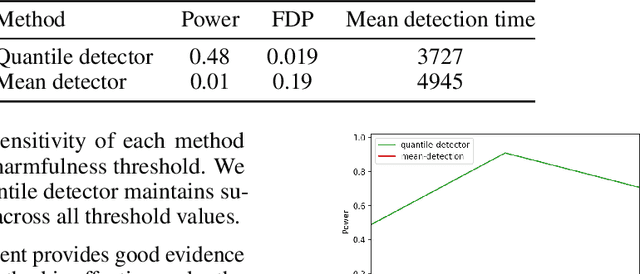
We introduce a novel approach for detecting distribution shifts that negatively impact the performance of machine learning models in continuous production environments, which requires no access to ground truth data labels. It builds upon the work of Podkopaev and Ramdas [2022], who address scenarios where labels are available for tracking model errors over time. Our solution extends this framework to work in the absence of labels, by employing a proxy for the true error. This proxy is derived using the predictions of a trained error estimator. Experiments show that our method has high power and false alarm control under various distribution shifts, including covariate and label shifts and natural shifts over geography and time.