 Add to Chrome
 Add to Firefox
 Add to Edge
Mitigating Scoring Errors and Compensating for Nonverbal Subtests in Speech-Based Dementia Assessment
Jun 17, 2026
Early detection of cognitive impairment relies on neuropsychological tests to minimize subjectivity by assessing multiple cognitive domains. Speech-based evaluation can support diagnostics and improve accessibility, but transcription errors and the omission of nonverbal subtests (e.g., motor skills) limit accuracy. Beyond conventional test scores, speech-derived features can provide additional insights into cognitive status. This study investigates the speech-based evaluation of the German "Syndrom-Kurz-Test," a standardized dementia screening test comprising verbal and motor subtests. We train models that integrate transcript-derived scores and Whisper embeddings per verbal subtest to reduce scoring errors. To compensate for missing motor subtests, we then leverage these fused representations to approximate expert overall ratings. Despite omitting subtests, our models strongly correlate with expert ratings and efficiently and accurately discriminate between cognitive status groups.

Reading between the Lines: Leveraging Large Language Models for Global Dementia and Depression Assessment from Clinical Interviews
Jun 16, 2026Dementia and depression are the most prevalent neuropsychiatric disorders in geriatric populations, and their overlapping symptoms pose major challenges for differential diagnosis. In this study, we investigate open-weights Large Language Models (LLMs) for predicting dementia and depression severity from speech samples collected during standardized history taking interviews with 154 German-speaking subjects. We introduce an observer-based Global Depression Scale (GDS-D) aligned with the established Global Deterioration Scale (GDS), enabling parallel global staging of affective and cognitive symptoms. We compare three LLMs (Mistral 3.1, DeepHermes, Qwen3) in two settings: (1) zero-shot prediction and (2) LLM-based feature extraction for Support Vector Regression, using human and pause-enriched transcripts. Results show that LLMs effectively predict depression severity in zero-shot settings (best MAE of 0.60), while dementia assessment benefits substantially from structured feature extraction (best MAE of 0.78), reducing errors by up to 35% over zero-shot baselines. Pause-enriched transcripts achieve competitive performance with human transcriptions, demonstrating the viability of fully automatic screening pipelines for differential neuropsychiatric assessment.
Pitfalls and Limits in Automatic Dementia Assessment
Aug 06, 2025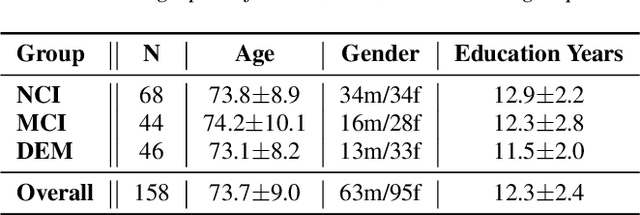
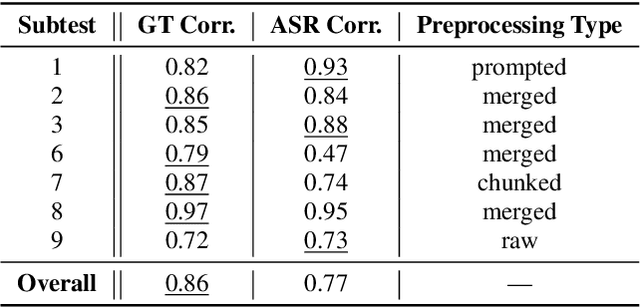
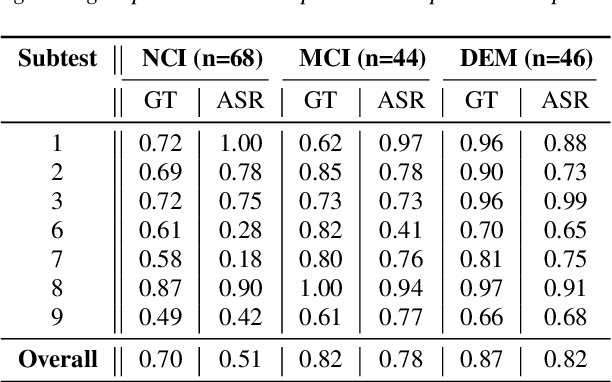
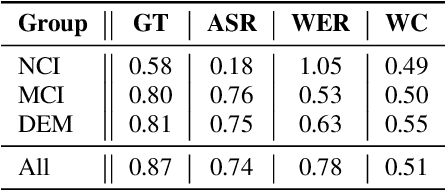
Current work on speech-based dementia assessment focuses on either feature extraction to predict assessment scales, or on the automation of existing test procedures. Most research uses public data unquestioningly and rarely performs a detailed error analysis, focusing primarily on numerical performance. We perform an in-depth analysis of an automated standardized dementia assessment, the Syndrom-Kurz-Test. We find that while there is a high overall correlation with human annotators, due to certain artifacts, we observe high correlations for the severely impaired individuals, which is less true for the healthy or mildly impaired ones. Speech production decreases with cognitive decline, leading to overoptimistic correlations when test scoring relies on word naming. Depending on the test design, fallback handling introduces further biases that favor certain groups. These pitfalls remain independent of group distributions in datasets and require differentiated analysis of target groups.
Infusing Acoustic Pause Context into Text-Based Dementia Assessment
Aug 27, 2024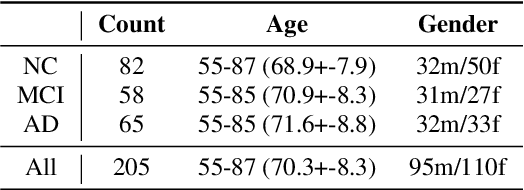
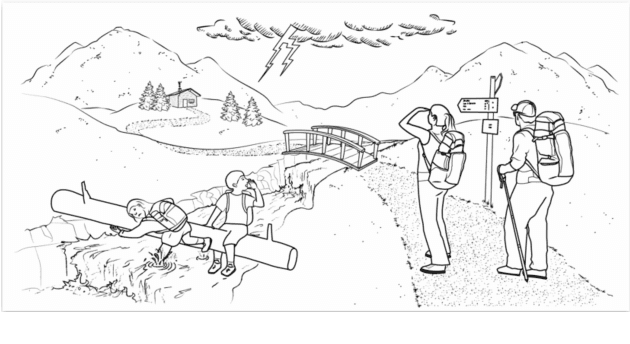
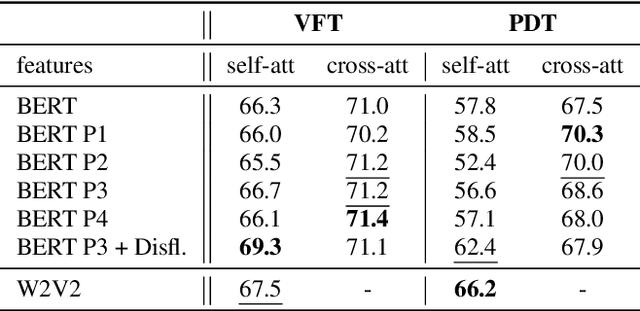
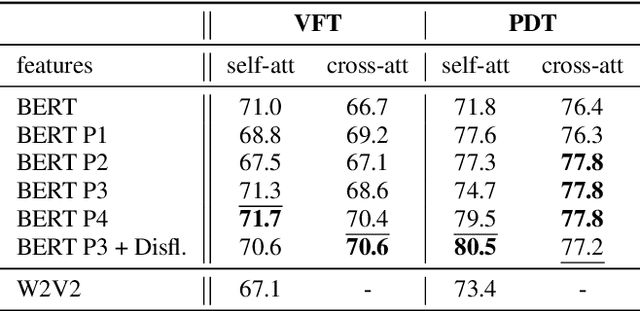
Speech pauses, alongside content and structure, offer a valuable and non-invasive biomarker for detecting dementia. This work investigates the use of pause-enriched transcripts in transformer-based language models to differentiate the cognitive states of subjects with no cognitive impairment, mild cognitive impairment, and Alzheimer's dementia based on their speech from a clinical assessment. We address three binary classification tasks: Onset, monitoring, and dementia exclusion. The performance is evaluated through experiments on a German Verbal Fluency Test and a Picture Description Test, comparing the model's effectiveness across different speech production contexts. Starting from a textual baseline, we investigate the effect of incorporation of pause information and acoustic context. We show the test should be chosen depending on the task, and similarly, lexical pause information and acoustic cross-attention contribute differently.
Classifying Dementia in the Presence of Depression: A Cross-Corpus Study
Aug 16, 2023Automated dementia screening enables early detection and intervention, reducing costs to healthcare systems and increasing quality of life for those affected. Depression has shared symptoms with dementia, adding complexity to diagnoses. The research focus so far has been on binary classification of dementia (DEM) and healthy controls (HC) using speech from picture description tests from a single dataset. In this work, we apply established baseline systems to discriminate cognitive impairment in speech from the semantic Verbal Fluency Test and the Boston Naming Test using text, audio and emotion embeddings in a 3-class classification problem (HC vs. MCI vs. DEM). We perform cross-corpus and mixed-corpus experiments on two independently recorded German datasets to investigate generalization to larger populations and different recording conditions. In a detailed error analysis, we look at depression as a secondary diagnosis to understand what our classifiers actually learn.
Automated Evaluation of Standardized Dementia Screening Tests
Jun 13, 2022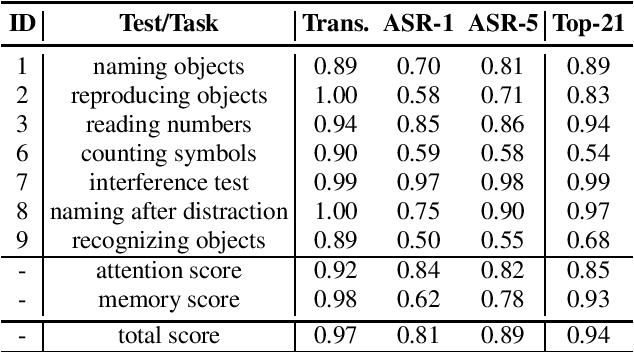
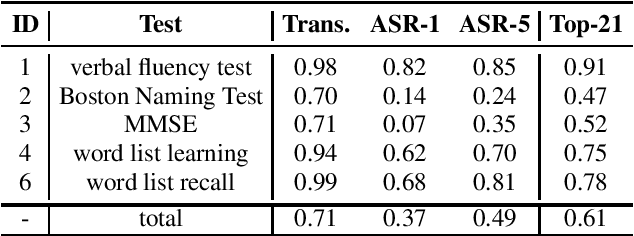
For dementia screening and monitoring, standardized tests play a key role in clinical routine since they aim at minimizing subjectivity by measuring performance on a variety of cognitive tasks. In this paper, we report on a study that consists of a semi-standardized history taking followed by two standardized neuropsychological tests, namely the SKT and the CERAD-NB. The tests include basic tasks such as naming objects, learning word lists, but also widely used tools such as the MMSE. Most of the tasks are performed verbally and should thus be suitable for automated scoring based on transcripts. For the first batch of 30 patients, we analyze the correlation between expert manual evaluations and automatic evaluations based on manual and automatic transcriptions. For both SKT and CERAD-NB, we observe high to perfect correlations using manual transcripts; for certain tasks with lower correlation, the automatic scoring is stricter than the human reference since it is limited to the audio. Using automatic transcriptions, correlations drop as expected and are related to recognition accuracy; however, we still observe high correlations of up to 0.98 (SKT) and 0.85 (CERAD-NB). We show that using word alternatives helps to mitigate recognition errors and subsequently improves correlation with expert scores.
Going Beyond the Cookie Theft Picture Test: Detecting Cognitive Impairments using Acoustic Features
Jun 10, 2022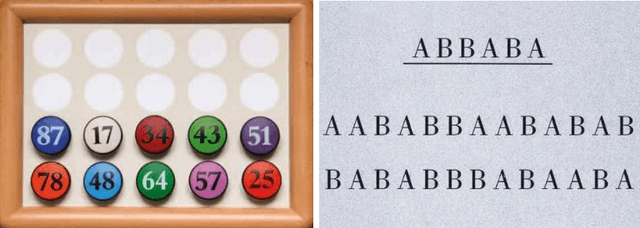

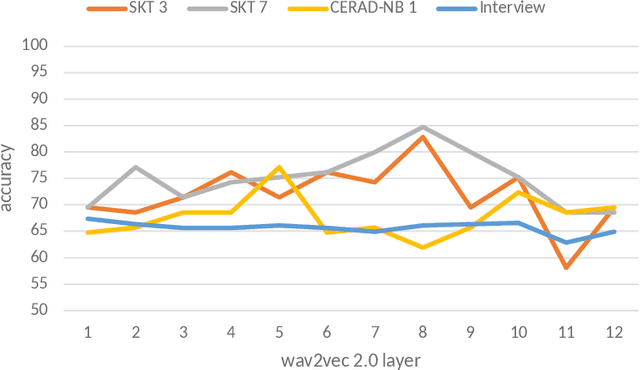
Standardized tests play a crucial role in the detection of cognitive impairment. Previous work demonstrated that automatic detection of cognitive impairment is possible using audio data from a standardized picture description task. The presented study goes beyond that, evaluating our methods on data taken from two standardized neuropsychological tests, namely the German SKT and a German version of the CERAD-NB, and a semi-structured clinical interview between a patient and a psychologist. For the tests, we focus on speech recordings of three sub-tests: reading numbers (SKT 3), interference (SKT 7), and verbal fluency (CERAD-NB 1). We show that acoustic features from standardized tests can be used to reliably discriminate cognitively impaired individuals from non-impaired ones. Furthermore, we provide evidence that even features extracted from random speech samples of the interview can be a discriminator of cognitive impairment. In our baseline experiments, we use OpenSMILE features and Support Vector Machine classifiers. In an improved setup, we show that using wav2vec 2.0 features instead, we can achieve an accuracy of up to 85%.