 Add to Chrome
 Add to Firefox
 Add to Edge
CTBench: Evaluating Troubleshooting Capabilities of AI Agents in Realistic Telecom Network Operations
Aug 12, 2026
Agents are increasingly considered for automating network operations and maintenance, where engineers must diagnose network faults, optimize configurations to enhance services, and reduce operational costs while acting under strict constraints. However, existing evaluations fail to accurately model real network characteristics or assess agents under partially observable telecom environments with diverse vendors, devices, protocols, and interfaces. In this paper, we introduce CTBench, a public benchmark for assessing whether an agent behaves like a competent telecom troubleshooting engineer. CTBench focuses on root cause analysis and path restoration. Each task is constructed by experts and annotated with rich task metadata, including golden evidence steps. CTBench uses expert-grounded metrics that evaluate both final answers and the diagnostic evidence. Experiments with representative harness-model combinations show that state-of-the-art agents perform very well at identifying endpoints in path-restoration tasks but, more generally, underperform in root cause analysis. In particular, agents struggle with interface state, link-layer, service-management, and other operational faults. Most importantly, even when agents produce plausible or correct final answers, they often fail to provide the evidence-grounded diagnoses required in operational practice. Our results further show that path restoration is generally more resource expensive, yet larger resource usage does not necessarily translate into better diagnosis.

Exploiting Inter-Session Information with Frequency-enhanced Dual-Path Networks for Sequential Recommendation
Nov 14, 2025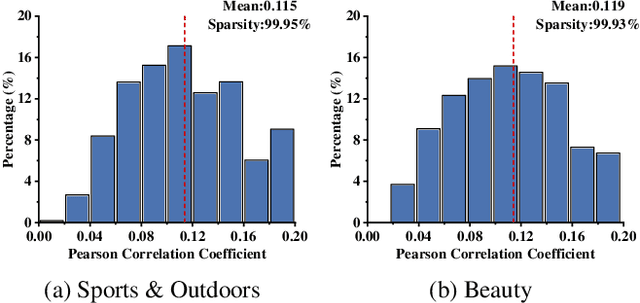
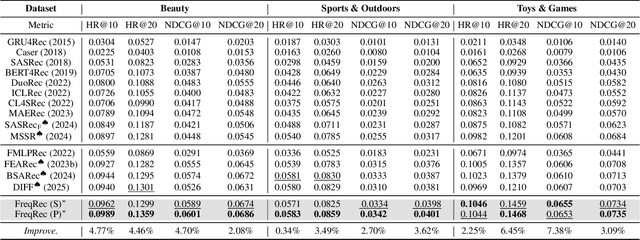
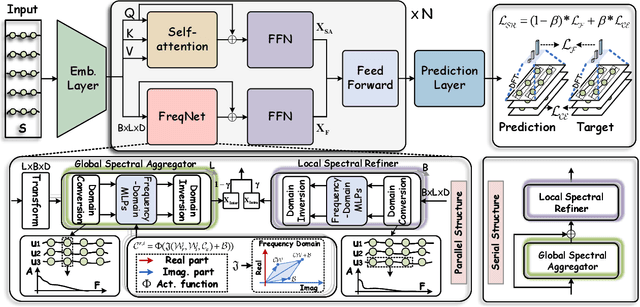

Sequential recommendation (SR) aims to predict a user's next item preference by modeling historical interaction sequences. Recent advances often integrate frequency-domain modules to compensate for self-attention's low-pass nature by restoring the high-frequency signals critical for personalized recommendations. Nevertheless, existing frequency-aware solutions process each session in isolation and optimize exclusively with time-domain objectives. Consequently, they overlook cross-session spectral dependencies and fail to enforce alignment between predicted and actual spectral signatures, leaving valuable frequency information under-exploited. To this end, we propose FreqRec, a Frequency-Enhanced Dual-Path Network for sequential Recommendation that jointly captures inter-session and intra-session behaviors via a learnable Frequency-domain Multi-layer Perceptrons. Moreover, FreqRec is optimized under a composite objective that combines cross entropy with a frequency-domain consistency loss, explicitly aligning predicted and true spectral signatures. Extensive experiments on three benchmarks show that FreqRec surpasses strong baselines and remains robust under data sparsity and noisy-log conditions.