 Add to Chrome
 Add to Firefox
 Add to Edge
GLIDE: Graph-guided Leap Inference for Diffusion Estimation of Spatio-Temporal Point Processes
May 31, 2026
Spatio-temporal point processes (STPPs) provide a principled framework for modeling asynchronous events in continuous time and space. Recent diffusion-based approaches offer a flexible alternative to deterministic prediction by modeling complex conditional distributions, but their application to STPPs remains challenging: reverse sampling from pure noise is costly, and weak structural constraints in sparse spatial domains can lead to poorly localized probability mass. We propose \textbf{GLIDE} (Graph-guided Leap Inference for Diffusion Estimation), a conditional diffusion framework for next-event modeling in STPPs. GLIDE organizes historical events into a multi-scale historical graph and encodes temporal evolution and spatial topology through a dual-stream architecture, yielding a structured conditioning context for a dual-branch diffusion denoiser. It further introduces a prior-guided leap inference mechanism, in which a lightweight mean predictor provides a deterministic anchor and the reverse process starts from an intermediate diffusion step instead of from pure Gaussian noise. Experiments on multiple real-world datasets show that GLIDE improves both distribution fitting and next-event prediction, with the largest gains appearing on the spatial side. The results also indicate that prior-guided leap inference substantially reduces reverse-sampling cost while preserving the stochastic generation capability of diffusion models.

DiffuSent: Towards a Unified Diffusion Framework for Aspect-Based Sentiment Analysis
May 31, 2026Aspect-Based Sentiment Analysis (ABSA) encompasses seven distinct subtasks, each focusing on different extracted elements. Despite the proven success of generative models in unified aspect sentiment analysis, existing approaches often rely on auto-regressive token-by-token generation without grasping the whole information of the aspect and opinion terms, resulting in boundary insensitivity, particularly in context of multi-word aspect and opinion terms. To address these issues, we present DiffuSent, a non-auto-regressive diffusion framework that systematically formulates all ABSA subtasks as boundary denoising diffusion processes, progressively refining boundaries over noisy states. Furthermore, we introduce a contrastive denoising training strategy which effectively address duplicate predictions with subtle variations introduced by diffusion process. Extensive experiments across 28 settings (7 subtasks x 4 datasets) demonstrate that DiffuSent achieves delivers consistent improvements over the strongest generative and span-based systems. DiffuSent exhibits notable gains on multi-word triplets, achieving an average improvement of +2.48 F1, and maintains robust extraction accuracy in sentences containing multiple sentiment triplets. Moreover, the non-auto-regressive decoding enables substantial efficiency benefits, reaching up to 181 times faster inference than auto-regressive generative baselines
FAiT: Frequency-Aware Inverted Transformer for Multivariate Time Series Forecasting
May 31, 2026While Transformer-based architectures have established themselves as a dominant paradigm in Multivariate Time Series Forecasting (MTSF), their core self-attention mechanism inherently functions as a low-pass filter, systematically smoothing out high-frequency signals vital for sharp local changes. Recent advancements have increasingly incorporated frequency-domain operations to address this bias, however, most existing designs rely on fixed spectral bases and apply sequence-wise (uniform) modulation, implicitly assuming a time-invariant frequency response. This overlooks a key property of real-world series that their spectral characteristics often evolve over time, making uniform modulation insufficient for capturing fine-grained temporal dynamics. To tackle these limitations, we propose FAiT, a Frequency-Aware inverted Transformer. Specifically, FAiT rectifies the spectral bias internally through Inverted Attention, which interprets the attention map as a learnable low-pass operator and constructs a dedicated complementary high-pass branch by inverting the attention matrix to recover attenuated transient signals. Furthermore, FAiT introduces Dynamic Temporal-Frequency Modulation (DTFM), which synthesizes instance-conditioned weights to adaptively re-calibrate the energy of spectral sub-bands, enabling fine-grained control over evolving multi-scale patterns. Extensive experiments on widely used benchmarks demonstrate that FAiT consistently outperforms state-of-the-art Transformer-based and frequency-enhanced baselines, while maintaining computational efficiency.
MuDD: A Multimodal Deception Detection Dataset and GSR-Guided Progressive Distillation for Non-Contact Deception Detection
Mar 27, 2026Non-contact automatic deception detection remains challenging because visual and auditory deception cues often lack stable cross-subject patterns. In contrast, galvanic skin response (GSR) provides more reliable physiological cues and has been widely used in contact-based deception detection. In this work, we leverage stable deception-related knowledge in GSR to guide representation learning in non-contact modalities through cross-modal knowledge distillation. A key obstacle, however, is the lack of a suitable dataset for this setting. To address this, we introduce MuDD, a large-scale Multimodal Deception Detection dataset containing recordings from 130 participants over 690 minutes. In addition to video, audio, and GSR, MuDD also provides Photoplethysmography, heart rate, and personality traits, supporting broader scientific studies of deception. Based on this dataset, we propose GSR-guided Progressive Distillation (GPD), a cross-modal distillation framework for mitigating the negative transfer caused by the large modality mismatch between GSR and non-contact signals. The core innovation of GPD is the integration of progressive feature-level and digit-level distillation with dynamic routing, which allows the model to adaptively determine how teacher knowledge should be transferred during training, leading to more stable cross-modal knowledge transfer. Extensive experiments and visualizations show that GPD outperforms existing methods and achieves state-of-the-art performance on both deception detection and concealed-digit identification.
Bridging Discrete Marks and Continuous Dynamics: Dual-Path Cross-Interaction for Marked Temporal Point Processes
Mar 12, 2026Predicting irregularly spaced event sequences with discrete marks poses significant challenges due to the complex, asynchronous dependencies embedded within continuous-time data streams.Existing sequential approaches capture dependencies among event tokens but ignore the continuous evolution between events, while Neural Ordinary Differential Equation (Neural ODE) methods model smooth dynamics yet fail to account for how event types influence future timing.To overcome these limitations, we propose NEXTPP, a dual-channel framework that unifies discrete and continuous representations via Event-granular Neural Evolution with Cross-Interaction for Marked Temporal Point Processes. Specifically, NEXTPP encodes discrete event marks via a self-attention mechanism, simultaneously evolving a latent continuous-time state using a Neural ODE. These parallel streams are then fused through a crossattention module to enable explicit bidirectional interaction between continuous and discrete representations. The fused representations drive the conditional intensity function of the neural Hawkes process, while an iterative thinning sampler is employed to generate future events. Extensive evaluations on five real-world datasets demonstrate that NEXTPP consistently outperforms state-of-the-art models. The source code can be found at https://github.com/AONE-NLP/NEXTPP.
Negative-Aware Diffusion Process for Temporal Knowledge Graph Extrapolation
Feb 09, 2026Temporal Knowledge Graph (TKG) reasoning seeks to predict future missing facts from historical evidence. While diffusion models (DM) have recently gained attention for their ability to capture complex predictive distributions, two gaps remain: (i) the generative path is conditioned only on positive evidence, overlooking informative negative context, and (ii) training objectives are dominated by cross-entropy ranking, which improves candidate ordering but provides little supervision over the calibration of the denoised embedding. To bridge this gap, we introduce Negative-Aware Diffusion model for TKG Extrapolation (NADEx). Specifically, NADEx encodes subject-centric histories of entities, relations and temporal intervals into sequential embeddings. NADEx perturbs the query object in the forward process and reconstructs it in reverse with a Transformer denoiser conditioned on the temporal-relational context. We further derive a cosine-alignment regularizer derived from batch-wise negative prototypes, which tightens the decision boundary against implausible candidates. Comprehensive experiments on four public TKG benchmarks demonstrate that NADEx delivers state-of-the-art performance.
Exploiting Inter-Session Information with Frequency-enhanced Dual-Path Networks for Sequential Recommendation
Nov 14, 2025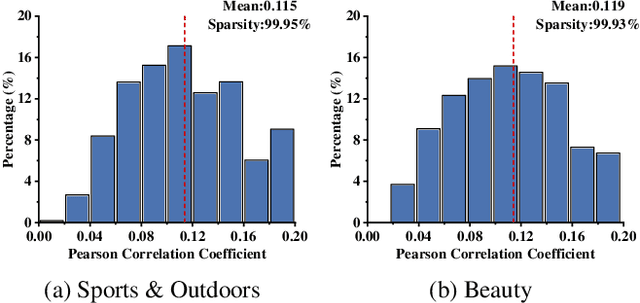
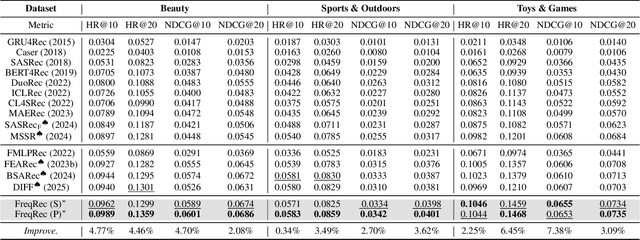
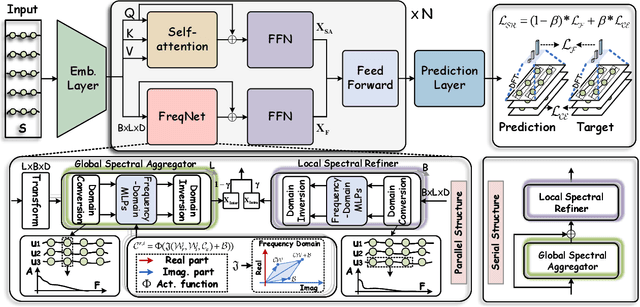

Sequential recommendation (SR) aims to predict a user's next item preference by modeling historical interaction sequences. Recent advances often integrate frequency-domain modules to compensate for self-attention's low-pass nature by restoring the high-frequency signals critical for personalized recommendations. Nevertheless, existing frequency-aware solutions process each session in isolation and optimize exclusively with time-domain objectives. Consequently, they overlook cross-session spectral dependencies and fail to enforce alignment between predicted and actual spectral signatures, leaving valuable frequency information under-exploited. To this end, we propose FreqRec, a Frequency-Enhanced Dual-Path Network for sequential Recommendation that jointly captures inter-session and intra-session behaviors via a learnable Frequency-domain Multi-layer Perceptrons. Moreover, FreqRec is optimized under a composite objective that combines cross entropy with a frequency-domain consistency loss, explicitly aligning predicted and true spectral signatures. Extensive experiments on three benchmarks show that FreqRec surpasses strong baselines and remains robust under data sparsity and noisy-log conditions.
DiffuTraj: A Stochastic Vessel Trajectory Prediction Approach via Guided Diffusion Process
Oct 12, 2024Maritime vessel maneuvers, characterized by their inherent complexity and indeterminacy, requires vessel trajectory prediction system capable of modeling the multi-modality nature of future motion states. Conventional stochastic trajectory prediction methods utilize latent variables to represent the multi-modality of vessel motion, however, tends to overlook the complexity and dynamics inherent in maritime behavior. In contrast, we explicitly simulate the transition of vessel motion from uncertainty towards a state of certainty, effectively handling future indeterminacy in dynamic scenes. In this paper, we present a novel framework (\textit{DiffuTraj}) to conceptualize the trajectory prediction task as a guided reverse process of motion pattern uncertainty diffusion, in which we progressively remove uncertainty from maritime regions to delineate the intended trajectory. Specifically, we encode the previous states of the target vessel, vessel-vessel interactions, and the environment context as guiding factors for trajectory generation. Subsequently, we devise a transformer-based conditional denoiser to capture spatio-temporal dependencies, enabling the generation of trajectories better aligned for particular maritime environment. Comprehensive experiments on vessel trajectory prediction benchmarks demonstrate the superiority of our method.
Synergistic Anchored Contrastive Pre-training for Few-Shot Relation Extraction
Dec 24, 2023
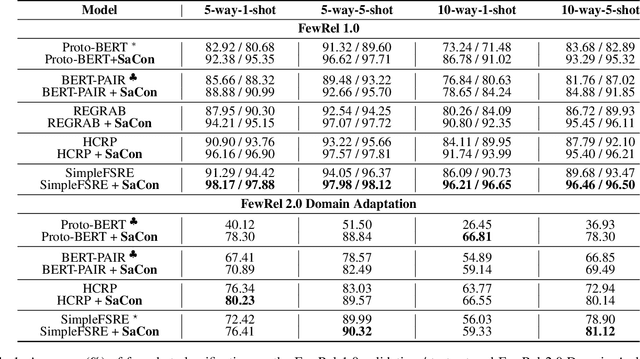

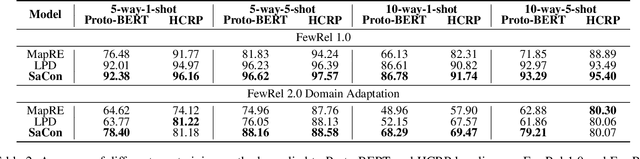
Few-shot Relation Extraction (FSRE) aims to extract relational facts from a sparse set of labeled corpora. Recent studies have shown promising results in FSRE by employing Pre-trained Language Models (PLMs) within the framework of supervised contrastive learning, which considers both instances and label facts. However, how to effectively harness massive instance-label pairs to encompass the learned representation with semantic richness in this learning paradigm is not fully explored. To address this gap, we introduce a novel synergistic anchored contrastive pre-training framework. This framework is motivated by the insight that the diverse viewpoints conveyed through instance-label pairs capture incomplete yet complementary intrinsic textual semantics. Specifically, our framework involves a symmetrical contrastive objective that encompasses both sentence-anchored and label-anchored contrastive losses. By combining these two losses, the model establishes a robust and uniform representation space. This space effectively captures the reciprocal alignment of feature distributions among instances and relational facts, simultaneously enhancing the maximization of mutual information across diverse perspectives within the same relation. Experimental results demonstrate that our framework achieves significant performance enhancements compared to baseline models in downstream FSRE tasks. Furthermore, our approach exhibits superior adaptability to handle the challenges of domain shift and zero-shot relation extraction. Our code is available online at https://github.com/AONE-NLP/FSRE-SaCon.
Aspect-oriented Opinion Alignment Network for Aspect-Based Sentiment Classification
Aug 22, 2023Aspect-based sentiment classification is a crucial problem in fine-grained sentiment analysis, which aims to predict the sentiment polarity of the given aspect according to its context. Previous works have made remarkable progress in leveraging attention mechanism to extract opinion words for different aspects. However, a persistent challenge is the effective management of semantic mismatches, which stem from attention mechanisms that fall short in adequately aligning opinions words with their corresponding aspect in multi-aspect sentences. To address this issue, we propose a novel Aspect-oriented Opinion Alignment Network (AOAN) to capture the contextual association between opinion words and the corresponding aspect. Specifically, we first introduce a neighboring span enhanced module which highlights various compositions of neighboring words and given aspects. In addition, we design a multi-perspective attention mechanism that align relevant opinion information with respect to the given aspect. Extensive experiments on three benchmark datasets demonstrate that our model achieves state-of-the-art results. The source code is available at https://github.com/AONE-NLP/ABSA-AOAN.