 Add to Chrome
 Add to Firefox
 Add to Edge
A Directed Graph Model and Experimental Framework for Design and Study of Time-Dependent Text Visualisation
Mar 02, 2026
Exponential growth in the quantity of digital news, social media, and other textual sources makes it difficult for humans to keep up with rapidly evolving narratives about world events. Various visualisation techniques have been touted to help people to understand such discourse by exposing relationships between texts (such as news articles) as topics and themes evolve over time. Arguably, the understandability of such visualisations hinges on the assumption that people will be able to easily interpret the relationships in such visual network structures. To test this assumption, we begin by defining an abstract model of time-dependent text visualisation based on directed graph structures. From this model we distill motifs that capture the set of possible ways that texts can be linked across changes in time. We also develop a controlled synthetic text generation methodology that leverages the power of modern LLMs to create fictional, yet structured sets of time-dependent texts that fit each of our patterns. Therefore, we create a clean user study environment (n=30) for participants to identify patterns that best represent a given set of synthetic articles. We find that it is a challenging task for the user to identify and recover the predefined motif. We analyse qualitative data to map an unexpectedly rich variety of user rationales when divergences from expected interpretation occur. A deeper analysis also points to unexpected complexities inherent in the formation of synthetic datasets with LLMs that undermine the study control in some cases. Furthermore, analysis of individual decision-making in our study hints at a future where text discourse visualisation may need to dispense with a one-size-fits-all approach and, instead, should be more adaptable to the specific user who is exploring the visualisation in front of them.

Creating Powerful and Interpretable Models withRegression Networks
Jul 30, 2021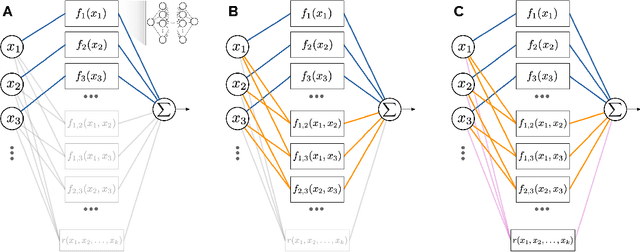
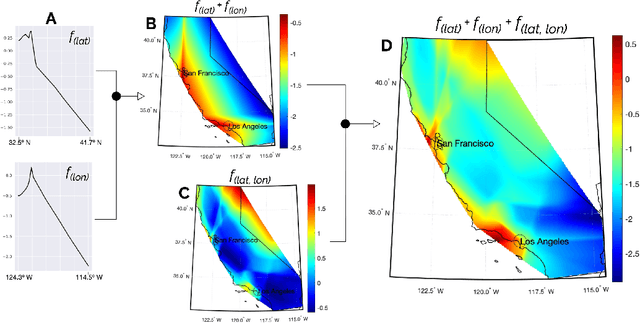
As the discipline has evolved, research in machine learning has been focused more and more on creating more powerful neural networks, without regard for the interpretability of these networks. Such "black-box models" yield state-of-the-art results, but we cannot understand why they make a particular decision or prediction. Sometimes this is acceptable, but often it is not. We propose a novel architecture, Regression Networks, which combines the power of neural networks with the understandability of regression analysis. While some methods for combining these exist in the literature, our architecture generalizes these approaches by taking interactions into account, offering the power of a dense neural network without forsaking interpretability. We demonstrate that the models exceed the state-of-the-art performance of interpretable models on several benchmark datasets, matching the power of a dense neural network. Finally, we discuss how these techniques can be generalized to other neural architectures, such as convolutional and recurrent neural networks.