 Add to Chrome
 Add to Firefox
 Add to Edge
A Directed Graph Model and Experimental Framework for Design and Study of Time-Dependent Text Visualisation
Mar 02, 2026
Exponential growth in the quantity of digital news, social media, and other textual sources makes it difficult for humans to keep up with rapidly evolving narratives about world events. Various visualisation techniques have been touted to help people to understand such discourse by exposing relationships between texts (such as news articles) as topics and themes evolve over time. Arguably, the understandability of such visualisations hinges on the assumption that people will be able to easily interpret the relationships in such visual network structures. To test this assumption, we begin by defining an abstract model of time-dependent text visualisation based on directed graph structures. From this model we distill motifs that capture the set of possible ways that texts can be linked across changes in time. We also develop a controlled synthetic text generation methodology that leverages the power of modern LLMs to create fictional, yet structured sets of time-dependent texts that fit each of our patterns. Therefore, we create a clean user study environment (n=30) for participants to identify patterns that best represent a given set of synthetic articles. We find that it is a challenging task for the user to identify and recover the predefined motif. We analyse qualitative data to map an unexpectedly rich variety of user rationales when divergences from expected interpretation occur. A deeper analysis also points to unexpected complexities inherent in the formation of synthetic datasets with LLMs that undermine the study control in some cases. Furthermore, analysis of individual decision-making in our study hints at a future where text discourse visualisation may need to dispense with a one-size-fits-all approach and, instead, should be more adaptable to the specific user who is exploring the visualisation in front of them.

ACCESS : A Benchmark for Abstract Causal Event Discovery and Reasoning
Feb 12, 2025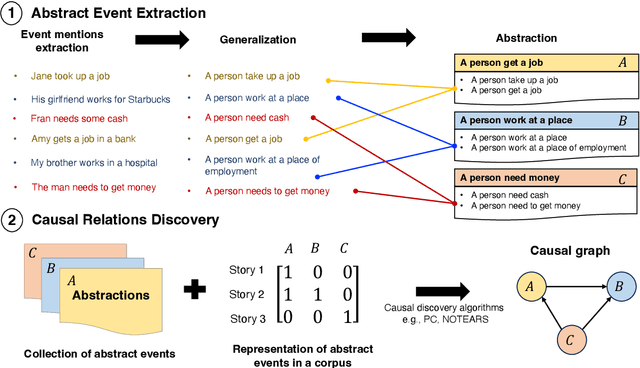
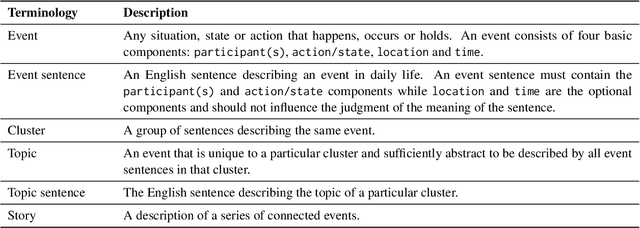
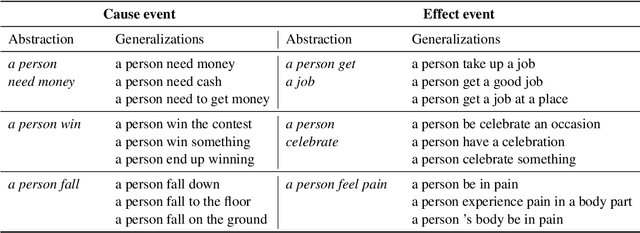
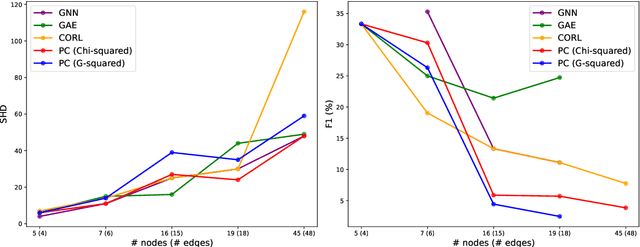
Identifying cause-and-effect relationships is critical to understanding real-world dynamics and ultimately causal reasoning. Existing methods for identifying event causality in NLP, including those based on Large Language Models (LLMs), exhibit difficulties in out-of-distribution settings due to the limited scale and heavy reliance on lexical cues within available benchmarks. Modern benchmarks, inspired by probabilistic causal inference, have attempted to construct causal graphs of events as a robust representation of causal knowledge, where \texttt{CRAB} \citep{romanou2023crab} is one such recent benchmark along this line. In this paper, we introduce \texttt{ACCESS}, a benchmark designed for discovery and reasoning over abstract causal events. Unlike existing resources, \texttt{ACCESS} focuses on causality of everyday life events on the abstraction level. We propose a pipeline for identifying abstractions for event generalizations from \texttt{GLUCOSE} \citep{mostafazadeh-etal-2020-glucose}, a large-scale dataset of implicit commonsense causal knowledge, from which we subsequently extract $1,4$K causal pairs. Our experiments highlight the ongoing challenges of using statistical methods and/or LLMs for automatic abstraction identification and causal discovery in NLP. Nonetheless, we demonstrate that the abstract causal knowledge provided in \texttt{ACCESS} can be leveraged for enhancing QA reasoning performance in LLMs.
Pre-insertion resistors temperature prediction based on improved WOA-SVR
Jan 07, 2024The pre-insertion resistors (PIR) within high-voltage circuit breakers are critical components and warm up by generating Joule heat when an electric current flows through them. Elevated temperature can lead to temporary closure failure and, in severe cases, the rupture of PIR. To accurately predict the temperature of PIR, this study combines finite element simulation techniques with Support Vector Regression (SVR) optimized by an Improved Whale Optimization Algorithm (IWOA) approach. The IWOA includes Tent mapping, a convergence factor based on the sigmoid function, and the Ornstein-Uhlenbeck variation strategy. The IWOA-SVR model is compared with the SSA-SVR and WOA-SVR. The results reveal that the prediction accuracies of the IWOA-SVR model were 90.2% and 81.5% (above 100$^\circ$C) in the 3$^\circ$C temperature deviation range and 96.3% and 93.4% (above 100$^\circ$C) in the 4$^\circ$C temperature deviation range, surpassing the performance of the comparative models. This research demonstrates the method proposed can realize the online monitoring of the temperature of the PIR, which can effectively prevent thermal faults PIR and provide a basis for the opening and closing of the circuit breaker within a short period.
Dance of Channel and Sequence: An Efficient Attention-Based Approach for Multivariate Time Series Forecasting
Dec 11, 2023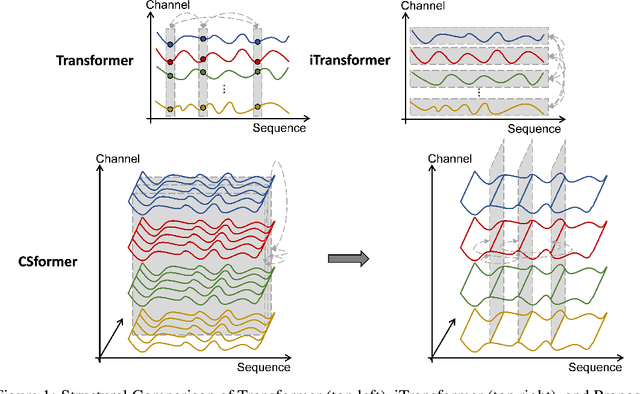

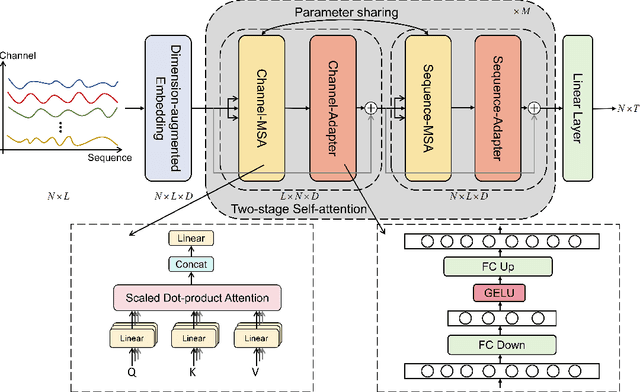

In recent developments, predictive models for multivariate time series analysis have exhibited commendable performance through the adoption of the prevalent principle of channel independence. Nevertheless, it is imperative to acknowledge the intricate interplay among channels, which fundamentally influences the outcomes of multivariate predictions. Consequently, the notion of channel independence, while offering utility to a certain extent, becomes increasingly impractical, leading to information degradation. In response to this pressing concern, we present CSformer, an innovative framework characterized by a meticulously engineered two-stage self-attention mechanism. This mechanism is purposefully designed to enable the segregated extraction of sequence-specific and channel-specific information, while sharing parameters to promote synergy and mutual reinforcement between sequences and channels. Simultaneously, we introduce sequence adapters and channel adapters, ensuring the model's ability to discern salient features across various dimensions. Rigorous experimentation, spanning multiple real-world datasets, underscores the robustness of our approach, consistently establishing its position at the forefront of predictive performance across all datasets. This augmentation substantially enhances the capacity for feature extraction inherent to multivariate time series data, facilitating a more comprehensive exploitation of the available information.
TimeSQL: Improving Multivariate Time Series Forecasting with Multi-Scale Patching and Smooth Quadratic Loss
Nov 19, 2023Time series is a special type of sequence data, a sequence of real-valued random variables collected at even intervals of time. The real-world multivariate time series comes with noises and contains complicated local and global temporal dynamics, making it difficult to forecast the future time series given the historical observations. This work proposes a simple and effective framework, coined as TimeSQL, which leverages multi-scale patching and smooth quadratic loss (SQL) to tackle the above challenges. The multi-scale patching transforms the time series into two-dimensional patches with different length scales, facilitating the perception of both locality and long-term correlations in time series. SQL is derived from the rational quadratic kernel and can dynamically adjust the gradients to avoid overfitting to the noises and outliers. Theoretical analysis demonstrates that, under mild conditions, the effect of the noises on the model with SQL is always smaller than that with MSE. Based on the two modules, TimeSQL achieves new state-of-the-art performance on the eight real-world benchmark datasets. Further ablation studies indicate that the key modules in TimeSQL could also enhance the results of other models for multivariate time series forecasting, standing as plug-and-play techniques.