 Add to Chrome
 Add to Firefox
 Add to Edge
Secure OFDM Waveform Design for ISAC: Artificial Phase-Doppler Shifts Against Passive Sensing
Feb 27, 2026
This paper proposes a novel low probability of intercept (LPI) waveform design approach for orthogonal frequency-division multiplexing (OFDM)-based integrated sensing and communication systems by introducing artificial phase and Doppler shifts. These controlled impairments, unknown to eavesdroppers, effectively disrupt passive radar processing and intercept attempts. At legitimate receivers, they can be fully compensated, so that standard OFDM communication and sensing performance are preserved. To support the effectiveness of the proposed LPI waveform design for OFDM-based ISAC, measurement results with 1 GHz bandwidth at 27 GHz are presented considering different impairment introduction approaches, all with no impact on cooperative system performance, and compensation capabilities at the eavesdropper.

Optimization-Based Behavioral Modeling of Mixers for Frequency Comb OFDM Radar Processing
Feb 27, 2026This paper presents an optimization-based behavioral model for mixers driven by multi-tone local oscillator (LO) signals, considered specifically for frequency comb orthogonal frequency-division multiplexing radar applications. Unlike traditional models, the proposed approach is designed and tested for multi-tone LO excitations. The model uses polynomial nonlinearities for both intermediate frequency and LO ports, supported by spectrum-domain fitting that selectively emphasizes strong intermodulation products. In addition, a polynomial block is introduced to capture input power-dependent phase nonlinearity. The approach is validated using circuit-level simulations and supported by measurements. Radar processing results show the model replicates distortive effects in simulations. The proposed model enables rapid system-level performance estimations and waveform optimization, replacing computationally expensive circuit-level simulations.
Breaking the CP Limit: Robust Long-Range OFDM Sensing via Interference Cleaning
Feb 23, 2026In orthogonal frequency-division multiplexing-based radar and integrated sensing and communication systems, the sensing range is traditionally limited by the round-trip time corresponding to the cyclic prefix duration. Targets whose echoes arrive after this duration induce intersymbol interference (ISI) and associated intercarrier interference (ICI), which significantly degrade detection performance, elevate the interference-noise floor in the radar image, and reduce the useful signal power due to window mismatch. Existing methods face a trade-off between recovering useful signal and suppressing interference, particularly in multi-target scenarios. This paper proposes two frameworks to resolve this dilemma, offering a flexible trade-off between computational cost and target detection performance. First, a signal model is derived, demonstrating that ISI and ICI-oriented interference often dominates thermal noise in high-dynamic-range scenarios. To combat the ISI and ICI-based interference-noise floor increase, joint-interference cancellation with coherent compensation is proposed. This approach is an efficient evolution of the successive-interference cancellation algorithm, utilizing high-precision chirp Z-transform estimation and frequency-domain coherent compensation to recover weak distant targets. For scenarios requiring maximum precision, the full reconstruction-based sliding window scheme is presented, which shifts the receive window to capture optimal signal energy while performing full-signal reconstruction for all detected targets. Numerical results show that both methods outperform state-of-the-art benchmarks.
Bistatic ISAC: Practical Challenges and Solutions
Jan 22, 2026This article presents and discusses challenges and solutions for practical issues in bistatic integrated sensing and communication (ISAC) in 6G networks. Considering orthogonal frequency-division multiplexing as the adopted waveform, a discussion on system design aiming to achieve both a desired sensing key performance indicators and limit the impact of hardware impairments is presented. In addition, signal processing techniques to enable over-the-air synchronization and generation of periodograms with range, Doppler shift, and angular information are discussed. Simulation results are then presented for a cellular-based ISAC scenario considering system parameterization compliant to current 5G and, finally, a discussion on open challenges for future deployments is presented.
Analysis of Sensing in OFDM-based ISAC under the Influence of Sampling Jitter
Jan 21, 2026To enable integrated sensing and communication (ISAC) in cellular networks, a wide range of additional requirements and challenges are either imposed or become more critical. One such impairment is sampling jitter (SJ), which arises due to imperfections in the sampling instants of the clocks of digital-to-analog converters (DACs) and analog-to-digital converters (ADCs). While SJ is already well studied for communication systems based on orthogonal frequency-division multiplexing (OFDM), which is expected to be the waveform of choice for most sixth-generation (6G) scenarios where ISAC could be possible, the implications of SJ on the OFDM-based radar sensing must still be thoroughly analyzed. Considering that phase-locked loop (PLL)-based oscillators are used to derive sampling clocks, which leads to colored SJ, i.e., SJ with non-flat power spectral density, this article analyzes the resulting distortion of the adopted digital constellation modulation and sensing performance in OFDM-based ISAC for both baseband (BB) and bandpass (BP) sampling strategies and different oversampling factors. For BB sampling, it is seen that SJ induces intercarrier interference (ICI), while for BP sampling, it causes carrier phase error and more severe ICI due to a phase noise-like effect at the digital intermediate frequency. Obtained results for a single-input single-output OFDM-based ISAC system with various OFDM signal parameterizations demonstrate that SJ-induced degradation becomes non-negligible for both BB and BP sampling only for root mean square (RMS) SJ values above 10^-11 s at both DAC and ADC, which corresponds to 0.5*10^-2 times the considered critical sampling period without oversampling. Based on the achieved results, it can be concluded that state-of-the-art hardware enables sufficient communication and sensing robustness against SJ, as RMS SJ values in the femtosecond range can be achieved.
Multi-RIS Deployment Optimization for mmWave ISAC Systems in Real-World Environments
Aug 10, 2025Reconfigurable intelligent surface-assisted integrated sensing and communication (RIS-ISAC) presents a promising system architecture to leverage the wide bandwidth available at millimeter-wave (mmWave) frequencies, while mitigating severe signal propagation losses and reducing infrastructure costs. To enhance ISAC functionalities in the future air-ground integrated network applications, RIS deployment must be carefully designed and evaluated, which forms the core motivation of this paper. To ensure practical relevance, a multi-RIS-ISAC system is established, with its signal model at mmWave frequencies demonstrated using ray-launching calibrated to real-world environments. On this basis, an energy-efficiency-driven optimization problem is formulated to minimize the multi-RIS size-to-coverage sum ratio, comprehensively considering real-world RIS deployment constraints, positions, orientations, as well as ISAC beamforming strategies at both the base station and the RISs. To solve the resulting non-convex mixed-integer problem, a simplified reformulation based on equivalent gain scaling method is introduced. A two-step iterative algorithm is then proposed, in which the deployment parameters are determined under fixed RIS positions in the first step, and the RIS position set is updated in the second step to progressively approach the optimum solution. Simulation results based on realistic parameter benchmarks present that the optimized RISs deployment significantly enhances communication coverage and sensing accuracy with the minimum RIS sizes, outperforming existing approaches.
Interference Analysis and Successive Interference Cancellation for Multistatic OFDM-based ISAC Systems
Jul 28, 2025Multistatic integrated sensing and communications (ISAC) systems, which use distributed transmitters and receivers, offer enhanced spatial coverage and sensing accuracy compared to stand-alone ISAC configurations. However, these systems face challenges due to interference between co-existing ISAC nodes, especially during simultaneous operation. In this paper, we analyze the impact of this mutual interference arising from the co-existence in a multistatic ISAC scenario, where a mono- and a bistatic ISAC system share the same spectral resources. We first classify differenct types of interference in the power domain. Then, we discuss how the interference can affect both sensing and communications in terms of bit error rate (BER), error vector magnitude (EVM), and radar image under varied transmit power and RCS configurations through simulations. Along with interfernce analysis, we propose a low-complexity successive interference cancellation method that adaptively cancels either the monostatic reflection or the bistatic line-of-sight signal based on a monostatic radar image signal-to-interference-plus-noise ratio (SINR). The proposed framework is evaluated with both simulations and proof-of-concept measurements using an ISAC testbed with a radar echo generator for object emulation. The results have shown that the proposed method reduces BER and improves EVM as well as radar image SINR across a wide range of SINR conditions. These results demonstrate that accurate component-wise cancellation can be achieved with low computational overhead, making the method suitable for practical applications.
System Concept and Demonstration of Bistatic MIMO-OFDM-based ISAC
Apr 10, 2025In future sixth-generation (6G) mobile networks, radar sensing is expected to be offered as an additional service to its original purpose of communication. Merging these two functions results in integrated sensing and communication (ISAC) systems. In this context, bistatic ISAC appears as a possibility to exploit the distributed nature of cellular networks while avoiding highly demanding hardware requirements such as full-duplex operation. Recent studies have introduced strategies to perform required synchronization and data exchange between nodes for bistatic ISAC operation, based on orthogonal frequency-division multiplexing (OFDM), however, only for single-input single-output architectures. In this article, a system concept for a bistatic multiple-input multiple-output (MIMO)-OFDM-based ISAC system with beamforming at both transmitter and receiver is proposed, and a distribution synchronization concept to ensure coherence among the different receive channels for direction-of-arrival estimation is presented. After a discussion on the ISAC processing chain, including relevant aspects for practical deployments such as transmitter digital pre-distortion and receiver calibration, a 4x8 MIMO measurement setup at 27.5 GHz and results are presented to validate the proposed system and distribution synchronization concepts.
Joint BS Deployment and Power Optimization for Minimum EMF Exposure with RL in Real-World Based Urban Scenario
Apr 07, 2025Conventional base station (BS) deployments typically prioritize coverage, quality of service (QoS), or cost reduction, often overlooking electromagnetic field (EMF) exposure. Whereas EMF exposure triggers significant public concern due to its potential health implications, making it crucial to address when deploying BS in densely populated areas. To this end, this paper addresses minimizing average EMF exposure while maintaining coverage in a 3D urban scenario by jointly optimizing BS deployment and power. To address this, firstly, accurate EMF prediction is essential, as traditional empirical models lack the required accuracy, necessitating a deterministic channel model. A novel least-time shoot-and-bounce ray (SBR) ray-launching (RL) algorithm is therefore developed to overcome several limitations of current simulators and is validated with real-world measurements. Secondly, to further reduce computational complexity, unlike using a fixed grid size to discretize the target area, the adaptive grid refinement (AGR) algorithm is designed with a flexible grid to predict the overall EMF exposure. Finally, based on the EMF exposure predictions, the Nelder-Mead (NM) method is used in the joint optimization, and urban user equipment (UE) distributions are incorporated to better reflect real-world conditions. When evaluating the benefits of the whole process, the results are compared against using empirical channel models, revealing notable differences and underestimation of EMF exposure that highlight the importance of considering real-world scenario.
On the Sensing Performance of OFDM-based ISAC under the Influence of Oscillator Phase Noise
Oct 17, 2024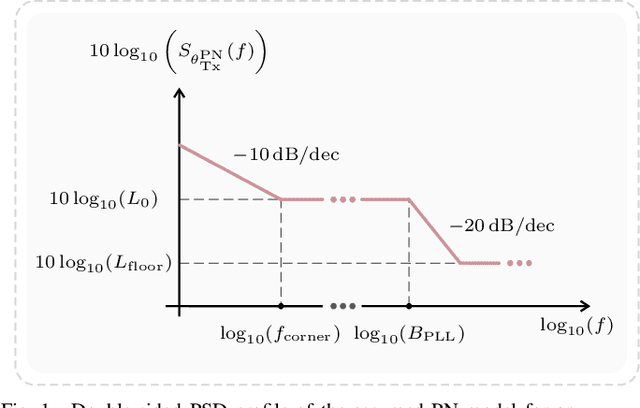
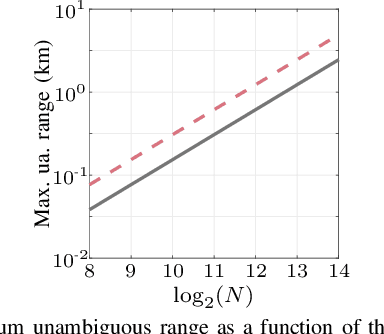
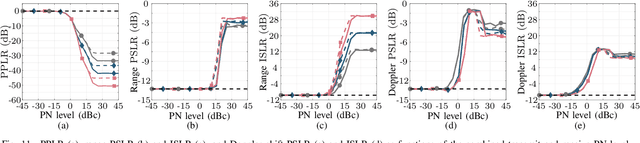
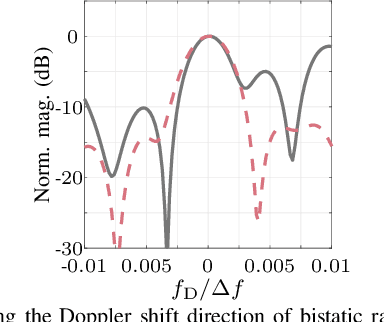
Integrated sensing and communication (ISAC) is a novel capability expected for sixth generation (6G) cellular networks. To that end, several challenges must be addressed to enable both mono- and bistatic sensing in existing deployments. A common impairment in both architectures is oscillator phase noise (PN), which not only degrades communication performance, but also severely impairs radar sensing. To enable a broader understanding of orthogonal-frequency division multiplexing (OFDM)-based sensing impaired by PN, this article presents an analysis of sensing peformance in OFDM-based ISAC for different waveform parameter choices and settings in both mono- and bistatic architectures. In this context, the distortion of the adopted digital constellation modulation is analyzed and the resulting PN-induced effects in range-Doppler radar images are investigated both without and with PN compensation. These effects include peak power loss of target reflections and higher sidelobe levels, especially in the Doppler shift direction. In the conducted analysis, these effects are measured by the peak power loss ratio, peak-to-sidelobe level ratio, and integrated sidelobe level ratio parameters, the two latter being evaluated in both range and Doppler shift directions. In addition, the signal-to-interference ratio is analyzed to allow not only quantifying the distortion of a target reflection, but also measuring the interference floor level in a radar image. The achieved results allow to quantify not only the PN-induced impairments to a single target, but also how the induced degradation may impair the sensing performance of OFDM-based ISAC systems in multi-target scenarios.