 Add to Chrome
 Add to Firefox
 Add to Edge
IMFACT: Counterfactual Explanations for Time Series via Intrinsic Mode Function Substitution
Aug 05, 2026
Oscillatory signals, such as vibration, carry class-discriminative information in specific frequency bands; perturbing them in raw feature space for counterfactual analysis easily destroys their temporal structure and produces physically implausible results. In this work, we introduce IMFACT (IMF-based counterfACTuals), a model-agnostic framework for generating plausible counterfactual explanations for time series classifiers that operates in the decomposition space of Empirical Mode Decomposition. An input signal is split into Intrinsic Mode Functions (IMFs), and selected IMFs are progressively substituted with those of a Nearest Unlike Neighbour (NUN) until the classifier flips to the target class. We evaluate six IMF-selection strategies and a multi-NUN cycling extension on two UCR benchmarks (FaultDetectionA, FruitFlies). The variance-based strategy with three NUNs outperforms two prominent baseline techniques on reliability and plausibility metrics, while cycling across three NUNs yields the best proximity across both datasets.

TunerDiT: Training-free Progressive Steering of Diffusion Transformer for Multi-Event Video Generation
May 29, 2026Text-to-video (T2V) generation faces challenging questions when generating videos with long horizons containing multiple events. Inspired by the intrinsics of the diffusion process, we probe video diffusion transformers (DiTs) and uncover intrinsic turning points in the DiT denoising trajectory where conditioning text affects generation from global layout to fine-grained details. Building on this finding, we present TunerDiT, a simple yet effective progressive steering method that requires no additional training for multi-event generation. TunerDiT comprises two steering handles: (1) Event-Partitioned Masking that enforces event boundaries while allowing cross-event transition bands; (2) Cross-Event Prompt Fusion that injects neighboring event semantics for late-stage refinement. We contribute a self-curated prompt suite for benchmarking multi-event generation, i.e., Meve. TunerDiT achieves state-of-the-art performance across 8 metrics and offers a tunable trade-off between video consistency and event separation, compared with other training-free methods. The improvement in text alignment increases with the event count, indicating a scaling possibility with increasing event count.
ExDBSCAN: Explaining DBSCAN with Counterfactual Reasoning -- Additional Material
May 28, 2026Clustering is an unsupervised technique for grouping data points by similarity. While explainability methods exist for supervised machine learning, they are not directly applicable to clustering, making it challenging to understand cluster assignments. This interpretability gap is particularly evident in the popular density-based method DBSCAN, which assigns points as inliers (cluster members in dense regions) or outliers (noise points in sparse regions). DBSCAN does not provide insight into why a particular point receives its assignment or whether its assignment is robust to small changes in the data. To address the lack of explainability, we introduce ExDBSCAN, a density-aware, post-hoc explanation method. ExDBSCAN offers actionable counterfactual explanations, with theoretical guarantees for validity. It generates multiple counterfactuals using a density connected weighted graph, adopting a physics-inspired model that repels counterfactual candidates from one another (diversity), while pulling them toward the instance to explain (proximity). Empirical evaluation on 30 tabular datasets comparing against four baselines shows that ExDBSCAN outperforms all baselines while attaining perfect validity and retrieving diverse, proximal counterfactuals.
Beyond Input Understanding: Diagnosing Multilingual Mathematical Reasoning with Directed Acyclic Trace Graphs
May 26, 2026Large reasoning models (LRMs) achieve strong mathematical reasoning performance in English, but remain much less reliable in many low- and medium-resource languages. This gap is often explained as a failure to understand non-English problem statements. We show that this view is incomplete: even when the problem is given in English, controlling the model's reasoning language can substantially reduce accuracy, suggesting that language also affects reasoning execution itself. To study this effect, we introduce DATG, a Directed Acyclic Trace Graph framework that maps reasoning traces to language-independent mathematical anchors and dependencies. This allows us to align target-language traces with reference DAGs and measure whether they cover required mathematical nodes, respect dependency edges, and avoid harmful mathematical actions. Experiments on the Qwen3 series across 12 languages show that non-English reasoning often suffers from reduced anchor coverage and weaker dependency fidelity, especially in low-resource languages. Motivated by this diagnosis, we propose Loop-Retry and Formula-Retry, two simple test-time controls targeting DATG-exposed failure modes, and show that they consistently improve target-language reasoning performance in low-resource languages.
Know Your Streams: On the Conceptualization, Characterization, and Generation of Intentional Event Streams
Apr 01, 2026The shift toward IoT-enabled, sensor-driven systems has transformed how operational data is generated, favoring continuous, real-time event streams (ES) over static event logs. This evolution presents new challenges for Streaming Process Mining (SPM), which must cope with out-of-order events, concurrent activities, incomplete cases, and concept drifts. Yet, the evaluation of SPM algorithms remains rooted in outdated practices, relying on static logs or artificially streamified data that fail to reflect the complexities of real-world streams. To address this gap, we first perform a comprehensive review of data stream literature to identify stream characteristics currently not reflected in the SPM community. Next, we use this information to extend the conceptual foundation for ES. Finally, we propose Stream of Intent, a prototype generator to produce ES with specific features. Our evaluation shows excellence in producing reproducible, intentional ES for targeted benchmarking and adaptive algorithm development in SPM.
What-If Explanations Over Time: Counterfactuals for Time Series Classification
Mar 29, 2026Counterfactual explanations emerge as a powerful approach in explainable AI, providing what-if scenarios that reveal how minimal changes to an input time series can alter the model's prediction. This work presents a survey of recent algorithms for counterfactual explanations for time series classification. We review state-of-the-art methods, spanning instance-based nearest-neighbor techniques, pattern-driven algorithms, gradient-based optimization, and generative models. For each, we discuss the underlying methodology, the models and classifiers they target, and the datasets on which they are evaluated. We highlight unique challenges in generating counterfactuals for temporal data, such as maintaining temporal coherence, plausibility, and actionable interpretability, which distinguish the temporal from tabular or image domains. We analyze the strengths and limitations of existing approaches and compare their effectiveness along key dimensions (validity, proximity, sparsity, plausibility, etc.). In addition, we implemented an open-source implementation library, Counterfactual Explanations for Time Series (CFTS), as a reference framework that includes many algorithms and evaluation metrics. We discuss this library's contributions in standardizing evaluation and enabling practical adoption of explainable time series techniques. Finally, based on the literature and identified gaps, we propose future research directions, including improved user-centered design, integration of domain knowledge, and counterfactuals for time series forecasting.
DocSLM: A Small Vision-Language Model for Long Multimodal Document Understanding
Nov 17, 2025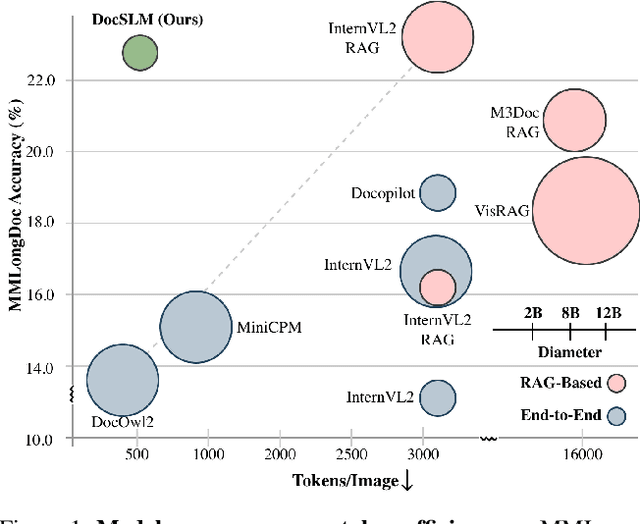
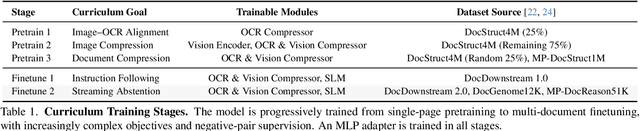
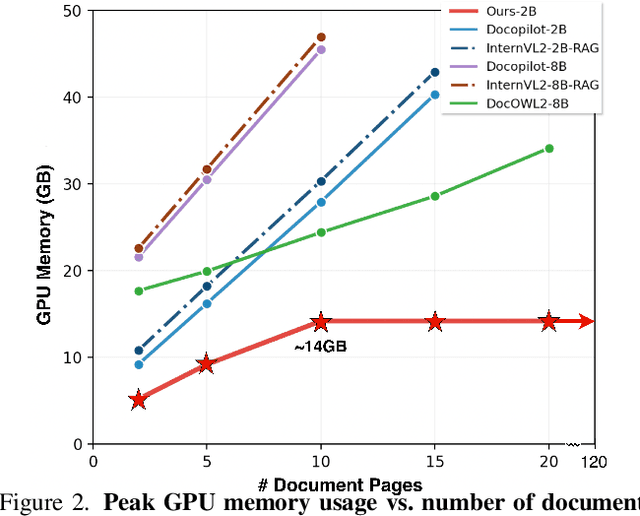
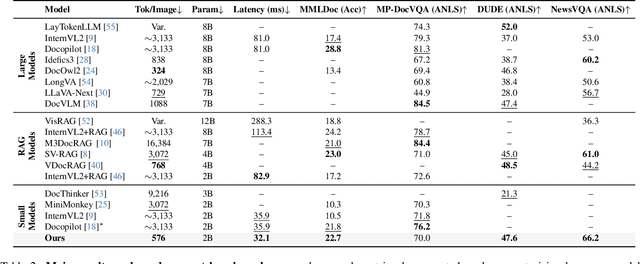
Large Vision-Language Models (LVLMs) have demonstrated strong multimodal reasoning capabilities on long and complex documents. However, their high memory footprint makes them impractical for deployment on resource-constrained edge devices. We present DocSLM, an efficient Small Vision-Language Model designed for long-document understanding under constrained memory resources. DocSLM incorporates a Hierarchical Multimodal Compressor that jointly encodes visual, textual, and layout information from each page into a fixed-length sequence, greatly reducing memory consumption while preserving both local and global semantics. To enable scalable processing over arbitrarily long inputs, we introduce a Streaming Abstention mechanism that operates on document segments sequentially and filters low-confidence responses using an entropy-based uncertainty calibrator. Across multiple long multimodal document benchmarks, DocSLM matches or surpasses state-of-the-art methods while using 82\% fewer visual tokens, 75\% fewer parameters, and 71\% lower latency, delivering reliable multimodal document understanding on lightweight edge devices. Code is available in the supplementary material.
PRSM: A Measure to Evaluate CLIP's Robustness Against Paraphrases
Nov 14, 2025Contrastive Language-Image Pre-training (CLIP) is a widely used multimodal model that aligns text and image representations through large-scale training. While it performs strongly on zero-shot and few-shot tasks, its robustness to linguistic variation, particularly paraphrasing, remains underexplored. Paraphrase robustness is essential for reliable deployment, especially in socially sensitive contexts where inconsistent representations can amplify demographic biases. In this paper, we introduce the Paraphrase Ranking Stability Metric (PRSM), a novel measure for quantifying CLIP's sensitivity to paraphrased queries. Using the Social Counterfactuals dataset, a benchmark designed to reveal social and demographic biases, we empirically assess CLIP's stability under paraphrastic variation, examine the interaction between paraphrase robustness and gender, and discuss implications for fairness and equitable deployment of multimodal systems. Our analysis reveals that robustness varies across paraphrasing strategies, with subtle yet consistent differences observed between male- and female-associated queries.
SHAining on Process Mining: Explaining Event Log Characteristics Impact on Algorithms
Sep 10, 2025Process mining aims to extract and analyze insights from event logs, yet algorithm metric results vary widely depending on structural event log characteristics. Existing work often evaluates algorithms on a fixed set of real-world event logs but lacks a systematic analysis of how event log characteristics impact algorithms individually. Moreover, since event logs are generated from processes, where characteristics co-occur, we focus on associational rather than causal effects to assess how strong the overlapping individual characteristic affects evaluation metrics without assuming isolated causal effects, a factor often neglected by prior work. We introduce SHAining, the first approach to quantify the marginal contribution of varying event log characteristics to process mining algorithms' metrics. Using process discovery as a downstream task, we analyze over 22,000 event logs covering a wide span of characteristics to uncover which affect algorithms across metrics (e.g., fitness, precision, complexity) the most. Furthermore, we offer novel insights about how the value of event log characteristics correlates with their contributed impact, assessing the algorithm's robustness.
Enhancing Robustness of Autoregressive Language Models against Orthographic Attacks via Pixel-based Approach
Aug 28, 2025Autoregressive language models are vulnerable to orthographic attacks, where input text is perturbed with characters from multilingual alphabets, leading to substantial performance degradation. This vulnerability primarily stems from the out-of-vocabulary issue inherent in subword tokenizers and their embeddings. To address this limitation, we propose a pixel-based generative language model that replaces the text-based embeddings with pixel-based representations by rendering words as individual images. This design provides stronger robustness to noisy inputs, while an extension of compatibility to multilingual text across diverse writing systems. We evaluate the proposed method on the multilingual LAMBADA dataset, WMT24 dataset and the SST-2 benchmark, demonstrating both its resilience to orthographic noise and its effectiveness in multilingual settings.