 Add to Chrome
 Add to Firefox
 Add to Edge
Unification and Optimization of Robust Supervised Learning
May 27, 2026
The literature has proposed various robust alternatives to empirical risk minimisation to address failure modes such as distribution shift, label noise and finite-sample degeneracies. Examples include distributionally robust optimization, label smoothing, vicinal risk minimization, and Mixup. However, such approaches are typically developed in isolation, forcing practitioners to commit a priori to a single failure mode even when the dominant mode for the task is unclear. To address this, we organize a broad class of existing methods along three common design axes and derive a tractable training procedure that decomposes robust learning into sequential stages (reference distribution enrichment, input-space perturbation, label-space perturbation, and sample-level aggregation), each with a choice of stance (pessimistic, neutral, or optimistic). This results in a unified design space in which joint hyperparameter optimization can compose and configure robustness strategies suited to the task at hand. Across tabular, image, and reward modeling benchmarks, joint hyperparameter optimization is competitive with the best single-method baseline in each setting, offering a reliable default for practitioners who do not know a priori which failure mode dominates their task.

Co-Exploration and Co-Exploitation via Shared Structure in Multi-Task Bandits
Dec 14, 2025We propose a novel Bayesian framework for efficient exploration in contextual multi-task multi-armed bandit settings, where the context is only observed partially and dependencies between reward distributions are induced by latent context variables. In order to exploit these structural dependencies, our approach integrates observations across all tasks and learns a global joint distribution, while still allowing personalised inference for new tasks. In this regard, we identify two key sources of epistemic uncertainty, namely structural uncertainty in the latent reward dependencies across arms and tasks, and user-specific uncertainty due to incomplete context and limited interaction history. To put our method into practice, we represent the joint distribution over tasks and rewards using a particle-based approximation of a log-density Gaussian process. This representation enables flexible, data-driven discovery of both inter-arm and inter-task dependencies without prior assumptions on the latent variables. Empirically, we demonstrate that our method outperforms baselines such as hierarchical model bandits, especially in settings with model misspecification or complex latent heterogeneity.
ALPBench: A Benchmark for Active Learning Pipelines on Tabular Data
Jun 25, 2024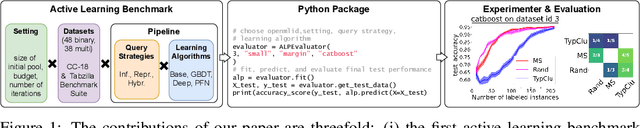
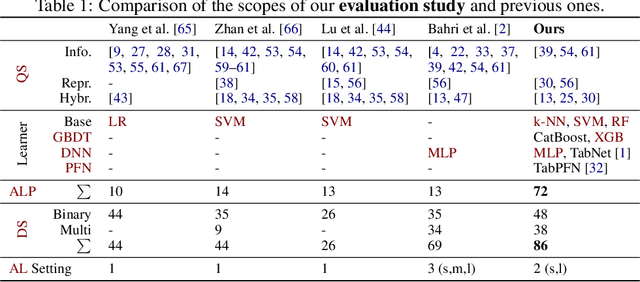
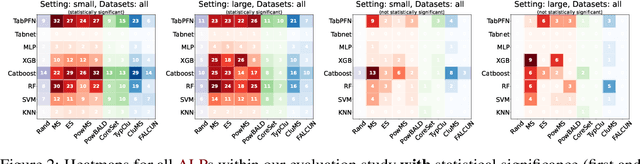
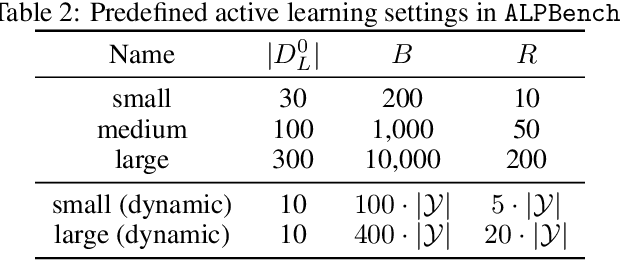
In settings where only a budgeted amount of labeled data can be afforded, active learning seeks to devise query strategies for selecting the most informative data points to be labeled, aiming to enhance learning algorithms' efficiency and performance. Numerous such query strategies have been proposed and compared in the active learning literature. However, the community still lacks standardized benchmarks for comparing the performance of different query strategies. This particularly holds for the combination of query strategies with different learning algorithms into active learning pipelines and examining the impact of the learning algorithm choice. To close this gap, we propose ALPBench, which facilitates the specification, execution, and performance monitoring of active learning pipelines. It has built-in measures to ensure evaluations are done reproducibly, saving exact dataset splits and hyperparameter settings of used algorithms. In total, ALPBench consists of 86 real-world tabular classification datasets and 5 active learning settings, yielding 430 active learning problems. To demonstrate its usefulness and broad compatibility with various learning algorithms and query strategies, we conduct an exemplary study evaluating 9 query strategies paired with 8 learning algorithms in 2 different settings. We provide ALPBench here: https://github.com/ValentinMargraf/ActiveLearningPipelines.