 Add to Chrome
 Add to Firefox
 Add to Edge
CatalogAgent: A Supervisor-mediated Self-Learning System Enabling Context Engineering for GenAI Models
Jul 15, 2026
Product catalogs are the backbone of e-commerce sites, yet a large number of structured attributes (SAs) -- such as material, color, and shape -- often have missing values. Typically, SA values are extracted from product information, including titles and descriptions. While LLM-based generator-evaluator frameworks have demonstrated effectiveness for SA prediction -- where an LLM generates SA values and another evaluates them -- they face challenges when the Generator and Evaluator produce conflicting outputs, as either component can make mistakes. We introduce \texttt{CatalogAgent}, a novel agentic system that continuously improves Generator and Evaluator models for e-commerce catalog enrichment. When disagreements arise from (1) internal conflicts between the LLM-based Generator and Evaluator, or (2) external feedback from sellers on LLM outputs, a Supervisor Agent intervenes to mediate these conflicts and make final decisions. The system also incorporates a Memory Base and a Memory Summarizer that stores Supervisor Agent activities from individual cases and aggregates patterns into learnings. These learnings are fed back to the worker Generator and Evaluator LLMs, enabling self-improvement without human intervention. Through context engineering -- injecting learnings and insights into worker LLMs' contexts -- the system successfully transfers the Supervisor's capabilities to the Generator and Evaluator, improving their performance by 15.24\% and 13.98\%, respectively. Our experiments demonstrate a new paradigm of Supervisor Agent-mediated self-learning systems for improving generative AI model accuracy.

An Amendment of Fast Subspace Tracking Methods
Feb 24, 2012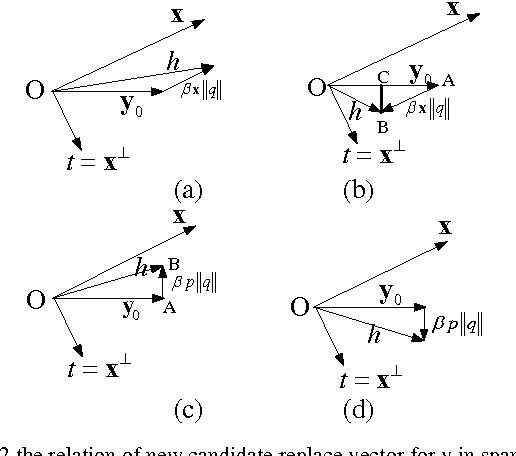
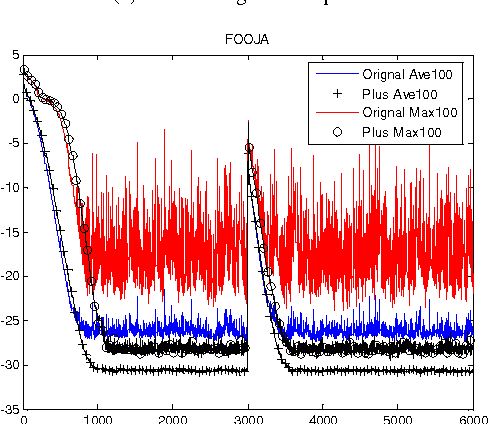
Tuning stepsize between convergence rate and steady state error level or stability is a problem in some subspace tracking schemes. Methods in DPM and OJA class may show sparks in their steady state error sometimes, even with a rather small stepsize. By a study on the schemes' updating formula, it is found that the update only happens in a specific plane but not all the subspace basis. Through an analysis on relationship between the vectors in that plane, an amendment as needed is made on the algorithm routine to fix the problem by constricting the stepsize at every update step. The simulation confirms elimination of the sparks.