 Add to Chrome
 Add to Firefox
 Add to Edge
Bilinear Coordinate Alignment for Training-Free Task-Vector Transfer
May 27, 2026
Fine-tuning large-scale pre-trained models is a recent prevalent paradigm for adapting general representations to specialized tasks. However, when a new version of a pre-trained model becomes available, expertise acquired through fine-tuning cannot be directly reused because it is tied to the parameterization of the original model, requiring another costly fine-tuning. To address this inefficiency, recent work uses task vectors, defined as the parameter difference between a fine-tuned model and its base model, to transfer expertise across models. While existing methods bridge disparate models by matching activations or gradients, a significant performance gap remains relative to direct fine-tuning, suggesting that these partial correspondences are insufficient. In this work, instead of viewing a task vector merely as a parameter offset, we revisit the formation of task vectors and show that they can be derived as accumulated bilinear interactions between input-side activations and output-side gradients. Motivated by this observation, we formulate task-vector transfer as a dual-space alignment problem and propose BiCo, a training-free framework for transferring task vectors through Bilinear Coordinate alignment. BiCo estimates orthogonal Procrustes mappings in both spaces using a single forward-backward pass on a small calibration set, without any parameter update. Across extensive computer vision and natural language processing benchmarks, BiCo consistently outperforms existing transfer methods across models that differ in width, depth, and pre-training configuration.

Anomaly as Non-Conformity via Training-Free Graph Laplacian Energy Minimization
May 27, 2026Detecting subtle visual anomalies in images remains challenging, particularly when only normal samples are available a priori. Such unsupervised anomaly detection is typically solved by measuring feature similarity of a query patch to a memory of normal patches. However, similarity alone does not reveal how strongly a query patch violates the structure of the normal feature manifold. We propose a training-free Laplacian graph energy optimization formulation, named ANoCo that scores Anomaly by the cost of Non-Conformity of a query patch to align with a fixed normal manifold. For each query patch, we construct a bipartite query to normal graph weighted by cosine affinity, explicitly removing query-query and normal-normal edges to prevent evidence dilution. We formulate anomaly scoring as a convex Laplacian energy with anchored normal nodes, and solve in closed form. In particular, we do not use the optimized features themselves-the anomaly score is the magnitude of the update required to satisfy normality constraints, reframing the graph Laplacian as a non-conformity operator rather than a smoothing prior. The proposed method introduces no learnable parameters, message passing, or sampling, and has complexity comparable to a single linear solve. Across standard benchmarks, it delivers strong image-level AUROC, stable localization maps, and improved robustness over prior methods, demonstrating the effectiveness of using optimization-induced feature drift as anomaly measure.
BiasEdit: A Training-Free Bias-Detect-and-Edit Framework for Learning Fair Visual Classifiers
May 27, 2026Visual data from the Web power image classifiers, which often underpin many web services, such as recommendation and content moderation. However, the raw Web data often contain spurious correlations and social biases, and neural networks are known for their tendency to learn biases present in data. This can reinforce unfairness in web services and the web data, leading to a vicious cycle. In the context of image classification, networks learn bias attributes for a specific class when a majority of images contain the same attribute only for a given class. Hence, training a fair and debiased classifier from a biased dataset demands handling an imbalanced problem between a majority of images with bias attributes (bias-aligned samples) and a minority without (bias-conflict samples). In this work, we introduce BiasEdit, a modular framework that automatically detects bias attributes from the original dataset and edits them to construct a debiased dataset. Specifically, BiasEdit first detects unknown bias attributes via statistical dependence and mutual information analysis of visual-linguistic representations, and then explicitly edits those attributes using text-guided image editing to generate realistic bias-conflict samples. Unlike prior works that assume known bias attributes or relies on synthetic mixing, our method operates without manual annotations and can leverage off-the-shelf vision-language and editing models. BiasEdit addresses a fundamental challenge in Web-sourced visual AI, mitigating dataset-induced bias and achieving state-of-the-art debiasing performance even when training data are fully biased.
EGLOCE: Training-Free Energy-Guided Latent Optimization for Concept Erasure
Apr 10, 2026As text-to-image diffusion models grow increasingly prevalent, the ability to remove specific concepts-mostly explicit content and many copyrighted characters or styles-has become essential for safety and compliance. Existing unlearning approaches often require costly re-training, modify parameters at the cost of degradation of unrelated concept fidelity, or depend on indirect inference-time adjustment that compromise the effectiveness of concept erasure. Inspired by the success of energy-guided sampling for preservation of the condition of diffusion models, we introduce Energy-Guided Latent Optimization for Concept Erasure (EGLOCE), a training-free approach that removes unwanted concepts by re-directing noisy latent during inference. Our method employs a dual-objective framework: a repulsion energy that steers generation away from target concepts via gradient descent in latent space, and a retention energy that preserves semantic alignment to the original prompt. Combined with previous approaches that either require erroneous modified model weights or provide weak inference-time guidance, EGLOCE operates entirely at inference and enhances erasure performance, enabling plug-and-play integration. Extensive experiments demonstrate that EGLOCE improves concept removal while maintaining image quality and prompt alignment across baselines, even with adversarial attacks. To the best of our knowledge, our work is the first to establish a new paradigm for safe and controllable image generation through dual energy-based guidance during sampling.
Mitigating Parameter Interference in Model Merging via Sharpness-Aware Fine-Tuning
Apr 20, 2025Large-scale deep learning models with a pretraining-finetuning paradigm have led to a surge of numerous task-specific models fine-tuned from a common pre-trained model. Recently, several research efforts have been made on merging these large models into a single multi-task model, particularly with simple arithmetic on parameters. Such merging methodology faces a central challenge: interference between model parameters fine-tuned on different tasks. Few recent works have focused on designing a new fine-tuning scheme that can lead to small parameter interference, however at the cost of the performance of each task-specific fine-tuned model and thereby limiting that of a merged model. To improve the performance of a merged model, we note that a fine-tuning scheme should aim for (1) smaller parameter interference and (2) better performance of each fine-tuned model on the corresponding task. In this work, we aim to design a new fine-tuning objective function to work towards these two goals. In the course of this process, we find such objective function to be strikingly similar to sharpness-aware minimization (SAM) objective function, which aims to achieve generalization by finding flat minima. Drawing upon our observation, we propose to fine-tune pre-trained models via sharpness-aware minimization. The experimental and theoretical results showcase the effectiveness and orthogonality of our proposed approach, improving performance upon various merging and fine-tuning methods. Our code is available at https://github.com/baiklab/SAFT-Merge.
Find A Winning Sign: Sign Is All We Need to Win the Lottery
Apr 07, 2025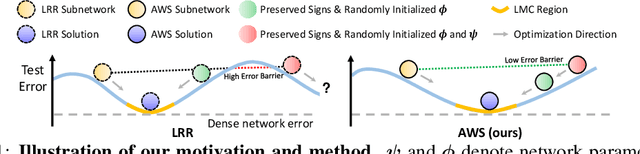
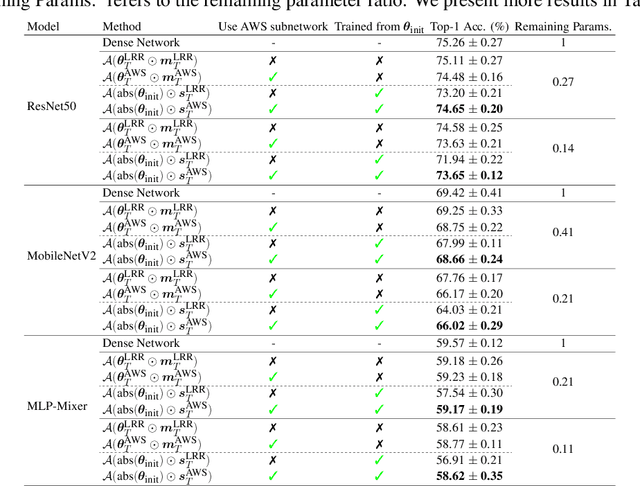
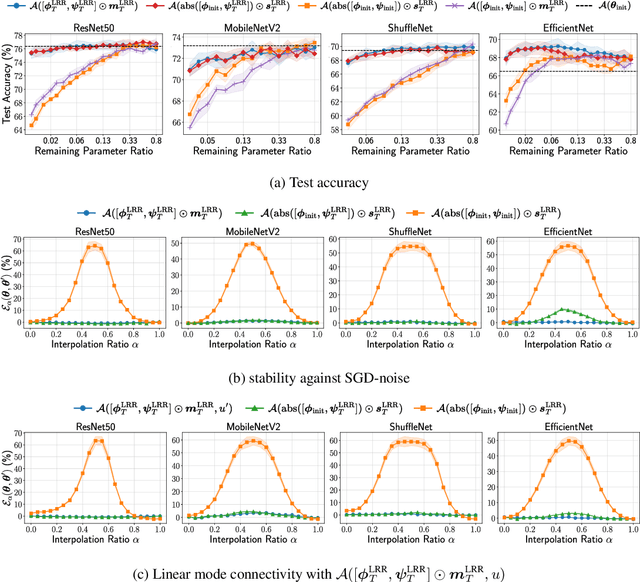
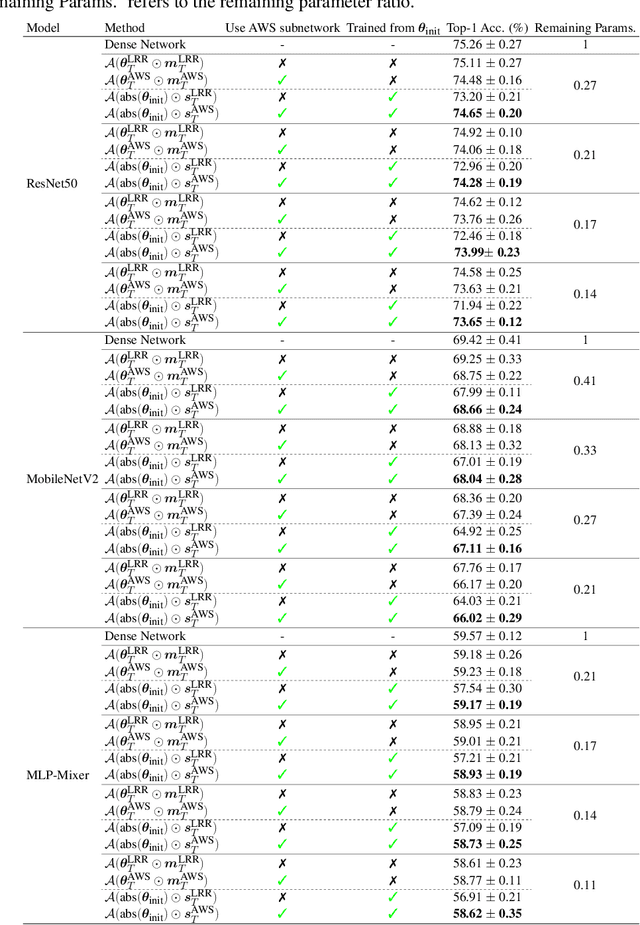
The Lottery Ticket Hypothesis (LTH) posits the existence of a sparse subnetwork (a.k.a. winning ticket) that can generalize comparably to its over-parameterized counterpart when trained from scratch. The common approach to finding a winning ticket is to preserve the original strong generalization through Iterative Pruning (IP) and transfer information useful for achieving the learned generalization by applying the resulting sparse mask to an untrained network. However, existing IP methods still struggle to generalize their observations beyond ad-hoc initialization and small-scale architectures or datasets, or they bypass these challenges by applying their mask to trained weights instead of initialized ones. In this paper, we demonstrate that the parameter sign configuration plays a crucial role in conveying useful information for generalization to any randomly initialized network. Through linear mode connectivity analysis, we observe that a sparse network trained by an existing IP method can retain its basin of attraction if its parameter signs and normalization layer parameters are preserved. To take a step closer to finding a winning ticket, we alleviate the reliance on normalization layer parameters by preventing high error barriers along the linear path between the sparse network trained by our method and its counterpart with initialized normalization layer parameters. Interestingly, across various architectures and datasets, we observe that any randomly initialized network can be optimized to exhibit low error barriers along the linear path to the sparse network trained by our method by inheriting its sparsity and parameter sign information, potentially achieving performance comparable to the original. The code is available at https://github.com/JungHunOh/AWS\_ICLR2025.git
LAN: Learning to Adapt Noise for Image Denoising
Dec 14, 2024


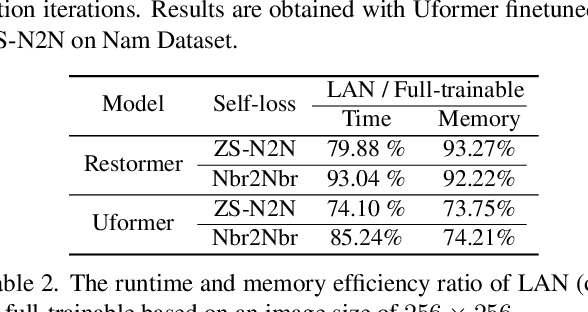
Removing noise from images, a.k.a image denoising, can be a very challenging task since the type and amount of noise can greatly vary for each image due to many factors including a camera model and capturing environments. While there have been striking improvements in image denoising with the emergence of advanced deep learning architectures and real-world datasets, recent denoising networks struggle to maintain performance on images with noise that has not been seen during training. One typical approach to address the challenge would be to adapt a denoising network to new noise distribution. Instead, in this work, we shift our focus to adapting the input noise itself, rather than adapting a network. Thus, we keep a pretrained network frozen, and adapt an input noise to capture the fine-grained deviations. As such, we propose a new denoising algorithm, dubbed Learning-to-Adapt-Noise (LAN), where a learnable noise offset is directly added to a given noisy image to bring a given input noise closer towards the noise distribution a denoising network is trained to handle. Consequently, the proposed framework exhibits performance improvement on images with unseen noise, displaying the potential of the proposed research direction. The code is available at https://github.com/chjinny/LAN
Deep Variational Bayesian Modeling of Haze Degradation Process
Dec 04, 2024
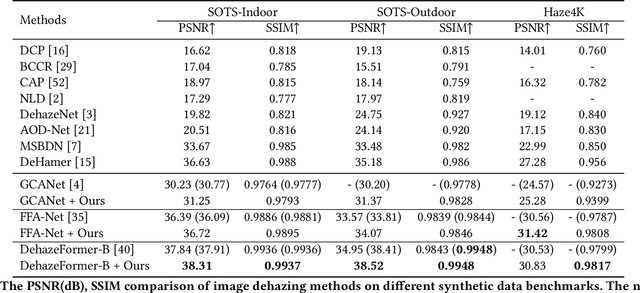


Relying on the representation power of neural networks, most recent works have often neglected several factors involved in haze degradation, such as transmission (the amount of light reaching an observer from a scene over distance) and atmospheric light. These factors are generally unknown, making dehazing problems ill-posed and creating inherent uncertainties. To account for such uncertainties and factors involved in haze degradation, we introduce a variational Bayesian framework for single image dehazing. We propose to take not only a clean image and but also transmission map as latent variables, the posterior distributions of which are parameterized by corresponding neural networks: dehazing and transmission networks, respectively. Based on a physical model for haze degradation, our variational Bayesian framework leads to a new objective function that encourages the cooperation between them, facilitating the joint training of and thereby boosting the performance of each other. In our framework, a dehazing network can estimate a clean image independently of a transmission map estimation during inference, introducing no overhead. Furthermore, our model-agnostic framework can be seamlessly incorporated with other existing dehazing networks, greatly enhancing the performance consistently across datasets and models.
* Published in CIKM 2023, 10 pages, 9 figures
CLOSER: Towards Better Representation Learning for Few-Shot Class-Incremental Learning
Oct 08, 2024Aiming to incrementally learn new classes with only few samples while preserving the knowledge of base (old) classes, few-shot class-incremental learning (FSCIL) faces several challenges, such as overfitting and catastrophic forgetting. Such a challenging problem is often tackled by fixing a feature extractor trained on base classes to reduce the adverse effects of overfitting and forgetting. Under such formulation, our primary focus is representation learning on base classes to tackle the unique challenge of FSCIL: simultaneously achieving the transferability and the discriminability of the learned representation. Building upon the recent efforts for enhancing transferability, such as promoting the spread of features, we find that trying to secure the spread of features within a more confined feature space enables the learned representation to strike a better balance between transferability and discriminability. Thus, in stark contrast to prior beliefs that the inter-class distance should be maximized, we claim that the closer different classes are, the better for FSCIL. The empirical results and analysis from the perspective of information bottleneck theory justify our simple yet seemingly counter-intuitive representation learning method, raising research questions and suggesting alternative research directions. The code is available at https://github.com/JungHunOh/CLOSER_ECCV2024.
CoAPT: Context Attribute words for Prompt Tuning
Jul 18, 2024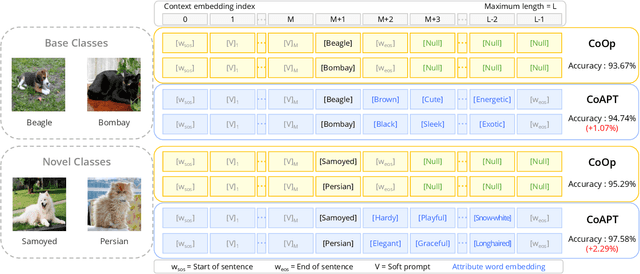
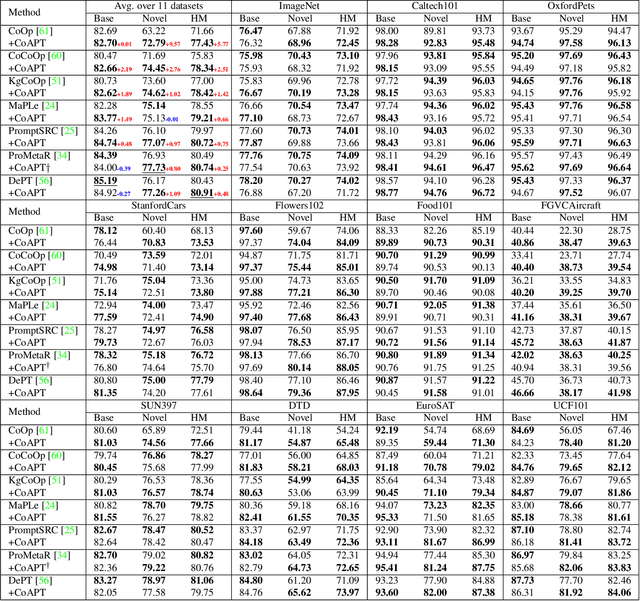
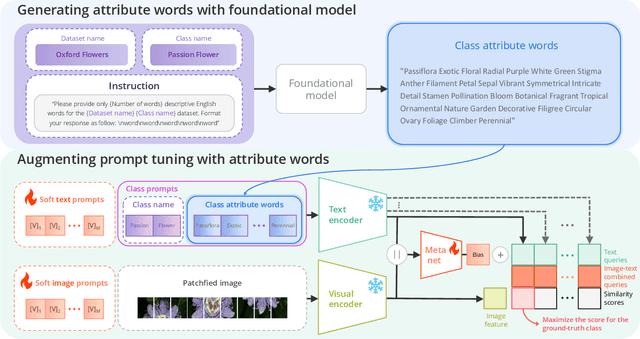
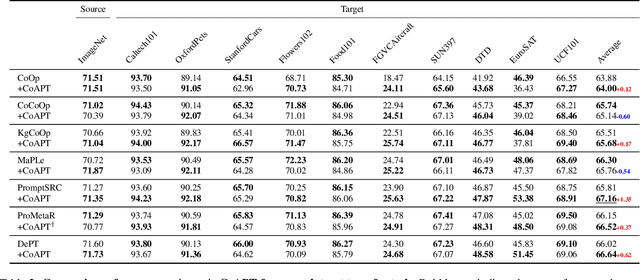
We propose a novel prompt tuning method called CoAPT(Context Attribute words in Prompt Tuning) for few/zero-shot image classification. The core motivation is that attributes are descriptive words with rich information about a given concept. Thus, we aim to enrich text queries of existing prompt tuning methods, improving alignment between text and image embeddings in CLIP embedding space. To do so, CoAPT integrates attribute words as additional prompts within learnable prompt tuning and can be easily incorporated into various existing prompt tuning methods. To facilitate the incorporation of attributes into text embeddings and the alignment with image embeddings, soft prompts are trained together with an additional meta-network that generates input-image-wise feature biases from the concatenated feature encodings of the image-text combined queries. Our experiments demonstrate that CoAPT leads to considerable improvements for existing baseline methods on several few/zero-shot image classification tasks, including base-to-novel generalization, cross-dataset transfer, and domain generalization. Our findings highlight the importance of combining hard and soft prompts and pave the way for future research on the interplay between text and image latent spaces in pre-trained models.