 Add to Chrome
 Add to Firefox
 Add to Edge
EGLOCE: Training-Free Energy-Guided Latent Optimization for Concept Erasure
Apr 10, 2026
As text-to-image diffusion models grow increasingly prevalent, the ability to remove specific concepts-mostly explicit content and many copyrighted characters or styles-has become essential for safety and compliance. Existing unlearning approaches often require costly re-training, modify parameters at the cost of degradation of unrelated concept fidelity, or depend on indirect inference-time adjustment that compromise the effectiveness of concept erasure. Inspired by the success of energy-guided sampling for preservation of the condition of diffusion models, we introduce Energy-Guided Latent Optimization for Concept Erasure (EGLOCE), a training-free approach that removes unwanted concepts by re-directing noisy latent during inference. Our method employs a dual-objective framework: a repulsion energy that steers generation away from target concepts via gradient descent in latent space, and a retention energy that preserves semantic alignment to the original prompt. Combined with previous approaches that either require erroneous modified model weights or provide weak inference-time guidance, EGLOCE operates entirely at inference and enhances erasure performance, enabling plug-and-play integration. Extensive experiments demonstrate that EGLOCE improves concept removal while maintaining image quality and prompt alignment across baselines, even with adversarial attacks. To the best of our knowledge, our work is the first to establish a new paradigm for safe and controllable image generation through dual energy-based guidance during sampling.

TexAvatars : Hybrid Texel-3D Representations for Stable Rigging of Photorealistic Gaussian Head Avatars
Dec 24, 2025
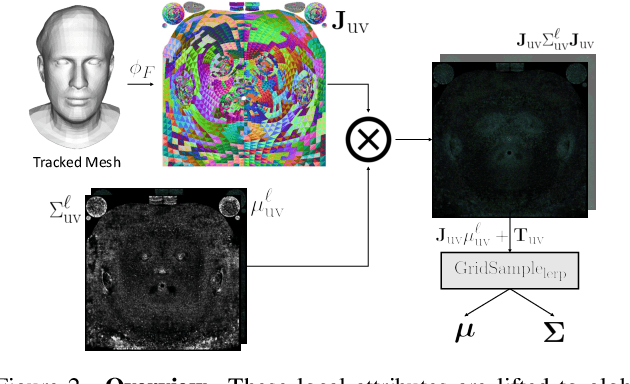
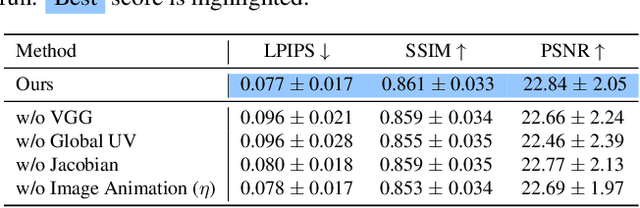
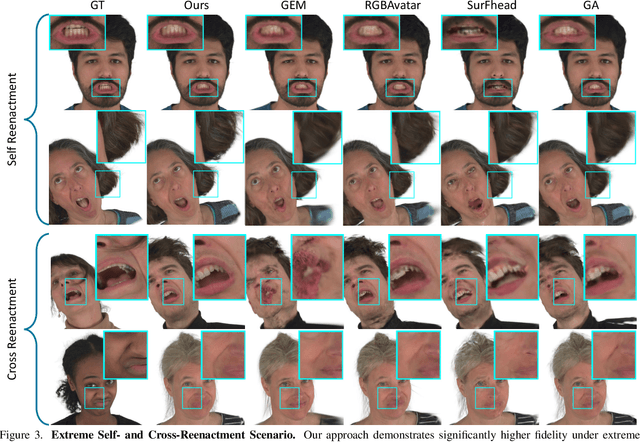
Constructing drivable and photorealistic 3D head avatars has become a central task in AR/XR, enabling immersive and expressive user experiences. With the emergence of high-fidelity and efficient representations such as 3D Gaussians, recent works have pushed toward ultra-detailed head avatars. Existing approaches typically fall into two categories: rule-based analytic rigging or neural network-based deformation fields. While effective in constrained settings, both approaches often fail to generalize to unseen expressions and poses, particularly in extreme reenactment scenarios. Other methods constrain Gaussians to the global texel space of 3DMMs to reduce rendering complexity. However, these texel-based avatars tend to underutilize the underlying mesh structure. They apply minimal analytic deformation and rely heavily on neural regressors and heuristic regularization in UV space, which weakens geometric consistency and limits extrapolation to complex, out-of-distribution deformations. To address these limitations, we introduce TexAvatars, a hybrid avatar representation that combines the explicit geometric grounding of analytic rigging with the spatial continuity of texel space. Our approach predicts local geometric attributes in UV space via CNNs, but drives 3D deformation through mesh-aware Jacobians, enabling smooth and semantically meaningful transitions across triangle boundaries. This hybrid design separates semantic modeling from geometric control, resulting in improved generalization, interpretability, and stability. Furthermore, TexAvatars captures fine-grained expression effects, including muscle-induced wrinkles, glabellar lines, and realistic mouth cavity geometry, with high fidelity. Our method achieves state-of-the-art performance under extreme pose and expression variations, demonstrating strong generalization in challenging head reenactment settings.