 Add to Chrome
 Add to Firefox
 Add to Edge
Anomaly as Non-Conformity via Training-Free Graph Laplacian Energy Minimization
May 27, 2026
Detecting subtle visual anomalies in images remains challenging, particularly when only normal samples are available a priori. Such unsupervised anomaly detection is typically solved by measuring feature similarity of a query patch to a memory of normal patches. However, similarity alone does not reveal how strongly a query patch violates the structure of the normal feature manifold. We propose a training-free Laplacian graph energy optimization formulation, named ANoCo that scores Anomaly by the cost of Non-Conformity of a query patch to align with a fixed normal manifold. For each query patch, we construct a bipartite query to normal graph weighted by cosine affinity, explicitly removing query-query and normal-normal edges to prevent evidence dilution. We formulate anomaly scoring as a convex Laplacian energy with anchored normal nodes, and solve in closed form. In particular, we do not use the optimized features themselves-the anomaly score is the magnitude of the update required to satisfy normality constraints, reframing the graph Laplacian as a non-conformity operator rather than a smoothing prior. The proposed method introduces no learnable parameters, message passing, or sampling, and has complexity comparable to a single linear solve. Across standard benchmarks, it delivers strong image-level AUROC, stable localization maps, and improved robustness over prior methods, demonstrating the effectiveness of using optimization-induced feature drift as anomaly measure.

Multispectral Pedestrian Detection with Sparsely Annotated Label
Jan 05, 2025
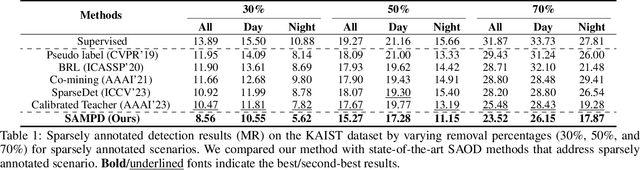


Although existing Sparsely Annotated Object Detection (SAOD) approches have made progress in handling sparsely annotated environments in multispectral domain, where only some pedestrians are annotated, they still have the following limitations: (i) they lack considerations for improving the quality of pseudo-labels for missing annotations, and (ii) they rely on fixed ground truth annotations, which leads to learning only a limited range of pedestrian visual appearances in the multispectral domain. To address these issues, we propose a novel framework called Sparsely Annotated Multispectral Pedestrian Detection (SAMPD). For limitation (i), we introduce Multispectral Pedestrian-aware Adaptive Weight (MPAW) and Positive Pseudo-label Enhancement (PPE) module. Utilizing multispectral knowledge, these modules ensure the generation of high-quality pseudo-labels and enable effective learning by increasing weights for high-quality pseudo-labels based on modality characteristics. To address limitation (ii), we propose an Adaptive Pedestrian Retrieval Augmentation (APRA) module, which adaptively incorporates pedestrian patches from ground-truth and dynamically integrates high-quality pseudo-labels with the ground-truth, facilitating a more diverse learning pool of pedestrians. Extensive experimental results demonstrate that our SAMPD significantly enhances performance in sparsely annotated environments within the multispectral domain.