 Add to Chrome
 Add to Firefox
 Add to Edge
Learning to Recover Task Experts from a Multi-Task Merged Model
Jun 25, 2026
Multi-task model merging aims to consolidate several task-specific experts into a unified model, yet static merging consistently suffers from parameter interference. While dynamic merging models aim to bridge this gap, many works rely on the costly storage and loading of redundant expert components at inference. In this work, from the perspective of task expert, we view parameter interference as parameter perturbation introduced to each expert during merging process. We show that such parameter perturbations can be modeled as affine transformation, which can be approximated as additive offsets. Motivated by these, we propose Recover Task eXpert (ReTeX), a framework that predicts those offsets, in order to undo parameter interference and recover task-expert performance from a single merged checkpoint. To recover the appropriate expert when task identity is unknown, we introduce a router-free task identifier based on SVD subspace signatures computed offline before inference. At inference, the identifier selects the task whose subspace yields the smallest projection residual for a given input. As a result, ReTeX recovers over 95% of individual-expert performance in both vision and NLP domains, while significantly improving generalization to unseen tasks. Crucially, we also show that the parameter offset prediction leads to emergent adaptive interpolation of expert knowledge for out-of-distribution (OOD) tasks. ReTeX adaptively interpolates seen expert knowledge to handle unseen tasks. Our code is available at https://github.com/BAIKLAB/ReTeX

Training-free Task Classification for Multi-Task Model Merging
Jun 21, 2026Ever since the advent of foundation models and the pre-training-finetuning paradigm, there have been numerous efforts to merge multiple task-specific experts into a single multi-task model. Prior work largely focuses on finding a single merged model, but it often underperforms individual experts due to parameter interference. To resolve this, dynamic model merging employs routing to activate task-relevant parameters per input. However, existing routers typically require either additional training with abundant labeled datasets or assume the access to task IDs of each input at inference time. In this work, we aim to close the gap to expert performance without additional training or task-ID-access assumption. To this end, we formulate routing as training-free task classification for each test input. Using singular value decomposition (SVD)-based low-rank manifold approximations for each task, SiM scores tasks by the projection residual of the test input feature onto each task manifold and routes accordingly. The task manifolds are pre-computable offline from a pretrained backbone using a small per-task support set (e.g., 32 examples per task) prior to merging process, requiring no router training and no data during the merging process. Moreover, SiM integrates seamlessly with subspace-/mask-based merging that represents task-expert via lightweight compressed task vectors, avoiding the need to store full expert parameters. Experiments across computer vision and natural language processing benchmarks under task-unknown inference demonstrate that SiM substantially improves merged-model performance and consistently narrows the gap to individual task experts.
Bilinear Coordinate Alignment for Training-Free Task-Vector Transfer
May 27, 2026Fine-tuning large-scale pre-trained models is a recent prevalent paradigm for adapting general representations to specialized tasks. However, when a new version of a pre-trained model becomes available, expertise acquired through fine-tuning cannot be directly reused because it is tied to the parameterization of the original model, requiring another costly fine-tuning. To address this inefficiency, recent work uses task vectors, defined as the parameter difference between a fine-tuned model and its base model, to transfer expertise across models. While existing methods bridge disparate models by matching activations or gradients, a significant performance gap remains relative to direct fine-tuning, suggesting that these partial correspondences are insufficient. In this work, instead of viewing a task vector merely as a parameter offset, we revisit the formation of task vectors and show that they can be derived as accumulated bilinear interactions between input-side activations and output-side gradients. Motivated by this observation, we formulate task-vector transfer as a dual-space alignment problem and propose BiCo, a training-free framework for transferring task vectors through Bilinear Coordinate alignment. BiCo estimates orthogonal Procrustes mappings in both spaces using a single forward-backward pass on a small calibration set, without any parameter update. Across extensive computer vision and natural language processing benchmarks, BiCo consistently outperforms existing transfer methods across models that differ in width, depth, and pre-training configuration.
AIS-LLM: A Unified Framework for Maritime Trajectory Prediction, Anomaly Detection, and Collision Risk Assessment with Explainable Forecasting
Aug 11, 2025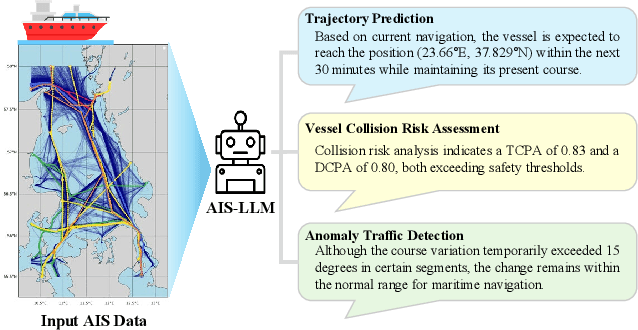
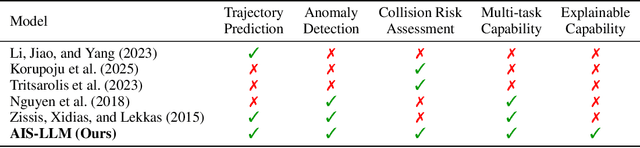
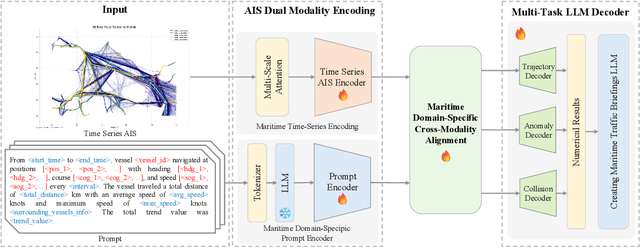

With the increase in maritime traffic and the mandatory implementation of the Automatic Identification System (AIS), the importance and diversity of maritime traffic analysis tasks based on AIS data, such as vessel trajectory prediction, anomaly detection, and collision risk assessment, is rapidly growing. However, existing approaches tend to address these tasks individually, making it difficult to holistically consider complex maritime situations. To address this limitation, we propose a novel framework, AIS-LLM, which integrates time-series AIS data with a large language model (LLM). AIS-LLM consists of a Time-Series Encoder for processing AIS sequences, an LLM-based Prompt Encoder, a Cross-Modality Alignment Module for semantic alignment between time-series data and textual prompts, and an LLM-based Multi-Task Decoder. This architecture enables the simultaneous execution of three key tasks: trajectory prediction, anomaly detection, and risk assessment of vessel collisions within a single end-to-end system. Experimental results demonstrate that AIS-LLM outperforms existing methods across individual tasks, validating its effectiveness. Furthermore, by integratively analyzing task outputs to generate situation summaries and briefings, AIS-LLM presents the potential for more intelligent and efficient maritime traffic management.
Mitigating Parameter Interference in Model Merging via Sharpness-Aware Fine-Tuning
Apr 20, 2025Large-scale deep learning models with a pretraining-finetuning paradigm have led to a surge of numerous task-specific models fine-tuned from a common pre-trained model. Recently, several research efforts have been made on merging these large models into a single multi-task model, particularly with simple arithmetic on parameters. Such merging methodology faces a central challenge: interference between model parameters fine-tuned on different tasks. Few recent works have focused on designing a new fine-tuning scheme that can lead to small parameter interference, however at the cost of the performance of each task-specific fine-tuned model and thereby limiting that of a merged model. To improve the performance of a merged model, we note that a fine-tuning scheme should aim for (1) smaller parameter interference and (2) better performance of each fine-tuned model on the corresponding task. In this work, we aim to design a new fine-tuning objective function to work towards these two goals. In the course of this process, we find such objective function to be strikingly similar to sharpness-aware minimization (SAM) objective function, which aims to achieve generalization by finding flat minima. Drawing upon our observation, we propose to fine-tune pre-trained models via sharpness-aware minimization. The experimental and theoretical results showcase the effectiveness and orthogonality of our proposed approach, improving performance upon various merging and fine-tuning methods. Our code is available at https://github.com/baiklab/SAFT-Merge.
PBVS 2024 Solution: Self-Supervised Learning and Sampling Strategies for SAR Classification in Extreme Long-Tail Distribution
Dec 17, 2024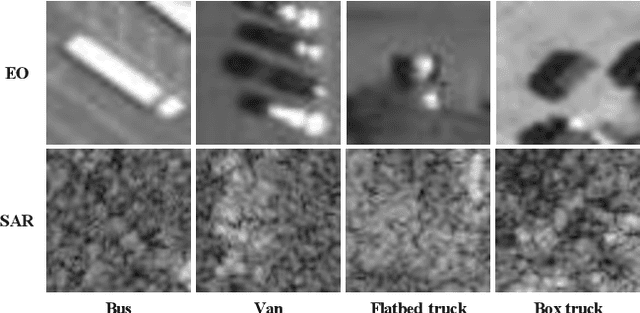


The Multimodal Learning Workshop (PBVS 2024) aims to improve the performance of automatic target recognition (ATR) systems by leveraging both Synthetic Aperture Radar (SAR) data, which is difficult to interpret but remains unaffected by weather conditions and visible light, and Electro-Optical (EO) data for simultaneous learning. The subtask, known as the Multi-modal Aerial View Imagery Challenge - Classification, focuses on predicting the class label of a low-resolution aerial image based on a set of SAR-EO image pairs and their respective class labels. The provided dataset consists of SAR-EO pairs, characterized by a severe long-tail distribution with over a 1000-fold difference between the largest and smallest classes, making typical long-tail methods difficult to apply. Additionally, the domain disparity between the SAR and EO datasets complicates the effectiveness of standard multimodal methods. To address these significant challenges, we propose a two-stage learning approach that utilizes self-supervised techniques, combined with multimodal learning and inference through SAR-to-EO translation for effective EO utilization. In the final testing phase of the PBVS 2024 Multi-modal Aerial View Image Challenge - Classification (SAR Classification) task, our model achieved an accuracy of 21.45%, an AUC of 0.56, and a total score of 0.30, placing us 9th in the competition.