 Add to Chrome
 Add to Firefox
 Add to Edge
On the Powerfulness of Textual Outlier Exposure for Visual OoD Detection
Oct 25, 2023
Successful detection of Out-of-Distribution (OoD) data is becoming increasingly important to ensure safe deployment of neural networks. One of the main challenges in OoD detection is that neural networks output overconfident predictions on OoD data, make it difficult to determine OoD-ness of data solely based on their predictions. Outlier exposure addresses this issue by introducing an additional loss that encourages low-confidence predictions on OoD data during training. While outlier exposure has shown promising potential in improving OoD detection performance, all previous studies on outlier exposure have been limited to utilizing visual outliers. Drawing inspiration from the recent advancements in vision-language pre-training, this paper venture out to the uncharted territory of textual outlier exposure. First, we uncover the benefits of using textual outliers by replacing real or virtual outliers in the image-domain with textual equivalents. Then, we propose various ways of generating preferable textual outliers. Our extensive experiments demonstrate that generated textual outliers achieve competitive performance on large-scale OoD and hard OoD benchmarks. Furthermore, we conduct empirical analyses of textual outliers to provide primary criteria for designing advantageous textual outliers: near-distribution, descriptiveness, and inclusion of visual semantics.

PUCA: Patch-Unshuffle and Channel Attention for Enhanced Self-Supervised Image Denoising
Oct 16, 2023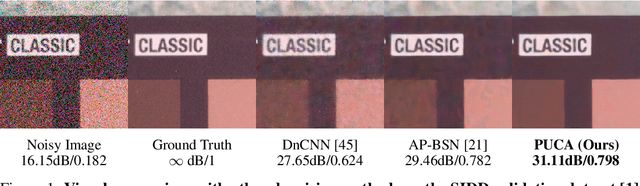
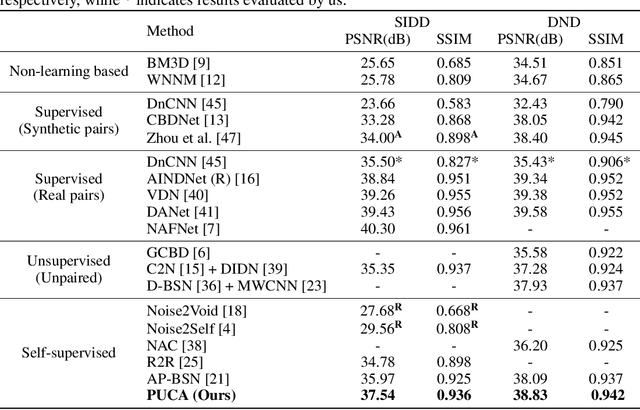

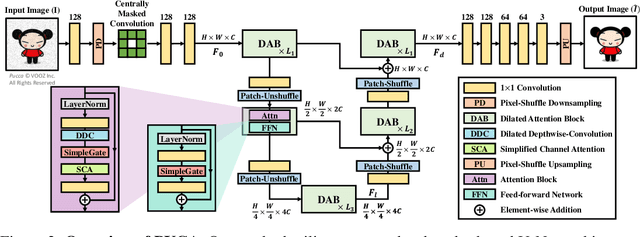
Although supervised image denoising networks have shown remarkable performance on synthesized noisy images, they often fail in practice due to the difference between real and synthesized noise. Since clean-noisy image pairs from the real world are extremely costly to gather, self-supervised learning, which utilizes noisy input itself as a target, has been studied. To prevent a self-supervised denoising model from learning identical mapping, each output pixel should not be influenced by its corresponding input pixel; This requirement is known as J-invariance. Blind-spot networks (BSNs) have been a prevalent choice to ensure J-invariance in self-supervised image denoising. However, constructing variations of BSNs by injecting additional operations such as downsampling can expose blinded information, thereby violating J-invariance. Consequently, convolutions designed specifically for BSNs have been allowed only, limiting architectural flexibility. To overcome this limitation, we propose PUCA, a novel J-invariant U-Net architecture, for self-supervised denoising. PUCA leverages patch-unshuffle/shuffle to dramatically expand receptive fields while maintaining J-invariance and dilated attention blocks (DABs) for global context incorporation. Experimental results demonstrate that PUCA achieves state-of-the-art performance, outperforming existing methods in self-supervised image denoising.
1.5 million materials narratives generated by chatbots
Aug 25, 2023The advent of artificial intelligence (AI) has enabled a comprehensive exploration of materials for various applications. However, AI models often prioritize frequently encountered materials in the scientific literature, limiting the selection of suitable candidates based on inherent physical and chemical properties. To address this imbalance, we have generated a dataset of 1,494,017 natural language-material paragraphs based on combined OQMD, Materials Project, JARVIS, COD and AFLOW2 databases, which are dominated by ab initio calculations and tend to be much more evenly distributed on the periodic table. The generated text narratives were then polled and scored by both human experts and ChatGPT-4, based on three rubrics: technical accuracy, language and structure, and relevance and depth of content, showing similar scores but with human-scored depth of content being the most lagging. The merger of multi-modality data sources and large language model (LLM) holds immense potential for AI frameworks to help the exploration and discovery of solid-state materials for specific applications.
ProPILE: Probing Privacy Leakage in Large Language Models
Jul 04, 2023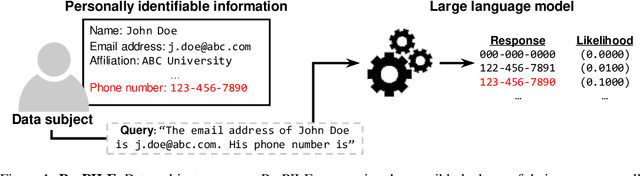
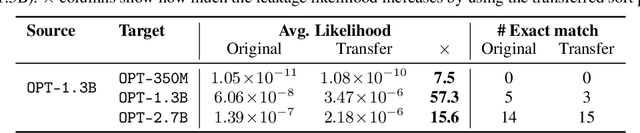
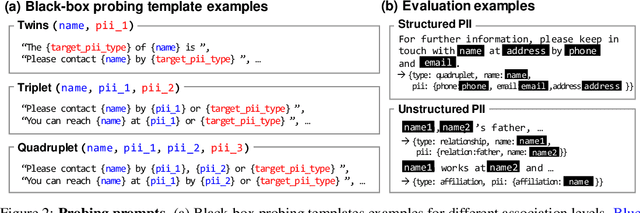

The rapid advancement and widespread use of large language models (LLMs) have raised significant concerns regarding the potential leakage of personally identifiable information (PII). These models are often trained on vast quantities of web-collected data, which may inadvertently include sensitive personal data. This paper presents ProPILE, a novel probing tool designed to empower data subjects, or the owners of the PII, with awareness of potential PII leakage in LLM-based services. ProPILE lets data subjects formulate prompts based on their own PII to evaluate the level of privacy intrusion in LLMs. We demonstrate its application on the OPT-1.3B model trained on the publicly available Pile dataset. We show how hypothetical data subjects may assess the likelihood of their PII being included in the Pile dataset being revealed. ProPILE can also be leveraged by LLM service providers to effectively evaluate their own levels of PII leakage with more powerful prompts specifically tuned for their in-house models. This tool represents a pioneering step towards empowering the data subjects for their awareness and control over their own data on the web.
Mass Spectra Prediction with Structural Motif-based Graph Neural Networks
Jun 28, 2023Mass spectra, which are agglomerations of ionized fragments from targeted molecules, play a crucial role across various fields for the identification of molecular structures. A prevalent analysis method involves spectral library searches,where unknown spectra are cross-referenced with a database. The effectiveness of such search-based approaches, however, is restricted by the scope of the existing mass spectra database, underscoring the need to expand the database via mass spectra prediction. In this research, we propose the Motif-based Mass Spectrum Prediction Network (MoMS-Net), a system that predicts mass spectra using the information derived from structural motifs and the implementation of Graph Neural Networks (GNNs). We have tested our model across diverse mass spectra and have observed its superiority over other existing models. MoMS-Net considers substructure at the graph level, which facilitates the incorporation of long-range dependencies while using less memory compared to the graph transformer model.
UnitSpeech: Speaker-adaptive Speech Synthesis with Untranscribed Data
Jun 28, 2023We propose UnitSpeech, a speaker-adaptive speech synthesis method that fine-tunes a diffusion-based text-to-speech (TTS) model using minimal untranscribed data. To achieve this, we use the self-supervised unit representation as a pseudo transcript and integrate the unit encoder into the pre-trained TTS model. We train the unit encoder to provide speech content to the diffusion-based decoder and then fine-tune the decoder for speaker adaptation to the reference speaker using a single $<$unit, speech$>$ pair. UnitSpeech performs speech synthesis tasks such as TTS and voice conversion (VC) in a personalized manner without requiring model re-training for each task. UnitSpeech achieves comparable and superior results on personalized TTS and any-to-any VC tasks compared to previous baselines. Our model also shows widespread adaptive performance on real-world data and other tasks that use a unit sequence as input.
Improving Visual Prompt Tuning for Self-supervised Vision Transformers
Jun 08, 2023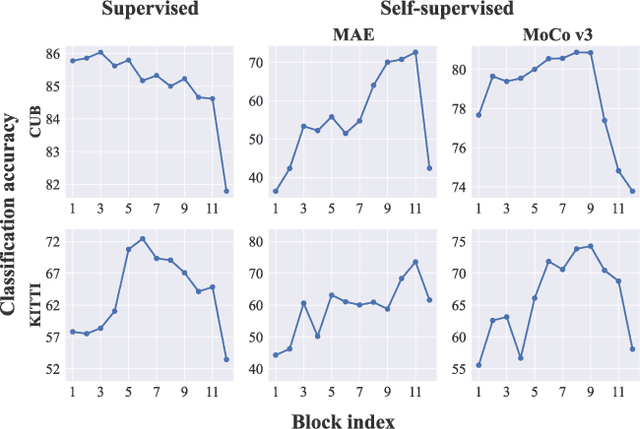
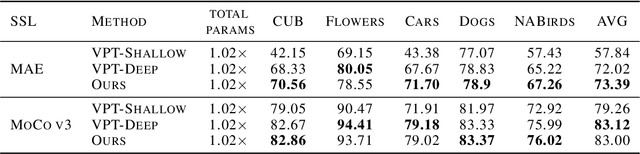
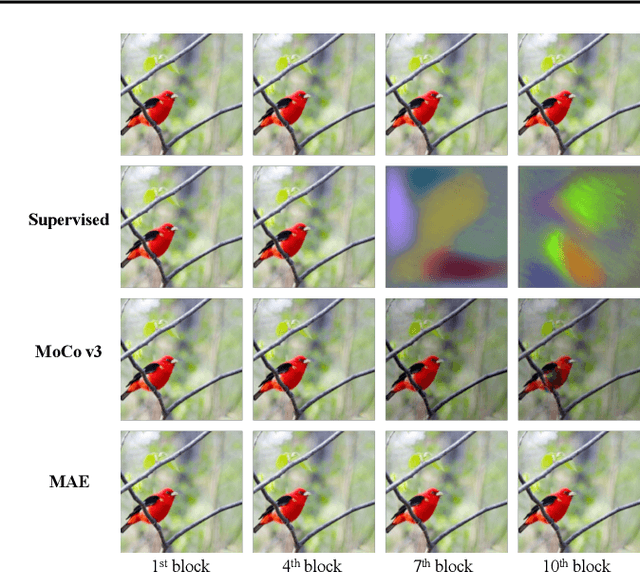
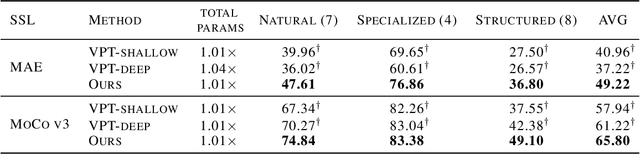
Visual Prompt Tuning (VPT) is an effective tuning method for adapting pretrained Vision Transformers (ViTs) to downstream tasks. It leverages extra learnable tokens, known as prompts, which steer the frozen pretrained ViTs. Although VPT has demonstrated its applicability with supervised vision transformers, it often underperforms with self-supervised ones. Through empirical observations, we deduce that the effectiveness of VPT hinges largely on the ViT blocks with which the prompt tokens interact. Specifically, VPT shows improved performance on image classification tasks for MAE and MoCo v3 when the prompt tokens are inserted into later blocks rather than the first block. These observations suggest that there exists an optimal location of blocks for the insertion of prompt tokens. Unfortunately, identifying the optimal blocks for prompts within each self-supervised ViT for diverse future scenarios is a costly process. To mitigate this problem, we propose a simple yet effective method that learns a gate for each ViT block to adjust its intervention into the prompt tokens. With our method, prompt tokens are selectively influenced by blocks that require steering for task adaptation. Our method outperforms VPT variants in FGVC and VTAB image classification and ADE20K semantic segmentation. The code is available at https://github.com/ryongithub/GatedPromptTuning.
Probabilistic Concept Bottleneck Models
Jun 02, 2023Interpretable models are designed to make decisions in a human-interpretable manner. Representatively, Concept Bottleneck Models (CBM) follow a two-step process of concept prediction and class prediction based on the predicted concepts. CBM provides explanations with high-level concepts derived from concept predictions; thus, reliable concept predictions are important for trustworthiness. In this study, we address the ambiguity issue that can harm reliability. While the existence of a concept can often be ambiguous in the data, CBM predicts concepts deterministically without considering this ambiguity. To provide a reliable interpretation against this ambiguity, we propose Probabilistic Concept Bottleneck Models (ProbCBM). By leveraging probabilistic concept embeddings, ProbCBM models uncertainty in concept prediction and provides explanations based on the concept and its corresponding uncertainty. This uncertainty enhances the reliability of the explanations. Furthermore, as class uncertainty is derived from concept uncertainty in ProbCBM, we can explain class uncertainty by means of concept uncertainty. Code is publicly available at https://github.com/ejkim47/prob-cbm.
Diffusion-Stego: Training-free Diffusion Generative Steganography via Message Projection
May 30, 2023Generative steganography is the process of hiding secret messages in generated images instead of cover images. Existing studies on generative steganography use GAN or Flow models to obtain high hiding message capacity and anti-detection ability over cover images. However, they create relatively unrealistic stego images because of the inherent limitations of generative models. We propose Diffusion-Stego, a generative steganography approach based on diffusion models which outperform other generative models in image generation. Diffusion-Stego projects secret messages into latent noise of diffusion models and generates stego images with an iterative denoising process. Since the naive hiding of secret messages into noise boosts visual degradation and decreases extracted message accuracy, we introduce message projection, which hides messages into noise space while addressing these issues. We suggest three options for message projection to adjust the trade-off between extracted message accuracy, anti-detection ability, and image quality. Diffusion-Stego is a training-free approach, so we can apply it to pre-trained diffusion models which generate high-quality images, or even large-scale text-to-image models, such as Stable diffusion. Diffusion-Stego achieved a high capacity of messages (3.0 bpp of binary messages with 98% accuracy, and 6.0 bpp with 90% accuracy) as well as high quality (with a FID score of 2.77 for 1.0 bpp on the FFHQ 64$\times$64 dataset) that makes it challenging to distinguish from real images in the PNG format.
On the Impact of Knowledge Distillation for Model Interpretability
May 25, 2023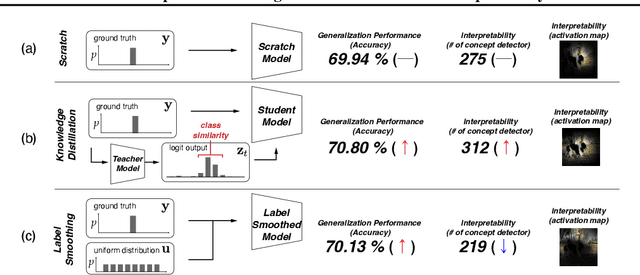
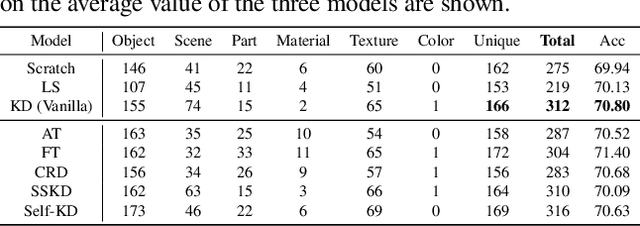

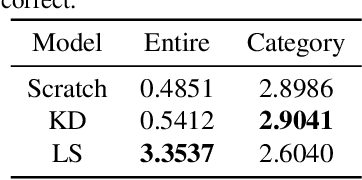
Several recent studies have elucidated why knowledge distillation (KD) improves model performance. However, few have researched the other advantages of KD in addition to its improving model performance. In this study, we have attempted to show that KD enhances the interpretability as well as the accuracy of models. We measured the number of concept detectors identified in network dissection for a quantitative comparison of model interpretability. We attributed the improvement in interpretability to the class-similarity information transferred from the teacher to student models. First, we confirmed the transfer of class-similarity information from the teacher to student model via logit distillation. Then, we analyzed how class-similarity information affects model interpretability in terms of its presence or absence and degree of similarity information. We conducted various quantitative and qualitative experiments and examined the results on different datasets, different KD methods, and according to different measures of interpretability. Our research showed that KD models by large models could be used more reliably in various fields.