 Add to Chrome
 Add to Firefox
 Add to Edge
Mirroring the Mind: Distilling Human-Like Metacognitive Strategies into Large Language Models
Feb 26, 2026
Large Reasoning Models (LRMs) often exhibit structural fragility in complex reasoning tasks, failing to produce correct answers even after successfully deriving valid intermediate steps. Through systematic analysis, we observe that these failures frequently stem not from a lack of reasoning capacity, but from a deficiency in self-regulatory control, where valid logic is destabilized by uncontrolled exploration or the failure to recognize logical sufficiency. Motivated by this observation, we propose Metacognitive Behavioral Tuning (MBT), a post-training framework that explicitly injects metacognitive behaviors into the model's thought process. MBT implements this via two complementary formulations: (1) MBT-S, which synthesizes rigorous reasoning traces from scratch, and (2) MBT-R, which rewrites the student's initial traces to stabilize intrinsic exploration patterns. Experiments across multi-hop QA benchmarks demonstrate that MBT consistently outperforms baselines, achieving notable gains on challenging benchmarks. By effectively eliminating reasoning collapse, MBT achieves higher accuracy with significantly reduced token consumption, demonstrating that internalizing metacognitive strategies leads to more stable and robust reasoning.

On the Impact of Knowledge Distillation for Model Interpretability
May 25, 2023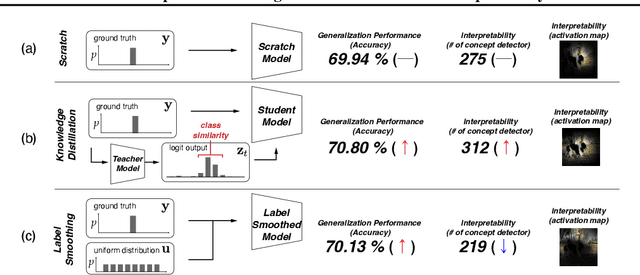
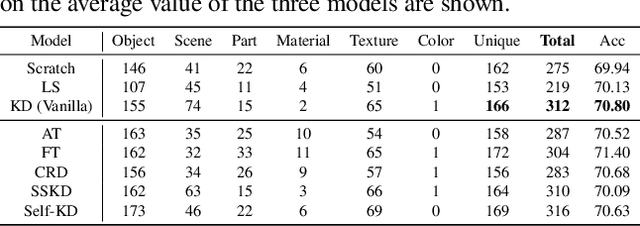

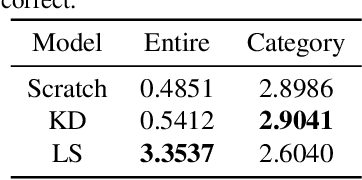
Several recent studies have elucidated why knowledge distillation (KD) improves model performance. However, few have researched the other advantages of KD in addition to its improving model performance. In this study, we have attempted to show that KD enhances the interpretability as well as the accuracy of models. We measured the number of concept detectors identified in network dissection for a quantitative comparison of model interpretability. We attributed the improvement in interpretability to the class-similarity information transferred from the teacher to student models. First, we confirmed the transfer of class-similarity information from the teacher to student model via logit distillation. Then, we analyzed how class-similarity information affects model interpretability in terms of its presence or absence and degree of similarity information. We conducted various quantitative and qualitative experiments and examined the results on different datasets, different KD methods, and according to different measures of interpretability. Our research showed that KD models by large models could be used more reliably in various fields.