 Add to Chrome
 Add to Firefox
 Add to Edge
DEO: Training-Free Direct Embedding Optimization for Negation-Aware Retrieval
Mar 10, 2026
Recent advances in Large Language Models (LLMs) and Retrieval-Augmented Generation (RAG) have enabled diverse retrieval methods. However, existing retrieval methods often fail to accurately retrieve results for negation and exclusion queries. To address this limitation, prior approaches rely on embedding adaptation or fine-tuning, which introduce additional computational cost and deployment complexity. We propose Direct Embedding Optimization (DEO), a training-free method for negation-aware text and multimodal retrieval. DEO decomposes queries into positive and negative components and optimizes the query embedding with a contrastive objective. Without additional training data or model updates, DEO outperforms baselines on NegConstraint, with gains of +0.0738 nDCG@10 and +0.1028 MAP@100, while improving Recall@5 by +6\% over OpenAI CLIP in multimodal retrieval. These results demonstrate the practicality of DEO for negation- and exclusion-aware retrieval in real-world settings.

DreamFlow: Local Navigation Beyond Observation via Conditional Flow Matching in the Latent Space
Mar 03, 2026Local navigation in cluttered environments often suffers from dense obstacles and frequent local minima. Conventional local planners rely on heuristics and are prone to failure, while deep reinforcement learning(DRL)based approaches provide adaptability but are constrained by limited onboard sensing. These limitations lead to navigation failures because the robot cannot perceive structures outside its field of view. In this paper, we propose DreamFlow, a DRL-based local navigation framework that extends the robot's perceptual horizon through conditional flow matching(CFM). The proposed CFM based prediction module learns probabilistic mapping between local height map latent representation and broader spatial representation conditioned on navigation context. This enables the navigation policy to predict unobserved environmental features and proactively avoid potential local minima. Experimental results demonstrate that DreamFlow outperforms existing methods in terms of latent prediction accuracy and navigation performance in simulation. The proposed method was further validated in cluttered real world environments with a quadrupedal robot. The project page is available at https://dreamflow-icra.github.io.
Structure-Preserving Zero-Shot Image Editing via Stage-Wise Latent Injection in Diffusion Models
Apr 22, 2025We propose a diffusion-based framework for zero-shot image editing that unifies text-guided and reference-guided approaches without requiring fine-tuning. Our method leverages diffusion inversion and timestep-specific null-text embeddings to preserve the structural integrity of the source image. By introducing a stage-wise latent injection strategy-shape injection in early steps and attribute injection in later steps-we enable precise, fine-grained modifications while maintaining global consistency. Cross-attention with reference latents facilitates semantic alignment between the source and reference. Extensive experiments across expression transfer, texture transformation, and style infusion demonstrate state-of-the-art performance, confirming the method's scalability and adaptability to diverse image editing scenarios.
Reasoning Abilities of Large Language Models: In-Depth Analysis on the Abstraction and Reasoning Corpus
Mar 18, 2024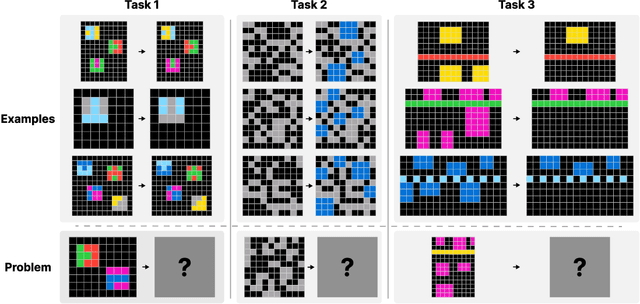
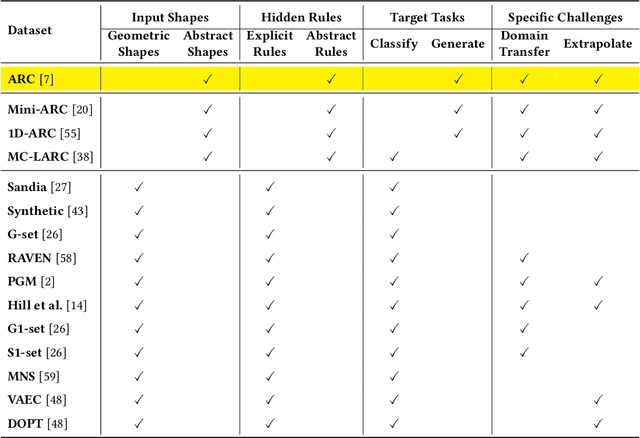
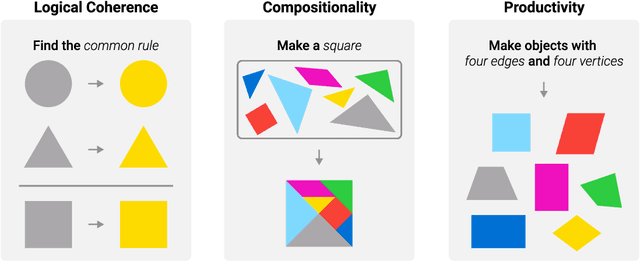
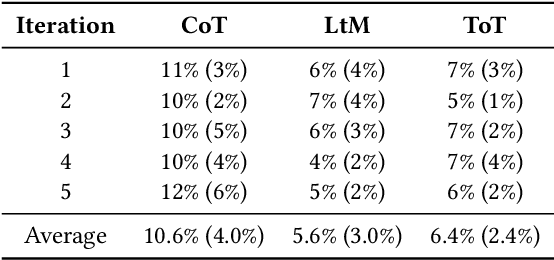
The existing methods for evaluating the inference abilities of Large Language Models (LLMs) have been results-centric, making it difficult to assess the inference process. We introduce a new approach using the Abstract and Reasoning Corpus (ARC) dataset to evaluate the inference and contextual understanding abilities of large language models in a process-centric manner. ARC demands rigorous logical structures for problem-solving, making it a benchmark that facilitates the comparison of model inference abilities with humans. Experimental results confirm that while large language models possess weak inference abilities, they still lag in terms of logical coherence, compositionality, and productivity. Our experiments highlight the reasoning capabilities of LLMs, proposing development paths for achieving human-level reasoning.
Mass Spectra Prediction with Structural Motif-based Graph Neural Networks
Jun 28, 2023Mass spectra, which are agglomerations of ionized fragments from targeted molecules, play a crucial role across various fields for the identification of molecular structures. A prevalent analysis method involves spectral library searches,where unknown spectra are cross-referenced with a database. The effectiveness of such search-based approaches, however, is restricted by the scope of the existing mass spectra database, underscoring the need to expand the database via mass spectra prediction. In this research, we propose the Motif-based Mass Spectrum Prediction Network (MoMS-Net), a system that predicts mass spectra using the information derived from structural motifs and the implementation of Graph Neural Networks (GNNs). We have tested our model across diverse mass spectra and have observed its superiority over other existing models. MoMS-Net considers substructure at the graph level, which facilitates the incorporation of long-range dependencies while using less memory compared to the graph transformer model.