 Add to Chrome
 Add to Firefox
 Add to Edge
A Taxonomy of Cognitive Capability Gaps in Generative and Agentic AI
Aug 03, 2026
Cognitive AI seeks to move beyond language generation and autonomous task execution toward systems capable of sustained reasoning, adaptive behavior, persistent memory, and self-regulation. While generative and agentic AI have demonstrated impressive capabilities across a wide range of tasks, many fundamental cognitive functions remain fragmented or weakly developed, limiting reliable operation over extended time horizons. This paper presents a taxonomy-driven survey of the major cognitive capability gaps that continue to constrain the development of Cognitive AI. The literature is organized around five dimensions: persistent state modeling, goal-directed autonomy, self-monitoring and control, environment interaction, and learning and adaptation. For each dimension, we review recent advances, identify recurring limitations, and discuss open research challenges. Building on these insights, we outline a conceptual Adaptive Cognitive Intelligence Architecture (ACIA) and examine emerging directions in cognition-centric evaluation. The proposed taxonomy provides a unified framework for organizing existing research, identifying unresolved challenges, and guiding the design of future cognitively capable systems. Together, the taxonomy, architectural perspective, and evaluation framework offer a roadmap for advancing AI systems that exhibit more reliable long-term reasoning, adaptive decision-making, and continual learning. The survey highlights key research opportunities toward more adaptive, reliable, and cognitively capable AI systems, providing a foundation for future progress toward Cognitive AI and, ultimately, Artificial General Intelligence (AGI).

Find Before You Fine-Tune: A Diagnostic Study of Small LLMs for Cybersecurity QA
Jul 21, 2026Large Language Models (LLMs) are increasingly fine-tuned for critical-domain Question-Answering (QA), yet choosing which small model to adapt, before paying the cost of adaptation, remains difficult. Fine-tuning can improve domain alignment, but it may also erode prior knowledge, weaken instruction-following, or increase hallucination, especially when labeled data are scarce or rapidly evolving as in cybersecurity. We present FiT (Find before Fine-Tune), a task-oriented diagnostic framework that characterizes small LLMs along three capabilities required for cybersecurity QA: vocabulary recognition, parametric knowledge, and contextualization of retrieved information. Using FiT, we conduct an empirical study of five open-weight 7-billion-parameter models under two fine-tuning regimes. We find that fine-tuning does not uniformly help: it consistently degrades vocabulary and parametric knowledge in small models, and the two regimes trade off differently. Knowledge-focused tuning causes moderate, rank-preserving degradation, whereas instruction-focused tuning collapses measured knowledge through induced abstention, inverting the knowledge ranking while leaving retrieval-grounded contextualization essentially intact. We quantify these regime-specific patterns with rank-correlation analysis and show that pre-fine-tuning FiT scores anticipate the direction of post-tuning change. Our results suggest that task-oriented diagnosis can screen out unsuitable models, avoid unnecessary fine-tuning, and support safer deployment of small LLMs in cybersecurity QA pipelines.
Agentra: A Supervisable Multi-Agent Framework for Enterprise Intrusion Response
Jun 18, 2026Enterprise intrusion response still depends on static playbooks and analyst-driven triage, creating delay between alert generation and containment. We present Agentra, a supervisable multi-agent Intrusion Response System (IRS) framework that converts alerts from IDS, EDR, and XDR platforms into structured incident response plans grounded in MITRE ATT&CK, MITRE D3FEND, and NIST CSF 2.0. Agentra decomposes response reasoning across role-scoped agents, validates proposed plans through a bounded Planner--Validator review loop, screens retrieved threat intelligence through a Moderator security gateway, gates actions through an Action Catalog and risk score, and records decisions in an append-only audit log. We evaluate Agentra against a static OASIS CACAO v2.0 cyber-playbook baseline on a 120-event corpus drawn from ThreatHunter-Playbook, Splunk BOTSv3, and DARPA OpTC. The strongest configuration improves FP-aware IRS F1 from 0.61 to 0.84 and restores the projected harmful-action rate to the static baseline level of 0.0% after Planner-only configurations introduce unsafe overreaction. These results indicate that multi-agent response planning can improve ontology-grounded IRS coverage while preserving analyst approval and auditability.
Evaluating Open-Source LLMs for Multi-Label ATT&CK Technique Classification on CTI Reports
Jun 16, 2026Classifying Cyber Threat Intelligence (CTI) using MITRE Adversarial Tactics, Techniques, and Common Knowledge (ATT&CK) is essential for proactive defense, but historically required extensive human effort. Pre-Large Language Model (LLM) automation sped up this process, but could not resolve the complex language and multi-step attack patterns found in unstructured CTI reports. LLMs addressed previous limitations by using contextual reasoning to understand unstructured text. However, current evaluations rely on simplified, single-technique sentences that ignore the complexity of real-world CTI reports, which often leads to inflated performance results. Consequently, the baseline performance of open-source LLMs on complex unstructured CTI reports remains unevaluated. To address this gap, we constructed a ground-truth dataset of 2,076 human-annotated sentences (1,281 technique-positive, 795 negative) from 83 complex unstructured CTI reports. These sentences were mapped to 114 unique ATT&CK techniques using a six-phase annotation process, achieving \k{appa} = 0.68 inter-annotator agreement. Using this dataset, we evaluated seven open-source LLMs ranging from 8B to 236B parameters across prompt strategy and temperature configurations. The highest-performing LLM achieved a micro-averaged F1 score of 0.22, establishing the empirical baseline for multi-label ATT&CK classification on complex unstructured CTI. Parameter size showed a statistically significant positive correlation with F1 score. Prompt strategy and temperature produced no statistically significant gains across model configurations. These results indicate that current open-source LLMs are insufficient for production-grade ATT&CK classification. The dataset, benchmark, and findings provide a reproducible foundation for future CTI research.
Evaluating Transformer and LSTM Frameworks for Prediction in Ungauged Basins
Jun 01, 2026Watershed networks exhibit convergent topologies in which multiple tributaries merge into downstream channels,integrating diverse upstream hydrological processes. In ungauged basins, the absence of direct observations increases uncertainty and limits the ability to anticipate extreme events. This study evaluates whether an encoder-only Transformer provides an advantage over an LSTM for upstream streamflow inference under limited hydrologic information, using retrospective simulations from the NOAA National Water Model (NWM). Across both upstream-only and combined configurations, the LSTM showed stronger overall performance than the Transformer model across the two configurations. Incorporating downstream information further boosted performance for all models, increasing median NNSE by more than 60%. Rather than treating this as a leaderboard-style comparison, we interpret the experiments as a test of architectural inductive bias for hydrologic sequence inference. The results indicate that recurrent memory remains better aligned with this upstream reconstruction task than an encoder-only Transformer, while downstream hydrologic context provides a strong auxiliary constraint that substantially improves prediction skill across architectures
FALCON: Autonomous Cyber Threat Intelligence Mining with LLMs for IDS Rule Generation
Aug 26, 2025Signature-based Intrusion Detection Systems (IDS) detect malicious activities by matching network or host activity against predefined rules. These rules are derived from extensive Cyber Threat Intelligence (CTI), which includes attack signatures and behavioral patterns obtained through automated tools and manual threat analysis, such as sandboxing. The CTI is then transformed into actionable rules for the IDS engine, enabling real-time detection and prevention. However, the constant evolution of cyber threats necessitates frequent rule updates, which delay deployment time and weaken overall security readiness. Recent advancements in agentic systems powered by Large Language Models (LLMs) offer the potential for autonomous IDS rule generation with internal evaluation. We introduce FALCON, an autonomous agentic framework that generates deployable IDS rules from CTI data in real-time and evaluates them using built-in multi-phased validators. To demonstrate versatility, we target both network (Snort) and host-based (YARA) mediums and construct a comprehensive dataset of IDS rules with their corresponding CTIs. Our evaluations indicate FALCON excels in automatic rule generation, with an average of 95% accuracy validated by qualitative evaluation with 84% inter-rater agreement among multiple cybersecurity analysts across all metrics. These results underscore the feasibility and effectiveness of LLM-driven data mining for real-time cyber threat mitigation.
Semantic-Aware Contrastive Fine-Tuning: Boosting Multimodal Malware Classification with Discriminative Embeddings
Apr 25, 2025The rapid evolution of malware variants requires robust classification methods to enhance cybersecurity. While Large Language Models (LLMs) offer potential for generating malware descriptions to aid family classification, their utility is limited by semantic embedding overlaps and misalignment with binary behavioral features. We propose a contrastive fine-tuning (CFT) method that refines LLM embeddings via targeted selection of hard negative samples based on cosine similarity, enabling LLMs to distinguish between closely related malware families. Our approach combines high-similarity negatives to enhance discriminative power and mid-tier negatives to increase embedding diversity, optimizing both precision and generalization. Evaluated on the CIC-AndMal-2020 and BODMAS datasets, our refined embeddings are integrated into a multimodal classifier within a Model-Agnostic Meta-Learning (MAML) framework on a few-shot setting. Experiments demonstrate significant improvements: our method achieves 63.15% classification accuracy with as few as 20 samples on CIC-AndMal-2020, outperforming baselines by 11--21 percentage points and surpassing prior negative sampling strategies. Ablation studies confirm the superiority of similarity-based selection over random sampling, with gains of 10-23%. Additionally, fine-tuned LLMs generate attribute-aware descriptions that generalize to unseen variants, bridging textual and binary feature gaps. This work advances malware classification by enabling nuanced semantic distinctions and provides a scalable framework for adapting LLMs to cybersecurity challenges.
Towards a HIPAA Compliant Agentic AI System in Healthcare
Apr 24, 2025Agentic AI systems powered by Large Language Models (LLMs) as their foundational reasoning engine, are transforming clinical workflows such as medical report generation and clinical summarization by autonomously analyzing sensitive healthcare data and executing decisions with minimal human oversight. However, their adoption demands strict compliance with regulatory frameworks such as Health Insurance Portability and Accountability Act (HIPAA), particularly when handling Protected Health Information (PHI). This work-in-progress paper introduces a HIPAA-compliant Agentic AI framework that enforces regulatory compliance through dynamic, context-aware policy enforcement. Our framework integrates three core mechanisms: (1) Attribute-Based Access Control (ABAC) for granular PHI governance, (2) a hybrid PHI sanitization pipeline combining regex patterns and BERT-based model to minimize leakage, and (3) immutable audit trails for compliance verification.
From Patient Consultations to Graphs: Leveraging LLMs for Patient Journey Knowledge Graph Construction
Mar 18, 2025The transition towards patient-centric healthcare necessitates a comprehensive understanding of patient journeys, which encompass all healthcare experiences and interactions across the care spectrum. Existing healthcare data systems are often fragmented and lack a holistic representation of patient trajectories, creating challenges for coordinated care and personalized interventions. Patient Journey Knowledge Graphs (PJKGs) represent a novel approach to addressing the challenge of fragmented healthcare data by integrating diverse patient information into a unified, structured representation. This paper presents a methodology for constructing PJKGs using Large Language Models (LLMs) to process and structure both formal clinical documentation and unstructured patient-provider conversations. These graphs encapsulate temporal and causal relationships among clinical encounters, diagnoses, treatments, and outcomes, enabling advanced temporal reasoning and personalized care insights. The research evaluates four different LLMs, such as Claude 3.5, Mistral, Llama 3.1, and Chatgpt4o, in their ability to generate accurate and computationally efficient knowledge graphs. Results demonstrate that while all models achieved perfect structural compliance, they exhibited variations in medical entity processing and computational efficiency. The paper concludes by identifying key challenges and future research directions. This work contributes to advancing patient-centric healthcare through the development of comprehensive, actionable knowledge graphs that support improved care coordination and outcome prediction.
The AI Pentad, the CHARME$^{2}$D Model, and an Assessment of Current-State AI Regulation
Mar 08, 2025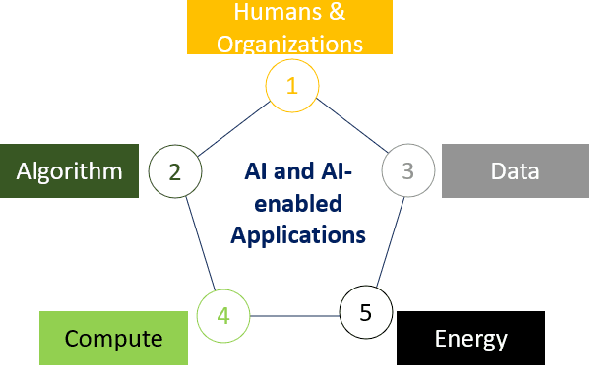
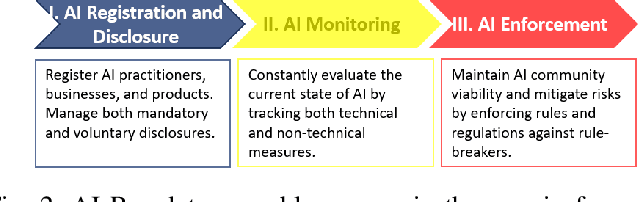
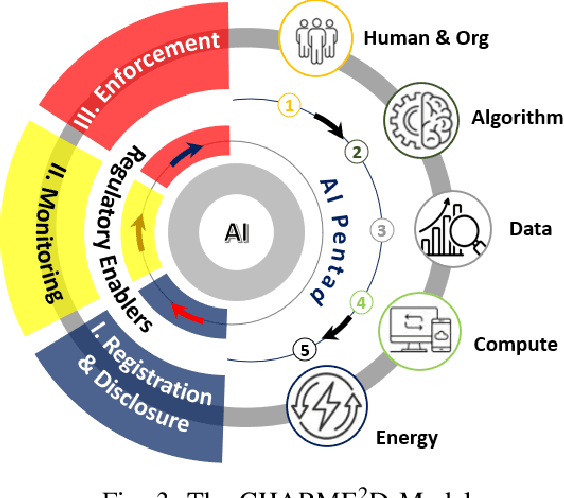
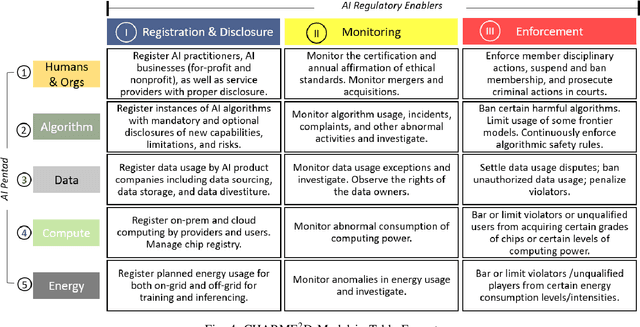
Artificial Intelligence (AI) has made remarkable progress in the past few years with AI-enabled applications beginning to permeate every aspect of our society. Despite the widespread consensus on the need to regulate AI, there remains a lack of a unified approach to framing, developing, and assessing AI regulations. Many of the existing methods take a value-based approach, for example, accountability, fairness, free from bias, transparency, and trust. However, these methods often face challenges at the outset due to disagreements in academia over the subjective nature of these definitions. This paper aims to establish a unifying model for AI regulation from the perspective of core AI components. We first introduce the AI Pentad, which comprises the five essential components of AI: humans and organizations, algorithms, data, computing, and energy. We then review AI regulatory enablers, including AI registration and disclosure, AI monitoring, and AI enforcement mechanisms. Subsequently, we present the CHARME$^{2}$D Model to explore further the relationship between the AI Pentad and AI regulatory enablers. Finally, we apply the CHARME$^{2}$D model to assess AI regulatory efforts in the European Union (EU), China, the United Arab Emirates (UAE), the United Kingdom (UK), and the United States (US), highlighting their strengths, weaknesses, and gaps. This comparative evaluation offers insights for future legislative work in the AI domain.