 Add to Chrome
 Add to Firefox
 Add to Edge
Likelihood hacking in probabilistic program synthesis
Mar 25, 2026
When language models are trained by reinforcement learning (RL) to write probabilistic programs, they can artificially inflate their marginal-likelihood reward by producing programs whose data distribution fails to normalise instead of fitting the data better. We call this failure likelihood hacking (LH). We formalise LH in a core probabilistic programming language (PPL) and give sufficient syntactic conditions for its prevention, proving that a safe language fragment $\mathcal{L}_{\text{safe}}$ satisfying these conditions cannot produce likelihood-hacking programs. Empirically, we show that GRPO-trained models generating PyMC code discover LH exploits within the first few training steps, driving violation rates well above the untrained-model baseline. We implement $\mathcal{L}_{\text{safe}}$'s conditions as $\texttt{SafeStan}$, a LH-resistant modification of Stan, and show empirically that it prevents LH under optimisation pressure. These results show that language-level safety constraints are both theoretically grounded and effective in practice for automated Bayesian model discovery.

Geometric structures and deviations on James' symmetric positive-definite matrix bicone domain
Mar 03, 2026Symmetric positive-definite (SPD) matrix datasets play a central role across numerous scientific disciplines, including signal processing, statistics, finance, computer vision, information theory, and machine learning among others. The set of SPD matrices forms a cone which can be viewed as a global coordinate chart of the underlying SPD manifold. Rich differential-geometric structures may be defined on the SPD cone manifold. Among the most widely used geometric frameworks on this manifold are the affine-invariant Riemannian structure and the dual information-geometric log-determinant barrier structure, each associated with dissimilarity measures (distance and divergence, respectively). In this work, we introduce two new structures, a Finslerian structure and a dual information-geometric structure, both derived from James' bicone reparameterization of the SPD domain. Those structures ensure that geodesics correspond to straight lines in appropriate coordinate systems. The closed bicone domain includes the spectraplex (the set of positive semi-definite diagonal matrices with unit trace) as an affine subspace, and the Hilbert VPM distance is proven to generalize the Hilbert simplex distance which found many applications in machine learning. Finally, we discuss several applications of these Finsler/dual Hessian structures and provide various inequalities between the new and traditional dissimilarities.
Hilbert geometry of the symmetric positive-definite bicone: Application to the geometry of the extended Gaussian family
Aug 20, 2025The extended Gaussian family is the closure of the Gaussian family obtained by completing the Gaussian family with the counterpart elements induced by degenerate covariance or degenerate precision matrices, or a mix of both degeneracies. The parameter space of the extended Gaussian family forms a symmetric positive semi-definite matrix bicone, i.e. two partial symmetric positive semi-definite matrix cones joined at their bases. In this paper, we study the Hilbert geometry of such an open bounded convex symmetric positive-definite bicone. We report the closed-form formula for the corresponding Hilbert metric distance and study exhaustively its invariance properties. We also touch upon potential applications of this geometry for dealing with extended Gaussian distributions.
Characterizing stable regions in the residual stream of LLMs
Sep 26, 2024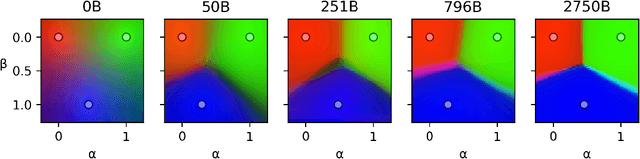
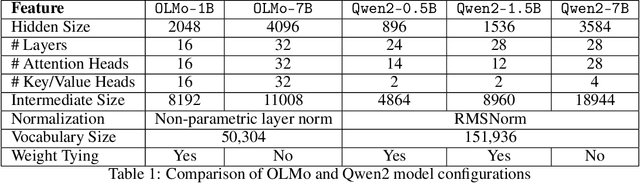
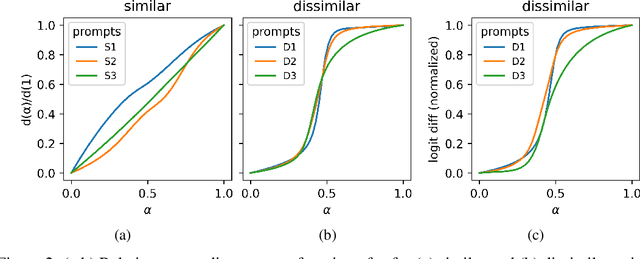
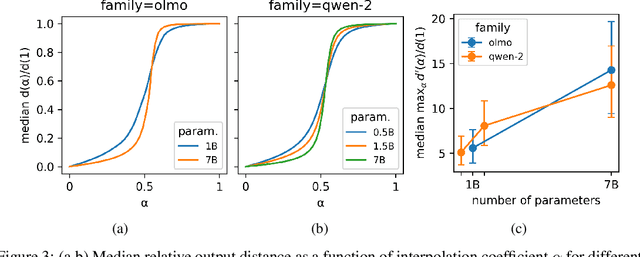
We identify "stable regions" in the residual stream of Transformers, where the model's output remains insensitive to small activation changes, but exhibits high sensitivity at region boundaries. These regions emerge during training and become more defined as training progresses or model size increases. The regions appear to be much larger than previously studied polytopes. Our analysis suggests that these stable regions align with semantic distinctions, where similar prompts cluster within regions, and activations from the same region lead to similar next token predictions. This work provides a promising research direction for understanding the complexity of neural networks, shedding light on training dynamics, and advancing interpretability.
Limitations of Agents Simulated by Predictive Models
Feb 08, 2024There is increasing focus on adapting predictive models into agent-like systems, most notably AI assistants based on language models. We outline two structural reasons for why these models can fail when turned into agents. First, we discuss auto-suggestive delusions. Prior work has shown theoretically that models fail to imitate agents that generated the training data if the agents relied on hidden observations: the hidden observations act as confounding variables, and the models treat actions they generate as evidence for nonexistent observations. Second, we introduce and formally study a related, novel limitation: predictor-policy incoherence. When a model generates a sequence of actions, the model's implicit prediction of the policy that generated those actions can serve as a confounding variable. The result is that models choose actions as if they expect future actions to be suboptimal, causing them to be overly conservative. We show that both of those failures are fixed by including a feedback loop from the environment, that is, re-training the models on their own actions. We give simple demonstrations of both limitations using Decision Transformers and confirm that empirical results agree with our conceptual and formal analysis. Our treatment provides a unifying view of those failure modes, and informs the question of why fine-tuning offline learned policies with online learning makes them more effective.
Goodhart's Law in Reinforcement Learning
Oct 13, 2023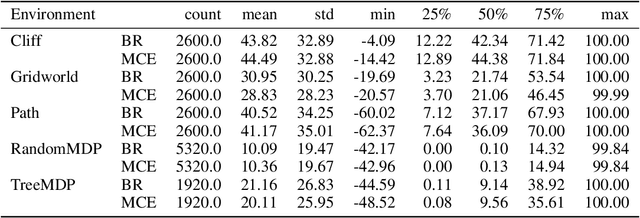
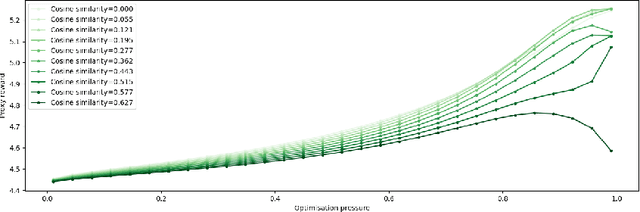
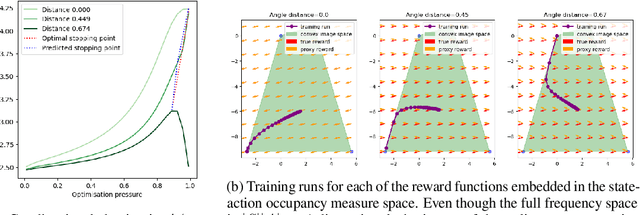
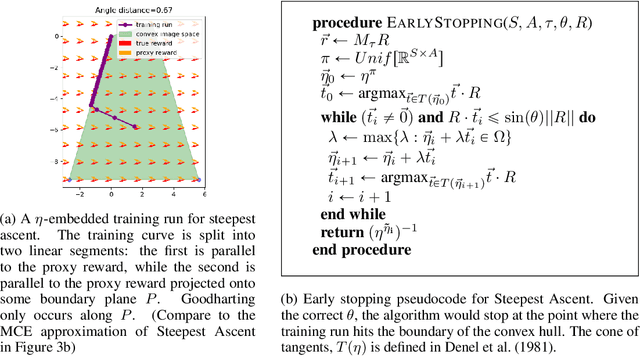
Implementing a reward function that perfectly captures a complex task in the real world is impractical. As a result, it is often appropriate to think of the reward function as a proxy for the true objective rather than as its definition. We study this phenomenon through the lens of Goodhart's law, which predicts that increasing optimisation of an imperfect proxy beyond some critical point decreases performance on the true objective. First, we propose a way to quantify the magnitude of this effect and show empirically that optimising an imperfect proxy reward often leads to the behaviour predicted by Goodhart's law for a wide range of environments and reward functions. We then provide a geometric explanation for why Goodhart's law occurs in Markov decision processes. We use these theoretical insights to propose an optimal early stopping method that provably avoids the aforementioned pitfall and derive theoretical regret bounds for this method. Moreover, we derive a training method that maximises worst-case reward, for the setting where there is uncertainty about the true reward function. Finally, we evaluate our early stopping method experimentally. Our results support a foundation for a theoretically-principled study of reinforcement learning under reward misspecification.