 Add to Chrome
 Add to Firefox
 Add to Edge
Linear Personality Probing and Steering in LLMs: A Big Five Study
Dec 19, 2025
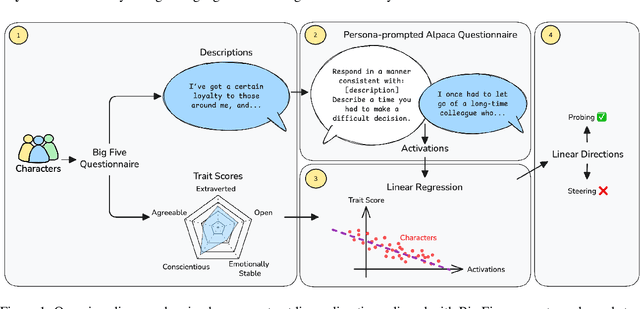
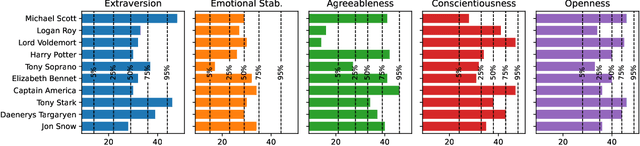
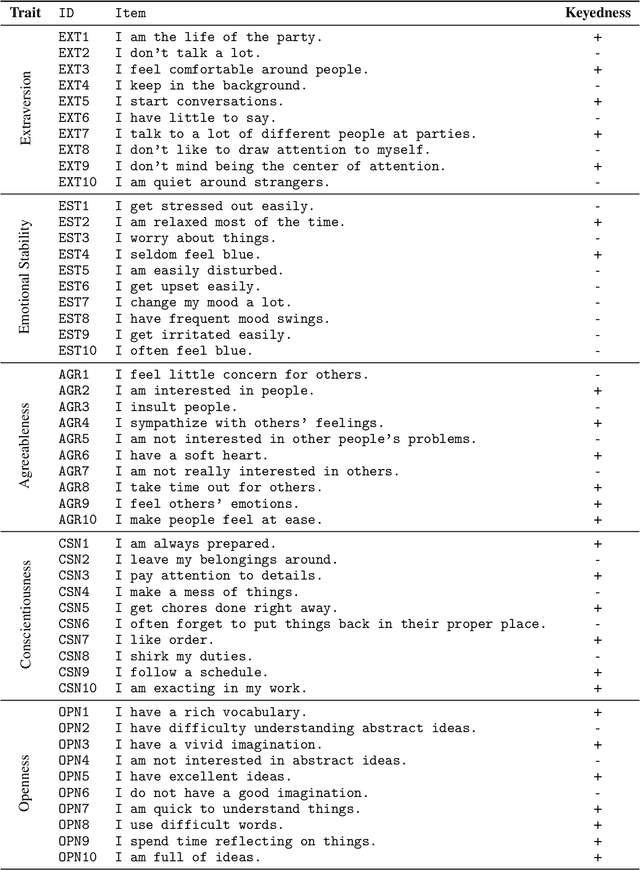
Large language models (LLMs) exhibit distinct and consistent personalities that greatly impact trust and engagement. While this means that personality frameworks would be highly valuable tools to characterize and control LLMs' behavior, current approaches remain either costly (post-training) or brittle (prompt engineering). Probing and steering via linear directions has recently emerged as a cheap and efficient alternative. In this paper, we investigate whether linear directions aligned with the Big Five personality traits can be used for probing and steering model behavior. Using Llama 3.3 70B, we generate descriptions of 406 fictional characters and their Big Five trait scores. We then prompt the model with these descriptions and questions from the Alpaca questionnaire, allowing us to sample hidden activations that vary along personality traits in known, quantifiable ways. Using linear regression, we learn a set of per-layer directions in activation space, and test their effectiveness for probing and steering model behavior. Our results suggest that linear directions aligned with trait-scores are effective probes for personality detection, while their steering capabilities strongly depend on context, producing reliable effects in forced-choice tasks but limited influence in open-ended generation or when additional context is present in the prompt.

Evolution of SAE Features Across Layers in LLMs
Oct 11, 2024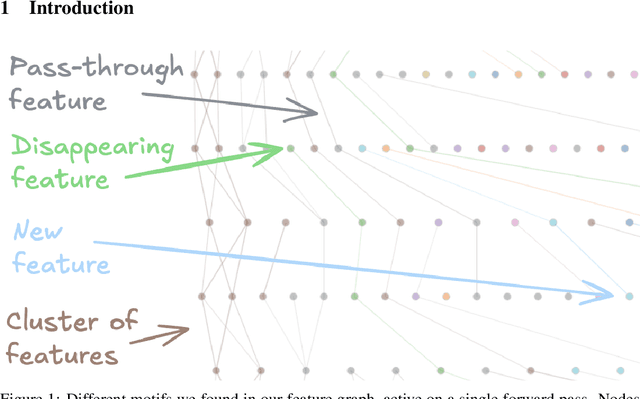
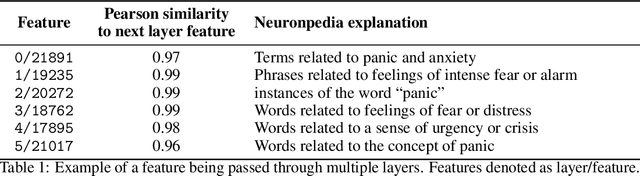
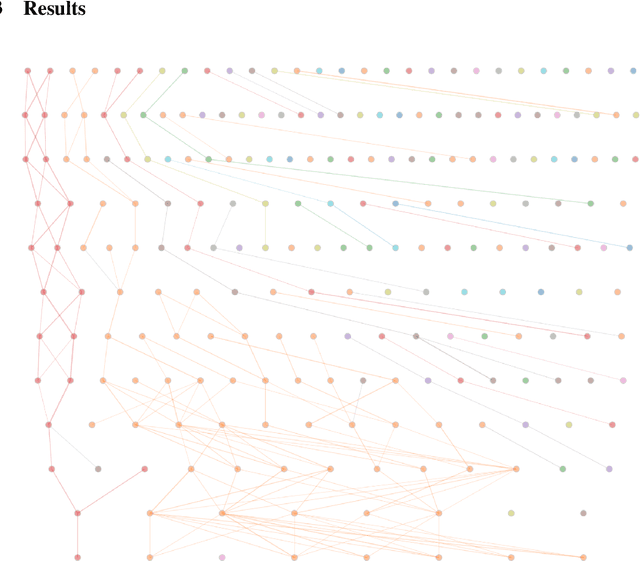
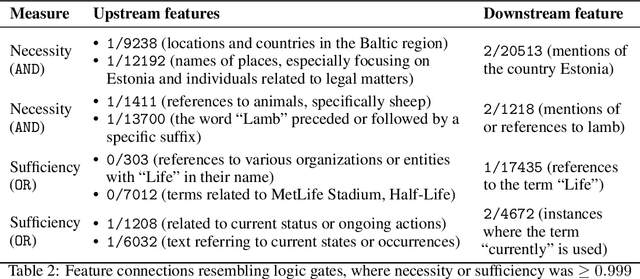
Sparse Autoencoders for transformer-based language models are typically defined independently per layer. In this work we analyze statistical relationships between features in adjacent layers to understand how features evolve through a forward pass. We provide a graph visualization interface for features and their most similar next-layer neighbors, and build communities of related features across layers. We find that a considerable amount of features are passed through from a previous layer, some features can be expressed as quasi-boolean combinations of previous features, and some features become more specialized in later layers.