 Add to Chrome
 Add to Firefox
 Add to Edge
Vanilla ViT for Automotive Point Cloud Semantic Segmentation
May 29, 2026
Plain Transformers have become the de-facto architecture for processing text, audio, image, and video, offering a unified backbone for multimodal learning. However, state-of-the-art architectures for point cloud semantic segmentation remain dominated by U-Nets architectures where convolutions are interleaved with local or windowed attentions. In this work, we show how to effectively leverage vanilla, non-hierarchical ViTs for segmentation of large-scale automotive lidar scenes. We bridge the performance gap thanks to a carefully designed tokenizer, a lightweight decoder segmentation head, and tailored data augmentations. Our approach, VaViT for Vanilla ViT, matches or exceeds the performance of state-of-the-art methods while maintaining the simplicity of ViT architecture. We provide extensive evaluations on nuScenes, SemanticKITTI, and Waymo Open Dataset to validate the efficiency of our method. Code and models are available at https://github.com/valeoai/VaViT.

Coevolving Representations in Joint Image-Feature Diffusion
Apr 19, 2026Joint image-feature generative modeling has recently emerged as an effective strategy for improving diffusion training by coupling low-level VAE latents with high-level semantic features extracted from pre-trained visual encoders. However, existing approaches rely on a fixed representation space, constructed independently of the generative objective and kept unchanged during training. We argue that the representation space guiding diffusion should itself adapt to the generative task. To this end, we propose Coevolving Representation Diffusion (CoReDi), a framework in which the semantic representation space evolves during training by learning a lightweight linear projection jointly with the diffusion model. While naively optimizing this projection leads to degenerate solutions, we show that stable coevolution can be achieved through a combination of stop-gradient targets, normalization, and targeted regularization that prevents feature collapse. This formulation enables the semantic space to progressively specialize to the needs of image synthesis, improving its complementarity with image latents. We apply CoReDi to both VAE latent diffusion and pixel-space diffusion, demonstrating that adaptive semantic representations improve generative modeling across both settings. Experiments show that CoReDi achieves faster convergence and higher sample quality compared to joint diffusion models operating in fixed representation spaces.
Boosting Visual Instruction Tuning with Self-Supervised Guidance
Apr 14, 2026Multimodal large language models (MLLMs) perform well on many vision-language tasks but often struggle with vision-centric problems that require fine-grained visual reasoning. Recent evidence suggests that this limitation arises not from weak visual representations, but from under-utilization of visual information during instruction tuning, where many tasks can be partially solved using language priors alone. We propose a simple and lightweight approach that augments visual instruction tuning with a small number of visually grounded self-supervised tasks expressed as natural language instructions. By reformulating classical self-supervised pretext tasks, such as rotation prediction, color matching, and cross-view correspondence, as image-instruction-response triplets, we introduce supervision that cannot be solved without relying on visual evidence. Our approach requires no human annotations, no architectural modifications, and no additional training stages. Across multiple models, training regimes, and benchmarks, injecting only a small fraction (3-10%) of such visually grounded instructions consistently improves performance on vision-centric evaluations. Our findings highlight instruction tuning with visually grounded SSL tasks as a powerful lever for improving visual reasoning in MLLMs through simple adjustments to the training data distribution. Code available at: https://github.com/sirkosophia/V-GIFT
Representations Before Pixels: Semantics-Guided Hierarchical Video Prediction
Apr 13, 2026Accurate future video prediction requires both high visual fidelity and consistent scene semantics, particularly in complex dynamic environments such as autonomous driving. We present Re2Pix, a hierarchical video prediction framework that decomposes forecasting into two stages: semantic representation prediction and representation-guided visual synthesis. Instead of directly predicting future RGB frames, our approach first forecasts future scene structure in the feature space of a frozen vision foundation model, and then conditions a latent diffusion model on these predicted representations to render photorealistic frames. This decomposition enables the model to focus first on scene dynamics and then on appearance generation. A key challenge arises from the train-test mismatch between ground-truth representations available during training and predicted ones used at inference. To address this, we introduce two conditioning strategies, nested dropout and mixed supervision, that improve robustness to imperfect autoregressive predictions. Experiments on challenging driving benchmarks demonstrate that the proposed semantics-first design significantly improves temporal semantic consistency, perceptual quality, and training efficiency compared to strong diffusion baselines. We provide the implementation code at https://github.com/Sta8is/Re2Pix
Driving on Registers
Jan 08, 2026We present DrivoR, a simple and efficient transformer-based architecture for end-to-end autonomous driving. Our approach builds on pretrained Vision Transformers (ViTs) and introduces camera-aware register tokens that compress multi-camera features into a compact scene representation, significantly reducing downstream computation without sacrificing accuracy. These tokens drive two lightweight transformer decoders that generate and then score candidate trajectories. The scoring decoder learns to mimic an oracle and predicts interpretable sub-scores representing aspects such as safety, comfort, and efficiency, enabling behavior-conditioned driving at inference. Despite its minimal design, DrivoR outperforms or matches strong contemporary baselines across NAVSIM-v1, NAVSIM-v2, and the photorealistic closed-loop HUGSIM benchmark. Our results show that a pure-transformer architecture, combined with targeted token compression, is sufficient for accurate, efficient, and adaptive end-to-end driving. Code and checkpoints will be made available via the project page.
Franca: Nested Matryoshka Clustering for Scalable Visual Representation Learning
Jul 18, 2025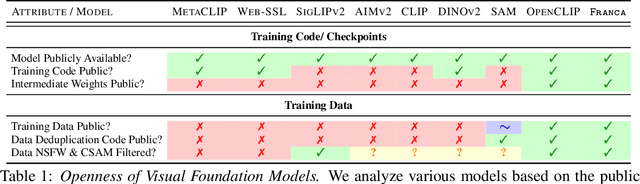
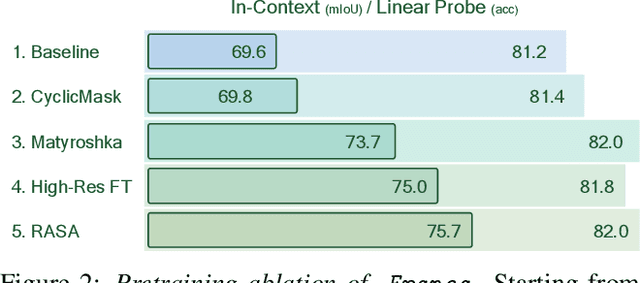
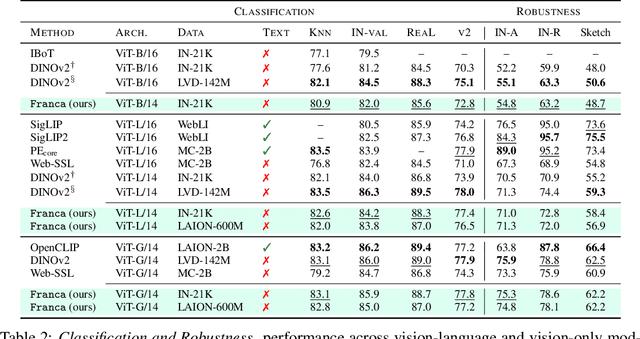
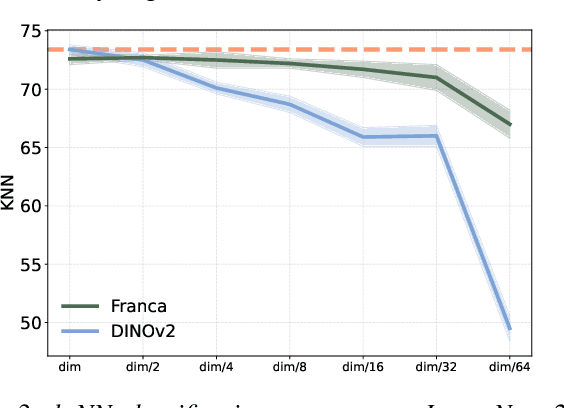
We present Franca (pronounced Fran-ka): free one; the first fully open-source (data, code, weights) vision foundation model that matches and in many cases surpasses the performance of state-of-the-art proprietary models, e.g., DINOv2, CLIP, SigLIPv2, etc. Our approach is grounded in a transparent training pipeline inspired by Web-SSL and uses publicly available data: ImageNet-21K and a subset of ReLAION-2B. Beyond model release, we tackle critical limitations in SSL clustering methods. While modern models rely on assigning image features to large codebooks via clustering algorithms like Sinkhorn-Knopp, they fail to account for the inherent ambiguity in clustering semantics. To address this, we introduce a parameter-efficient, multi-head clustering projector based on nested Matryoshka representations. This design progressively refines features into increasingly fine-grained clusters without increasing the model size, enabling both performance and memory efficiency. Additionally, we propose a novel positional disentanglement strategy that explicitly removes positional biases from dense representations, thereby improving the encoding of semantic content. This leads to consistent gains on several downstream benchmarks, demonstrating the utility of cleaner feature spaces. Our contributions establish a new standard for transparent, high-performance vision models and open a path toward more reproducible and generalizable foundation models for the broader AI community. The code and model checkpoints are available at https://github.com/valeoai/Franca.
Multi-Token Prediction Needs Registers
May 15, 2025Multi-token prediction has emerged as a promising objective for improving language model pretraining, but its benefits have not consistently generalized to other settings such as fine-tuning. In this paper, we propose MuToR, a simple and effective approach to multi-token prediction that interleaves learnable register tokens into the input sequence, each tasked with predicting future targets. Compared to existing methods, MuToR offers several key advantages: it introduces only a negligible number of additional parameters, requires no architectural changes--ensuring compatibility with off-the-shelf pretrained language models--and remains aligned with the next-token pretraining objective, making it especially well-suited for supervised fine-tuning. Moreover, it naturally supports scalable prediction horizons. We demonstrate the effectiveness and versatility of MuToR across a range of use cases, including supervised fine-tuning, parameter-efficient fine-tuning (PEFT), and pretraining, on challenging generative tasks in both language and vision domains. Our code will be available at: https://github.com/nasosger/MuToR.
Boosting Generative Image Modeling via Joint Image-Feature Synthesis
Apr 22, 2025Latent diffusion models (LDMs) dominate high-quality image generation, yet integrating representation learning with generative modeling remains a challenge. We introduce a novel generative image modeling framework that seamlessly bridges this gap by leveraging a diffusion model to jointly model low-level image latents (from a variational autoencoder) and high-level semantic features (from a pretrained self-supervised encoder like DINO). Our latent-semantic diffusion approach learns to generate coherent image-feature pairs from pure noise, significantly enhancing both generative quality and training efficiency, all while requiring only minimal modifications to standard Diffusion Transformer architectures. By eliminating the need for complex distillation objectives, our unified design simplifies training and unlocks a powerful new inference strategy: Representation Guidance, which leverages learned semantics to steer and refine image generation. Evaluated in both conditional and unconditional settings, our method delivers substantial improvements in image quality and training convergence speed, establishing a new direction for representation-aware generative modeling.
VaViM and VaVAM: Autonomous Driving through Video Generative Modeling
Feb 21, 2025We explore the potential of large-scale generative video models for autonomous driving, introducing an open-source auto-regressive video model (VaViM) and its companion video-action model (VaVAM) to investigate how video pre-training transfers to real-world driving. VaViM is a simple auto-regressive video model that predicts frames using spatio-temporal token sequences. We show that it captures the semantics and dynamics of driving scenes. VaVAM, the video-action model, leverages the learned representations of VaViM to generate driving trajectories through imitation learning. Together, the models form a complete perception-to-action pipeline. We evaluate our models in open- and closed-loop driving scenarios, revealing that video-based pre-training holds promise for autonomous driving. Key insights include the semantic richness of the learned representations, the benefits of scaling for video synthesis, and the complex relationship between model size, data, and safety metrics in closed-loop evaluations. We release code and model weights at https://github.com/valeoai/VideoActionModel
EQ-VAE: Equivariance Regularized Latent Space for Improved Generative Image Modeling
Feb 13, 2025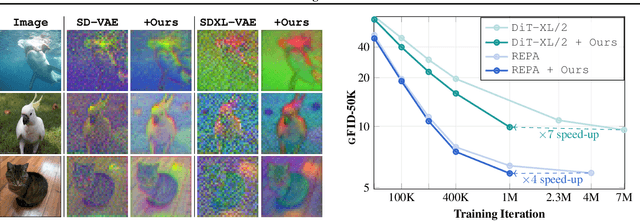
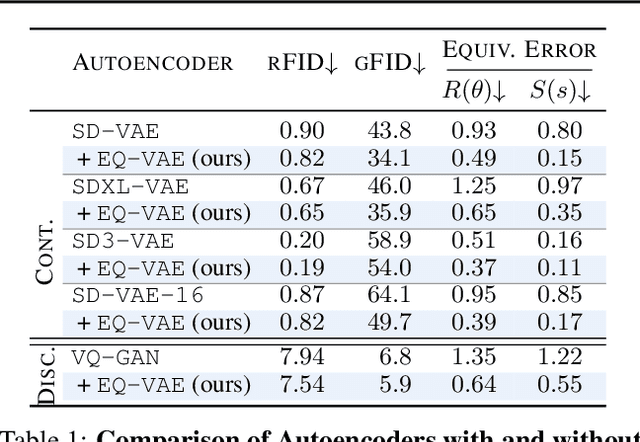
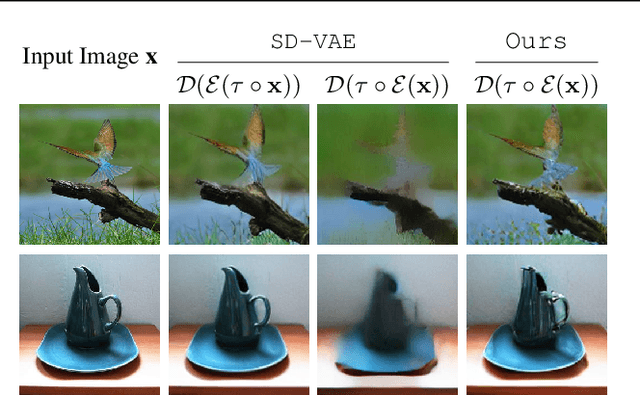
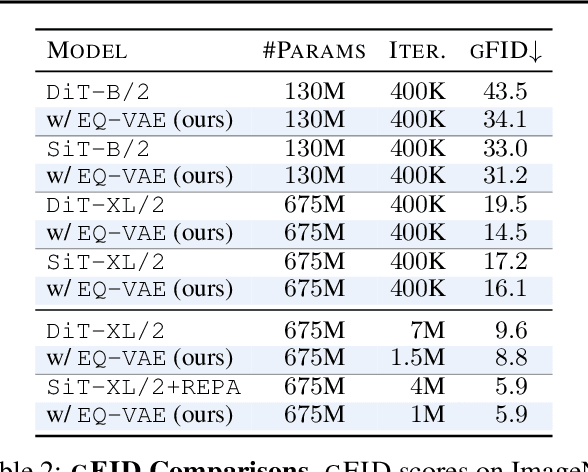
Latent generative models have emerged as a leading approach for high-quality image synthesis. These models rely on an autoencoder to compress images into a latent space, followed by a generative model to learn the latent distribution. We identify that existing autoencoders lack equivariance to semantic-preserving transformations like scaling and rotation, resulting in complex latent spaces that hinder generative performance. To address this, we propose EQ-VAE, a simple regularization approach that enforces equivariance in the latent space, reducing its complexity without degrading reconstruction quality. By finetuning pre-trained autoencoders with EQ-VAE, we enhance the performance of several state-of-the-art generative models, including DiT, SiT, REPA and MaskGIT, achieving a 7 speedup on DiT-XL/2 with only five epochs of SD-VAE fine-tuning. EQ-VAE is compatible with both continuous and discrete autoencoders, thus offering a versatile enhancement for a wide range of latent generative models. Project page and code: https://eq-vae.github.io/.