 Add to Chrome
 Add to Firefox
 Add to Edge
Boosting Visual Instruction Tuning with Self-Supervised Guidance
Apr 14, 2026
Multimodal large language models (MLLMs) perform well on many vision-language tasks but often struggle with vision-centric problems that require fine-grained visual reasoning. Recent evidence suggests that this limitation arises not from weak visual representations, but from under-utilization of visual information during instruction tuning, where many tasks can be partially solved using language priors alone. We propose a simple and lightweight approach that augments visual instruction tuning with a small number of visually grounded self-supervised tasks expressed as natural language instructions. By reformulating classical self-supervised pretext tasks, such as rotation prediction, color matching, and cross-view correspondence, as image-instruction-response triplets, we introduce supervision that cannot be solved without relying on visual evidence. Our approach requires no human annotations, no architectural modifications, and no additional training stages. Across multiple models, training regimes, and benchmarks, injecting only a small fraction (3-10%) of such visually grounded instructions consistently improves performance on vision-centric evaluations. Our findings highlight instruction tuning with visually grounded SSL tasks as a powerful lever for improving visual reasoning in MLLMs through simple adjustments to the training data distribution. Code available at: https://github.com/sirkosophia/V-GIFT

OccFeat: Self-supervised Occupancy Feature Prediction for Pretraining BEV Segmentation Networks
Apr 22, 2024


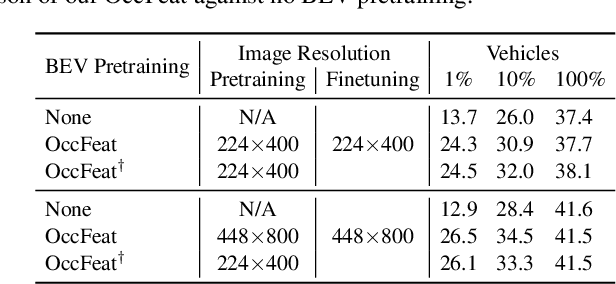
We introduce a self-supervised pretraining method, called OcFeat, for camera-only Bird's-Eye-View (BEV) segmentation networks. With OccFeat, we pretrain a BEV network via occupancy prediction and feature distillation tasks. Occupancy prediction provides a 3D geometric understanding of the scene to the model. However, the geometry learned is class-agnostic. Hence, we add semantic information to the model in the 3D space through distillation from a self-supervised pretrained image foundation model. Models pretrained with our method exhibit improved BEV semantic segmentation performance, particularly in low-data scenarios. Moreover, empirical results affirm the efficacy of integrating feature distillation with 3D occupancy prediction in our pretraining approach.