 Add to Chrome
 Add to Firefox
 Add to Edge
Understanding Electro-communication and Electro-sensing in Weakly Electric Fish using Multi-Agent Deep Reinforcement Learning
Nov 11, 2025

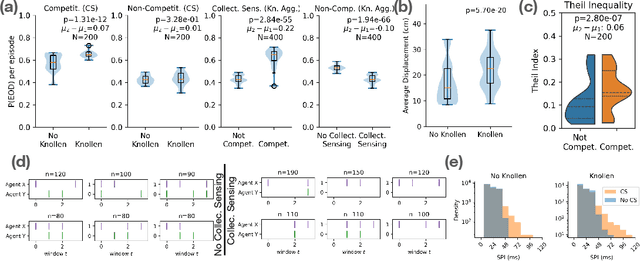
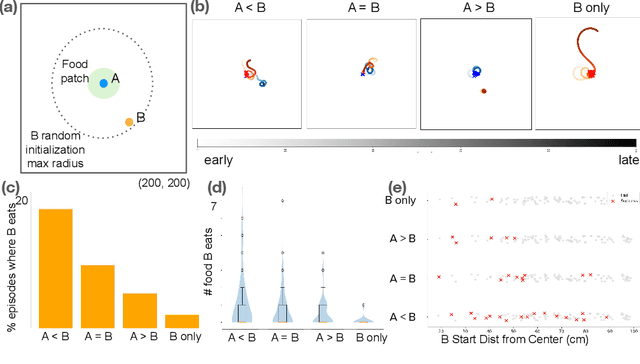
Weakly electric fish, like Gnathonemus petersii, use a remarkable electrical modality for active sensing and communication, but studying their rich electrosensing and electrocommunication behavior and associated neural activity in naturalistic settings remains experimentally challenging. Here, we present a novel biologically-inspired computational framework to study these behaviors, where recurrent neural network (RNN) based artificial agents trained via multi-agent reinforcement learning (MARL) learn to modulate their electric organ discharges (EODs) and movement patterns to collectively forage in virtual environments. Trained agents demonstrate several emergent features consistent with real fish collectives, including heavy tailed EOD interval distributions, environmental context dependent shifts in EOD interval distributions, and social interaction patterns like freeloading, where agents reduce their EOD rates while benefiting from neighboring agents' active sensing. A minimal two-fish assay further isolates the role of electro-communication, showing that access to conspecific EODs and relative dominance jointly shape foraging success. Notably, these behaviors emerge through evolution-inspired rewards for individual fitness and emergent inter-agent interactions, rather than through rewarding agents explicitly for social interactions. Our work has broad implications for the neuroethology of weakly electric fish, as well as other social, communicating animals in which extensive recordings from multiple individuals, and thus traditional data-driven modeling, are infeasible.

ForestNet: Classifying Drivers of Deforestation in Indonesia using Deep Learning on Satellite Imagery
Nov 11, 2020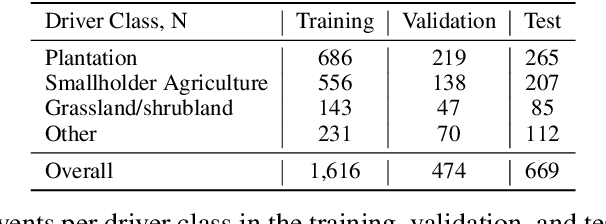
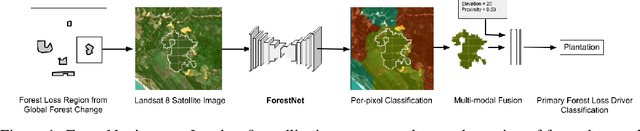
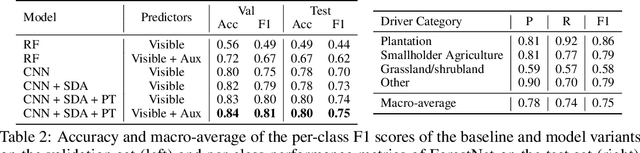
Characterizing the processes leading to deforestation is critical to the development and implementation of targeted forest conservation and management policies. In this work, we develop a deep learning model called ForestNet to classify the drivers of primary forest loss in Indonesia, a country with one of the highest deforestation rates in the world. Using satellite imagery, ForestNet identifies the direct drivers of deforestation in forest loss patches of any size. We curate a dataset of Landsat 8 satellite images of known forest loss events paired with driver annotations from expert interpreters. We use the dataset to train and validate the models and demonstrate that ForestNet substantially outperforms other standard driver classification approaches. In order to support future research on automated approaches to deforestation driver classification, the dataset curated in this study is publicly available at https://stanfordmlgroup.github.io/projects/forestnet .