 Add to Chrome
 Add to Firefox
 Add to Edge
Dynamic Load Model for Data Centers with Pattern-Consistent Calibration
Feb 08, 2026
The rapid growth of data centers has made large electronic load (LEL) modeling increasingly important for power system analysis. Such loads are characterized by fast workload-driven variability and protection-driven disconnection and reconnection behavior that are not captured by conventional load models. Existing data center load modeling includes physics-based approaches, which provide interpretable structure for grid simulation, and data-driven approaches, which capture empirical workload variability from data. However, physics-based models are typically uncalibrated to facility-level operation, while trajectory alignment in data-driven methods often leads to overfitting and unrealistic dynamic behavior. To resolve these limitations, we design the framework to leverage both physics-based structure and data-driven adaptability. The physics-based structure is parameterized to enable data-driven pattern-consistent calibration from real operational data, supporting facility-level grid planning. We further show that trajectory-level alignment is limited for inherently stochastic data center loads. Therefore, we design the calibration to align temporal and statistical patterns using temporal contrastive learning (TCL). This calibration is performed locally at the facility, and only calibrated parameters are shared with utilities, preserving data privacy. The proposed load model is calibrated by real-world operational load data from the MIT Supercloud, ASU Sol, Blue Waters, and ASHRAE datasets. Then it is integrated into the ANDES platform and evaluated on the IEEE 39-bus, NPCC 140-bus, and WECC 179-bus systems. We find that interactions among LELs can fundamentally alter post-disturbance recovery behavior, producing compound disconnection-reconnection dynamics and delayed stabilization that are not captured by uncalibrated load models.

Deep Multi-View Spatial-Temporal Network for Taxi Demand Prediction
Feb 27, 2018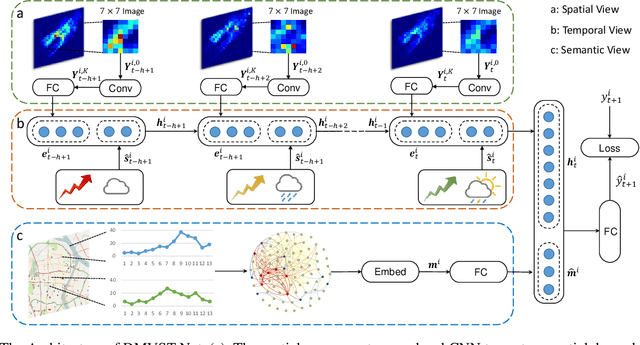
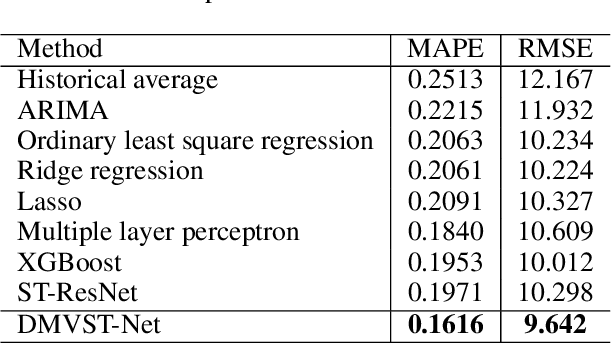
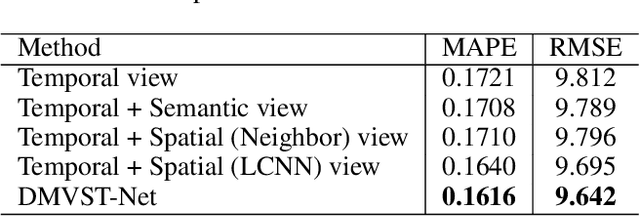
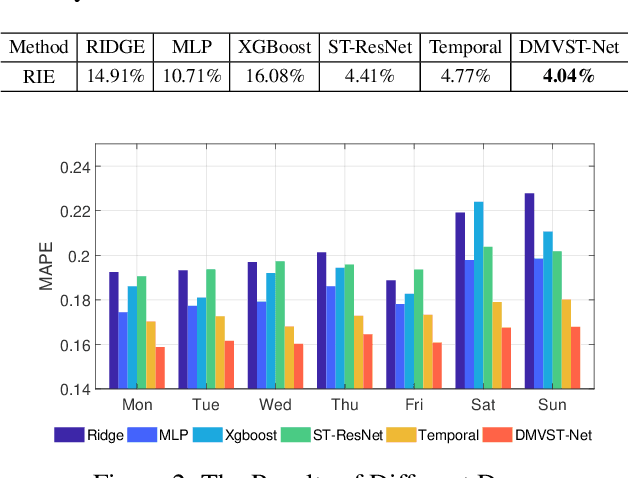
Taxi demand prediction is an important building block to enabling intelligent transportation systems in a smart city. An accurate prediction model can help the city pre-allocate resources to meet travel demand and to reduce empty taxis on streets which waste energy and worsen the traffic congestion. With the increasing popularity of taxi requesting services such as Uber and Didi Chuxing (in China), we are able to collect large-scale taxi demand data continuously. How to utilize such big data to improve the demand prediction is an interesting and critical real-world problem. Traditional demand prediction methods mostly rely on time series forecasting techniques, which fail to model the complex non-linear spatial and temporal relations. Recent advances in deep learning have shown superior performance on traditionally challenging tasks such as image classification by learning the complex features and correlations from large-scale data. This breakthrough has inspired researchers to explore deep learning techniques on traffic prediction problems. However, existing methods on traffic prediction have only considered spatial relation (e.g., using CNN) or temporal relation (e.g., using LSTM) independently. We propose a Deep Multi-View Spatial-Temporal Network (DMVST-Net) framework to model both spatial and temporal relations. Specifically, our proposed model consists of three views: temporal view (modeling correlations between future demand values with near time points via LSTM), spatial view (modeling local spatial correlation via local CNN), and semantic view (modeling correlations among regions sharing similar temporal patterns). Experiments on large-scale real taxi demand data demonstrate effectiveness of our approach over state-of-the-art methods.