 Add to Chrome
 Add to Firefox
 Add to Edge
WisdomInterrogatory (LuWen): An Open-Source Legal Large Language Model Technical Report
Apr 10, 2026
Large language models have demonstrated remarkable capabilities across a wide range of natural language processing tasks, yet their application in the legal domain remains challenging due to the specialized terminology, complex reasoning requirements, and rapidly evolving legal knowledge involved. In this paper, we present WisdomInterrogatory (LuWen), an open-source Chinese legal language model built upon the Baichuan foundation model through three key techniques: continual pre-training on a large-scale legal corpus, supervised fine-tuning with carefully curated legal instruction data, and retrieval-augmented generation integrated with a comprehensive legal knowledge base. We evaluate LuWen on five representative legal tasks spanning both prediction and generation settings, including legal judgment prediction, judicial examination, legal text summarization, law article question answering, and judicial decision reasoning. Experimental results show that LuWen outperforms several strong baselines, demonstrating the effectiveness of our approach in adapting general-purpose language models to the legal domain.

Luwen Technical Report
Apr 08, 2026Large language models have demonstrated remarkable capabilities across a wide range of natural language processing tasks, yet their application in the legal domain remains challenging due to the specialized terminology, complex reasoning requirements, and rapidly evolving legal knowledge involved. In this paper, we present Luwen, an open-source Chinese legal language model built upon the Baichuan foundation model through three key techniques: continual pre-training on a large-scale legal corpus, supervised fine-tuning with carefully curated legal instruction data, and retrieval-augmented generation integrated with a comprehensive legal knowledge base. We evaluate Luwen on five representative legal tasks spanning both prediction and generation settings, including legal judgment prediction, judicial examination, legal text summarization, law article question answering, and judicial decision reasoning. Experimental results show that Luwen outperforms several strong baselines, demonstrating the effectiveness of our approach in adapting general-purpose language models to the legal domain.
ClaimGen-CN: A Large-scale Chinese Dataset for Legal Claim Generation
Aug 24, 2025Legal claims refer to the plaintiff's demands in a case and are essential to guiding judicial reasoning and case resolution. While many works have focused on improving the efficiency of legal professionals, the research on helping non-professionals (e.g., plaintiffs) remains unexplored. This paper explores the problem of legal claim generation based on the given case's facts. First, we construct ClaimGen-CN, the first dataset for Chinese legal claim generation task, from various real-world legal disputes. Additionally, we design an evaluation metric tailored for assessing the generated claims, which encompasses two essential dimensions: factuality and clarity. Building on this, we conduct a comprehensive zero-shot evaluation of state-of-the-art general and legal-domain large language models. Our findings highlight the limitations of the current models in factual precision and expressive clarity, pointing to the need for more targeted development in this domain. To encourage further exploration of this important task, we will make the dataset publicly available.
Precedent-Enhanced Legal Judgment Prediction with LLM and Domain-Model Collaboration
Oct 13, 2023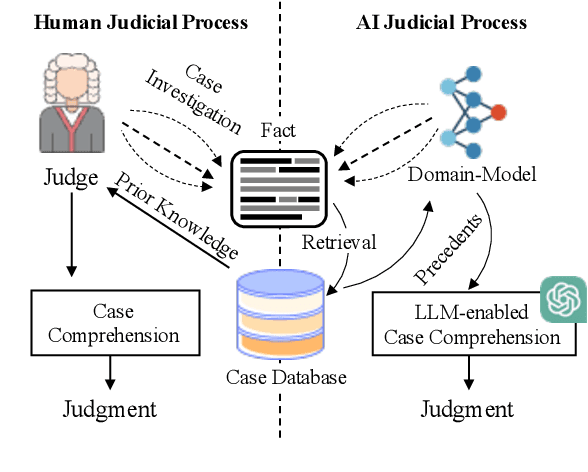
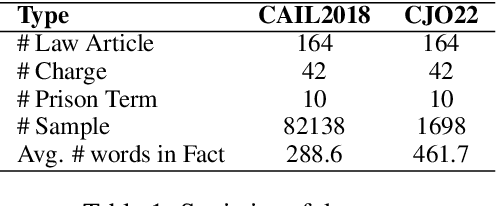
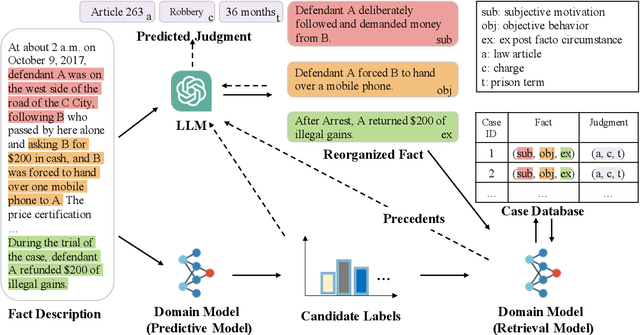
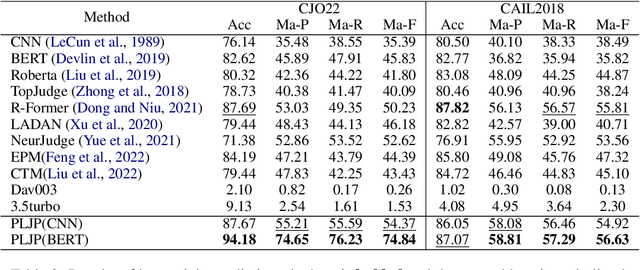
Legal Judgment Prediction (LJP) has become an increasingly crucial task in Legal AI, i.e., predicting the judgment of the case in terms of case fact description. Precedents are the previous legal cases with similar facts, which are the basis for the judgment of the subsequent case in national legal systems. Thus, it is worthwhile to explore the utilization of precedents in the LJP. Recent advances in deep learning have enabled a variety of techniques to be used to solve the LJP task. These can be broken down into two categories: large language models (LLMs) and domain-specific models. LLMs are capable of interpreting and generating complex natural language, while domain models are efficient in learning task-specific information. In this paper, we propose the precedent-enhanced LJP framework (PLJP), a system that leverages the strength of both LLM and domain models in the context of precedents. Specifically, the domain models are designed to provide candidate labels and find the proper precedents efficiently, and the large models will make the final prediction with an in-context precedents comprehension. Experiments on the real-world dataset demonstrate the effectiveness of our PLJP. Moreover, our work shows a promising direction for LLM and domain-model collaboration that can be generalized to other vertical domains.