 Add to Chrome
 Add to Firefox
 Add to Edge
MemTools: A Unified Research Framework for Interoperable Agent Memory
Jul 23, 2026
While memory systems are essential for agent architectures, pervasive architectural fragmentation restricts systematic research. Existing implementations typically couple different stages of the memory lifecycle, entangle evaluation logic with specific datasets, and provide limited support for the management of heterogeneous memory types. We introduce MemTools, an interoperability research framework that decouples memory system components from their underlying deployment environments. MemTools standardizes the memory lifecycle through declarative data contracts, enabling the interchangeable assembly of components across different systems. It orthogonally separates benchmark datasets from execution protocols to facilitate controlled assessments. Furthermore, MemTools provides a unified computational interface for coordinating symbolic, neural, and multimodal memory representations within a shared runtime. Empirical evaluations on cross-system component integration, evaluation protocol reconfiguration, and heterogeneous memory coordination demonstrate that MemTools enables systematic isolation and analysis of memory design variables. These findings suggest that MemTools provides a practical and extensible infrastructure for advancing principled research on agent memory.

STAGE-Claw: Automated State-based Agent Benchmarking for Realistic Scenarios
Jun 09, 2026Large language models are increasingly used to power personal agents for everyday applications, but evaluating these agents remains a challenge. Existing benchmarks still rely on sandboxed artifacts, static task design, and coarse scoring, which hinder scalability and limit progress toward reliable personal-agent evaluation. This paper introduces STAGE-Claw, an automated framework for building and evaluating realistic personal-agent scenarios in state-based personal-computing environments. Given a task hint, STAGE-Claw automatically creates and validates a realistic benchmark task with its environment, task prompts, ground truth, and related verification programs. Agents are then evaluated in realistic operating environments, where performance is measured by the correctness of the final system state rather than only the textual response. Using STAGE-Claw, this paper creates a benchmark with 40 challenging real scenario agent tasks, evaluates 11 frontier models, and analyzes their task scores, costs, tool-call reliability, and common failure patterns. Overall, STAGE-Claw offers a scalable, state-based way to evaluate agents in realistic user scenarios.
Learning How to Remember: A Meta-Cognitive Management Method for Structured and Transferable Agent Memory
Jan 12, 2026Large language model (LLM) agents increasingly rely on accumulated memory to solve long-horizon decision-making tasks. However, most existing approaches store memory in fixed representations and reuse it at a single or implicit level of abstraction, which limits generalization and often leads to negative transfer when distribution shift. This paper proposes the Meta-Cognitive Memory Abstraction method (MCMA), which treats memory abstraction as a learnable cognitive skill rather than a fixed design choice. MCMA decouples task execution from memory management by combining a frozen task model with a learned memory copilot. The memory copilot is trained using direct preference optimization, it determines how memories should be structured, abstracted, and reused. Memories are further organized into a hierarchy of abstraction levels, enabling selective reuse based on task similarity. When no memory is transferable, MCMA transfers the ability to abstract and manage memory by transferring the memory copilot. Experiments on ALFWorld, ScienceWorld, and BabyAI demonstrate substantial improvements in performance, out-of-distribution generalization, and cross-task transfer over several baselines.
Bias-Restrained Prefix Representation Finetuning for Mathematical Reasoning
Nov 13, 2025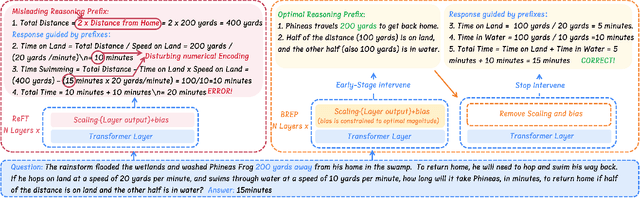
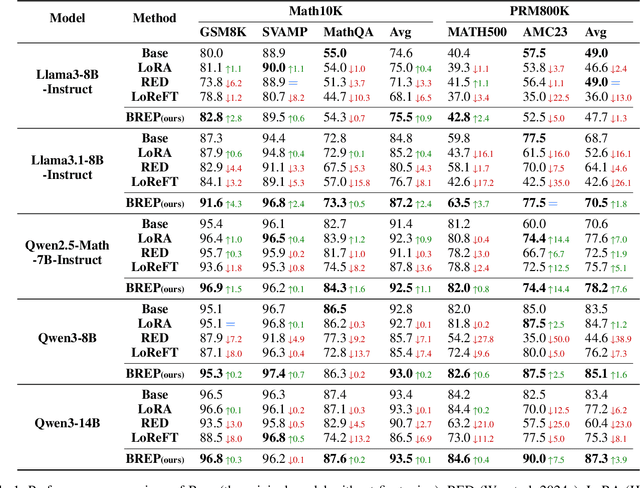
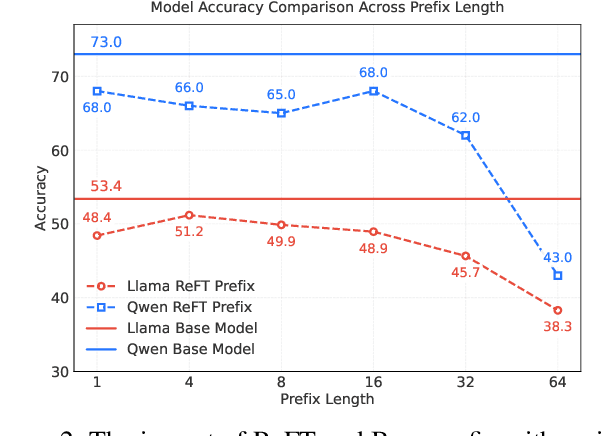
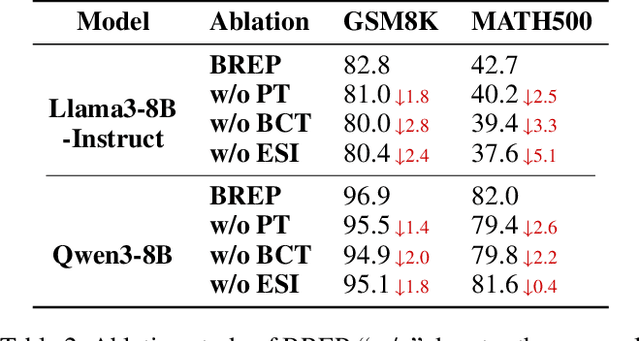
Parameter-Efficient finetuning (PEFT) enhances model performance on downstream tasks by updating a minimal subset of parameters. Representation finetuning (ReFT) methods further improve efficiency by freezing model weights and optimizing internal representations with fewer parameters than PEFT, outperforming PEFT on several tasks. However, ReFT exhibits a significant performance decline on mathematical reasoning tasks. To address this problem, the paper demonstrates that ReFT's poor performance on mathematical tasks primarily stems from its struggle to generate effective reasoning prefixes during the early inference phase. Moreover, ReFT disturbs the numerical encoding and the error accumulats during the CoT stage. Based on these observations, this paper proposes Bias-REstrained Prefix Representation FineTuning (BREP ReFT), which enhances ReFT's mathematical reasoning capability by truncating training data to optimize the generation of initial reasoning prefixes, intervening on the early inference stage to prevent error accumulation, and constraining the intervention vectors' magnitude to avoid disturbing numerical encoding. Extensive experiments across diverse model architectures demonstrate BREP's superior effectiveness, efficiency, and robust generalization capability, outperforming both standard ReFT and weight-based PEFT methods on the task of mathematical reasoning. The source code is available at https://github.com/LiangThree/BREP.
MechRetro is a chemical-mechanism-driven graph learning framework for interpretable retrosynthesis prediction and pathway planning
Oct 06, 2022
Leveraging artificial intelligence for automatic retrosynthesis speeds up organic pathway planning in digital laboratories. However, existing deep learning approaches are unexplainable, like "black box" with few insights, notably limiting their applications in real retrosynthesis scenarios. Here, we propose MechRetro, a chemical-mechanism-driven graph learning framework for interpretable retrosynthetic prediction and pathway planning, which learns several retrosynthetic actions to simulate a reverse reaction via elaborate self-adaptive joint learning. By integrating chemical knowledge as prior information, we design a novel Graph Transformer architecture to adaptively learn discriminative and chemically meaningful molecule representations, highlighting the strong capacity in molecule feature representation learning. We demonstrate that MechRetro outperforms the state-of-the-art approaches for retrosynthetic prediction with a large margin on large-scale benchmark datasets. Extending MechRetro to the multi-step retrosynthesis analysis, we identify efficient synthetic routes via an interpretable reasoning mechanism, leading to a better understanding in the realm of knowledgeable synthetic chemists. We also showcase that MechRetro discovers a novel pathway for protokylol, along with energy scores for uncertainty assessment, broadening the applicability for practical scenarios. Overall, we expect MechRetro to provide meaningful insights for high-throughput automated organic synthesis in drug discovery.