 Add to Chrome
 Add to Firefox
 Add to Edge
Intelligent Sky Mirrors: SAC-Driven MF-RIS Optimization for Secure NOMA in Low-Altitude Economy
Dec 22, 2025
Low-altitude economy (LAE) has become a key driving force for smart cities and economic growth. To address spectral efficiency and communication security challenges in LAE, this paper investigates secure energy efficiency (SEE) maximization using intelligent sky mirrors, UAV-mounted multifunctional reconfigurable intelligent surfaces (MF-RIS) assisting nonorthogonal multiple access (NOMA) systems. These aerial mirrors intelligently amplify legitimate signals while simultaneously generating jamming against eavesdroppers. We formulate a joint optimization problem encompassing UAV trajectory, base station power allocation, RIS phase shifts, amplification factors, and scheduling matrices. Given the fractional SEE objective and dynamic UAV scenarios, we propose a two-layer optimization scheme: SAC-driven first layer for trajectory and power management, and channel alignment-based second layer for phase optimization. Simulations demonstrate that our proposed scheme significantly outperforms benchmark approaches.

Towards Intelligent Antenna Positioning: Leveraging DRL for FAS-Aided ISAC Systems
Jan 02, 2025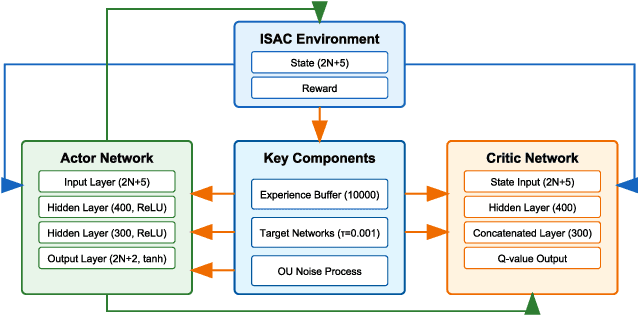
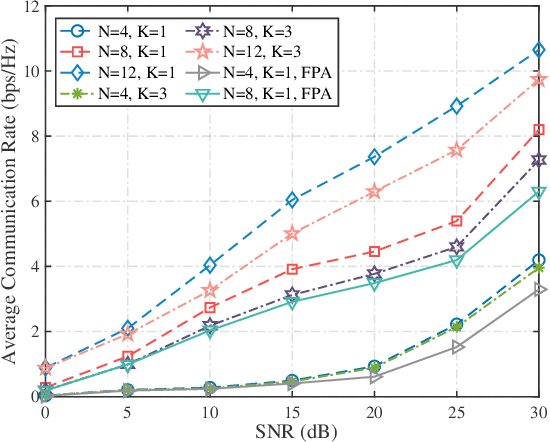
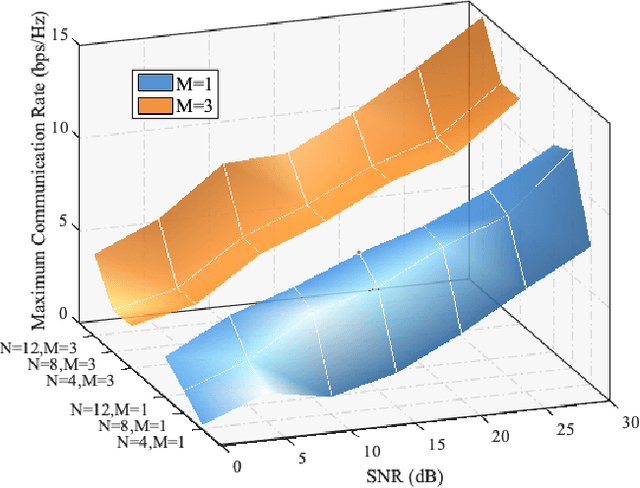
Fluid antenna systems (FAS) enable dynamic antenna positioning, offering new opportunities to enhance integrated sensing and communication (ISAC) performance. However, existing studies primarily focus on communication enhancement or single-target sensing, leaving multi-target scenarios underexplored. Additionally, the joint optimization of beamforming and antenna positions poses a highly non-convex problem, with traditional methods becoming impractical as the number of fluid antennas increases. To address these challenges, this letter proposes a block coordinate descent (BCD) framework integrated with a deep reinforcement learning (DRL)-based approach for intelligent antenna positioning. By leveraging the deep deterministic policy gradient (DDPG) algorithm, the proposed framework efficiently balances sensing and communication performance. Simulation results demonstrate the scalability and effectiveness of the proposed approach.