 Add to Chrome
 Add to Firefox
 Add to Edge
Intelligent Sky Mirrors: SAC-Driven MF-RIS Optimization for Secure NOMA in Low-Altitude Economy
Dec 22, 2025
Low-altitude economy (LAE) has become a key driving force for smart cities and economic growth. To address spectral efficiency and communication security challenges in LAE, this paper investigates secure energy efficiency (SEE) maximization using intelligent sky mirrors, UAV-mounted multifunctional reconfigurable intelligent surfaces (MF-RIS) assisting nonorthogonal multiple access (NOMA) systems. These aerial mirrors intelligently amplify legitimate signals while simultaneously generating jamming against eavesdroppers. We formulate a joint optimization problem encompassing UAV trajectory, base station power allocation, RIS phase shifts, amplification factors, and scheduling matrices. Given the fractional SEE objective and dynamic UAV scenarios, we propose a two-layer optimization scheme: SAC-driven first layer for trajectory and power management, and channel alignment-based second layer for phase optimization. Simulations demonstrate that our proposed scheme significantly outperforms benchmark approaches.

Hetero-Center Loss for Cross-Modality Person Re-Identification
Oct 22, 2019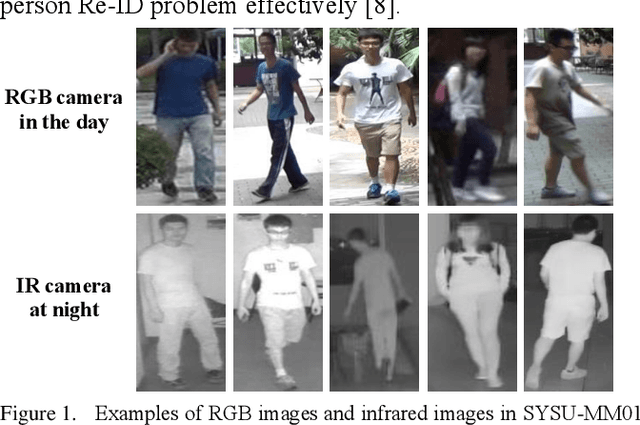
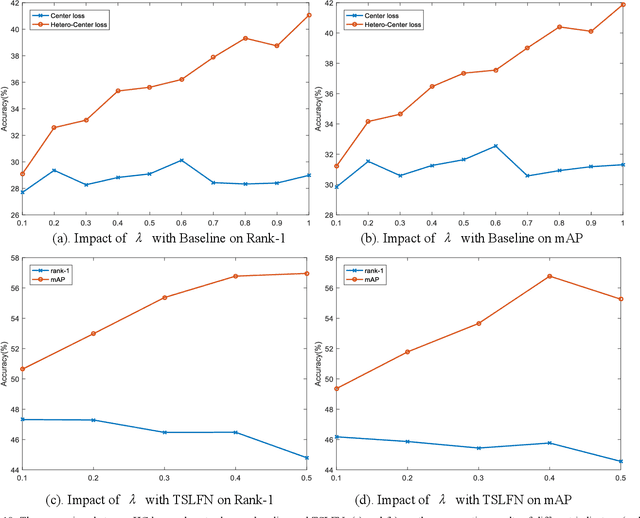
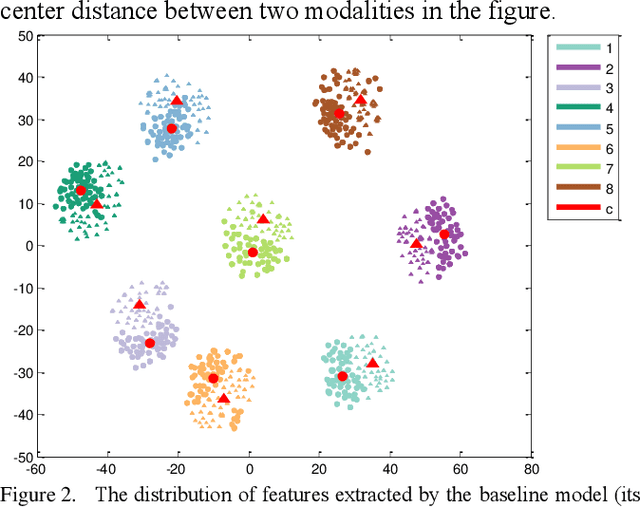
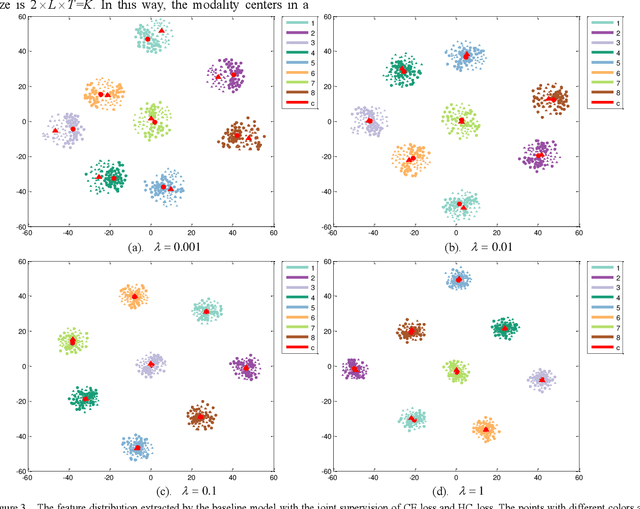
Cross-modality person re-identification is a challenging problem which retrieves a given pedestrian image in RGB modality among all the gallery images in infrared modality. The task can address the limitation of RGB-based person Re-ID in dark environments. Existing researches mainly focus on enlarging inter-class differences of feature to solve the problem. However, few studies investigate improving intra-class cross-modality similarity, which is important for this issue. In this paper, we propose a novel loss function, called Hetero-Center loss (HC loss) to reduce the intra-class cross-modality variations. Specifically, HC loss can supervise the network learning the cross-modality invariant information by constraining the intra-class center distance between two heterogenous modalities. With the joint supervision of Cross-Entropy (CE) loss and HC loss, the network is trained to achieve two vital objectives, inter-class discrepancy and intra-class cross-modality similarity as much as possible. Besides, we propose a simple and high-performance network architecture to learn local feature representations for cross-modality person re-identification, which can be a baseline for future research. Extensive experiments indicate the effectiveness of the proposed methods, which outperform state-of-the-art methods by a wide margin.