 Add to Chrome
 Add to Firefox
 Add to Edge
SkillMAS: Skill Co-Evolution with LLM-based Multi-Agent System
May 10, 2026
Large language model (LLM) agent systems are increasingly expected to improve after deployment, but existing work often decouples two adaptation targets: skill evolution and multi-agent system (MAS) restructuring. This separation can create organization bottlenecks, context pressure, and mis-specialization. We present SkillMAS, a non-parametric framework for adaptive specialization in multi-agent systems that couples skill evolution with MAS restructuring. SkillMAS uses Utility Learning to assign credit from verified execution traces, bounded skill evolution to refine reusable procedures without unfiltered library growth, and evidence-gated MAS restructuring when retained failures and Executor Utility indicate a structural mismatch. Across embodied manipulation, command-line execution, and retail workflows, SkillMAS is competitive under the reported harnesses while clarifying how post-deployment specialization is attributed, updated, and applied.

E2E-AFG: An End-to-End Model with Adaptive Filtering for Retrieval-Augmented Generation
Nov 01, 2024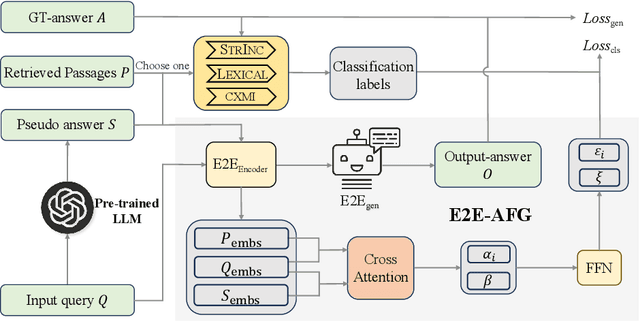
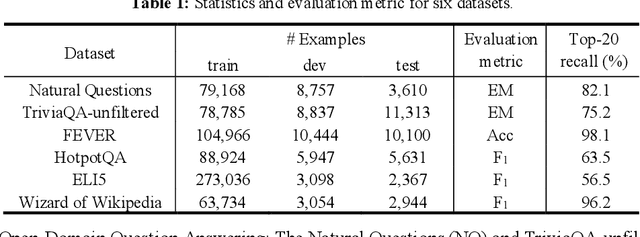
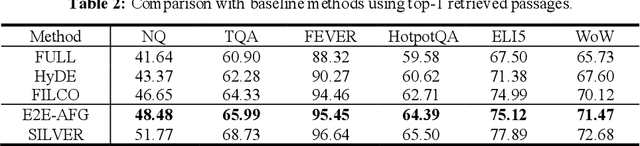
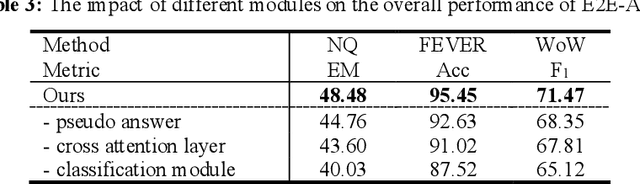
Retrieval-augmented generation methods often neglect the quality of content retrieved from external knowledge bases, resulting in irrelevant information or potential misinformation that negatively affects the generation results of large language models. In this paper, we propose an end-to-end model with adaptive filtering for retrieval-augmented generation (E2E-AFG), which integrates answer existence judgment and text generation into a single end-to-end framework. This enables the model to focus more effectively on relevant content while reducing the influence of irrelevant information and generating accurate answers. We evaluate E2E-AFG on six representative knowledge-intensive language datasets, and the results show that it consistently outperforms baseline models across all tasks, demonstrating the effectiveness and robustness of the proposed approach.