 Add to Chrome
 Add to Firefox
 Add to Edge
LoViF 2026 Challenge on Human-oriented Semantic Image Quality Assessment: Methods and Results
Apr 13, 2026
This paper reviews the LoViF 2026 Challenge on Human-oriented Semantic Image Quality Assessment. This challenge aims to raise a new direction, i.e., how to evaluate the loss of semantic information from the human perspective, intending to promote the development of some new directions, like semantic coding, processing, and semantic-oriented optimization, etc. Unlike existing datasets of quality assessment, we form a dataset of human-oriented semantic quality assessment, termed the SeIQA dataset. This dataset is divided into three parts for this competition: (i) training data: 510 pairs of degraded images and their corresponding ground truth references; (ii) validation data: 80 pairs of degraded images and their corresponding ground-truth references; (iii) testing data: 160 pairs of degraded images and their corresponding ground-truth references. The primary objective of this challenge is to establish a new and powerful benchmark for human-oriented semantic image quality assessment. There are a total of 58 teams registered in this competition, and 6 teams submitted valid solutions and fact sheets for the final testing phase. These submissions achieved state-of-the-art (SOTA) performance on the SeIQA dataset.

Vision-Language Modeling with Regularized Spatial Transformer Networks for All Weather Crosswind Landing of Aircraft
May 09, 2024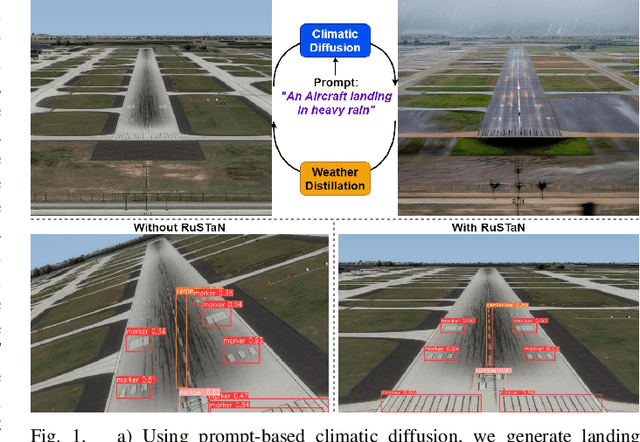
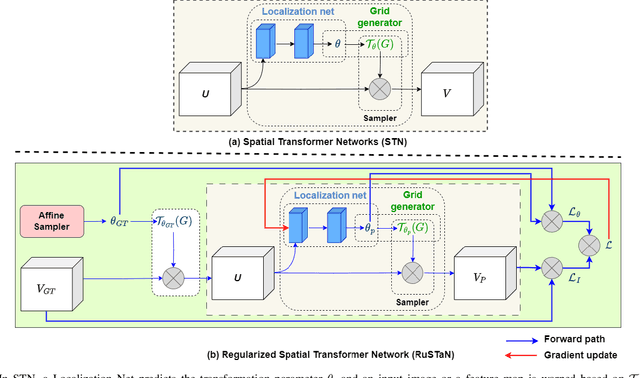
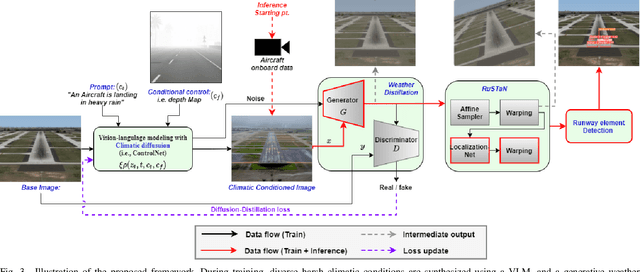
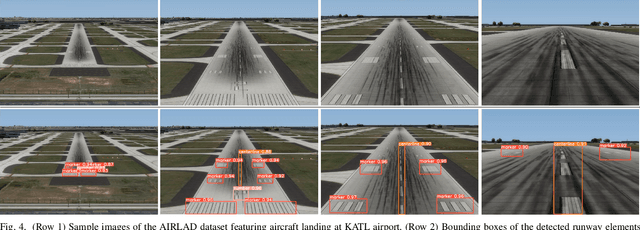
The intrinsic capability to perceive depth of field and extract salient information by the Human Vision System (HVS) stimulates a pilot to perform manual landing over an autoland approach. However, harsh weather creates visibility hindrances, and a pilot must have a clear view of runway elements before the minimum decision altitude. To help a pilot in manual landing, a vision-based system tailored to localize runway elements likewise gets affected, especially during crosswind due to the projective distortion of aircraft camera images. To combat this, we propose to integrate a prompt-based climatic diffusion network with a weather distillation model using a novel diffusion-distillation loss. Precisely, the diffusion model synthesizes climatic-conditioned landing images, and the weather distillation model learns inverse mapping by clearing those visual degradations. Then, to tackle the crosswind landing scenario, a novel Regularized Spatial Transformer Networks (RuSTaN) learns to accurately calibrate for projective distortion using self-supervised learning, which minimizes localization error by the downstream runway object detector. Finally, we have simulated a clear-day landing scenario at the busiest airport globally to curate an image-based Aircraft Landing Dataset (AIRLAD) and experimentally validated our contributions using this dataset to benchmark the performance.