 Add to Chrome
 Add to Firefox
 Add to Edge
SAM+D: Parameter-Efficient Dimensional Lifting of SAM-Family Models via Depth-Routed LoRA and Depth Shifting
Jul 31, 2026
Existing methods for adapting 2D foundation models such as SAM to 3D volumes either process slices independently---ignoring inter-slice context---or require substantial architectural changes and retraining. In this paper, we present \textbf{SAM+D}, a parameter-efficient framework that lifts SAM-family models by one spatial dimension---enabling 3D volumetric segmentation from 2D SAM and, for the first time via parameter-efficient fine-tuning, end-to-end 4D (3D+T) spatiotemporal segmentation from video-based SAM2---while keeping the vast majority of pre-trained parameters frozen. SAM+D introduces two lightweight, model-agnostic modules into frozen transformer blocks: (1)~\textbf{Depth-Routed LoRA (DRLoRA)} experts with learned routing for spatially adaptive low-rank updates, and (2)~\textbf{Depth Shift Modules (DSM)} for cross-slice feature exchange at zero additional parameter cost. Together, they provide volume-level context while tuning only ${\sim}$2.8\% of parameters for SAM and ${\sim}$3.7\% for SAM2. We evaluate SAM+D in two distinct settings, each lifting the base model by one spatial dimension: 3D segmentation, where SAM(2D$\,\to\,$3D) is evaluated on four CT benchmarks (KiTS, Pancreas, LiTS, Colon), and 4D segmentation, where SAM2 (2D+T$\,\to\,$3D+T) is evaluated on a cell tracking challenge (CTC) dataset (Fluo-N3DH-SIM+). In both settings SAM+D achieves competitive or superior results under the single-point prompt setting while using fewer trainable parameters than existing methods, demonstrating that SAM+D generalizes across SAM-family architectures, target dimensionalities (3D, 4D), and domains spanning medical imaging and bio-scene understanding. Code is publicly available at https://github.com/JerrySongCST/SAM-Plus-D.

DynaBridge: Dynamic Summary-Guided Cross-Task Multimodal Fusion for DASS-Structured Mental Health Assessment
Jul 28, 2026Multimodal behavioral analysis offers a scalable approach to assessing depression, anxiety, and stress, yet generic fusion models often ignore the psychometric structure of questionnaire labels. In DASS-21, risk labels are derived from ordered symptom items through fixed item-to-subscale mappings. We propose \textbf{DynaBridge}, a dynamic summary-guided cross-task multimodal framework for DASS-structured mental health assessment. DynaBridge encodes acoustic, visual, and textual cues across multiple sessions and augments them with frozen-LLM-generated DASS-aware summaries as participant-level semantic evidence. It predicts ordinal item distributions, reconstructs depression, anxiety, and stress risk evidence from item-level soft scores, and fuses this evidence with direct multimodal risk predictions. A confidence-aware refinement strategy further incorporates high-confidence semantic cues conservatively. On the official AdoDAS validation split, DynaBridge outperforms the official baseline and representative multimodal methods, achieving 0.5012 mean F1 for D/A/S risk prediction and 0.3216 mean QWK for DASS-21 item prediction. These results show the value of bridging multimodal cues, semantic summaries, and DASS-21 psychometric structure.
MIRTH: Mutual-Information Reasoning with Temporal Hubs for Vision-Language-Action Agents
Jun 30, 2026VLA models have emerged as a powerful paradigm for transferring semantic knowledge from web-scale data to physical robotic control. However, current single-frame architectures suffer from intrinsic limitations: temporal myopia that discards historical dynamics, reasoning gaps between high-level instructions and low-level motor commands, and inference inefficiency due to autoregressive scalar decoding. In this work, we propose MIRTH, a unified framework designed to address these challenges. MIRTH augments a pretrained VLA backbone with three key innovations: (1) dual-scale temporal memory hubs that compress long-term scene evolution and short-term motion trends into compact embeddings; (2) latent reasoning tokens optimized via a mutual-information objective carving out a semantic plan space to align multimodal context with action trajectories; and (3) a parallel action decoding scheme that replaces autoregressive generation with vector-wise prediction to maximize control throughput. Extensive evaluations on the LIBERO simulation benchmark and a real-world LeRobot platform demonstrate that MIRTH achieves state-of-the-art performance and exhibiting emergent error recovery capabilities. The codes and collected datasets are released at http://github.com/kiva12138/mirth.
Dynamic Summary Generation for Interpretable Multimodal Depression Detection
Apr 13, 2026Depression remains widely underdiagnosed and undertreated because stigma and subjective symptom ratings hinder reliable screening. To address this challenge, we propose a coarse-to-fine, multi-stage framework that leverages large language models (LLMs) for accurate and interpretable detection. The pipeline performs binary screening, five-class severity classification, and continuous regression. At each stage, an LLM produces progressively richer clinical summaries that guide a multimodal fusion module integrating text, audio, and video features, yielding predictions with transparent rationale. The system then consolidates all summaries into a concise, human-readable assessment report. Experiments on the E-DAIC and CMDC datasets show significant improvements over state-of-the-art baselines in both accuracy and interpretability.
A Text-Image Fusion Method with Data Augmentation Capabilities for Referring Medical Image Segmentation
Oct 14, 2025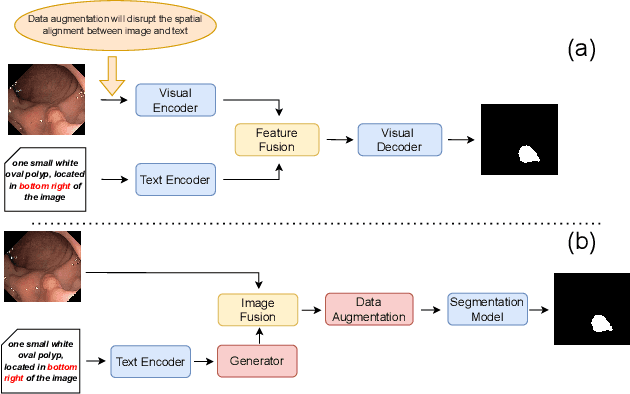
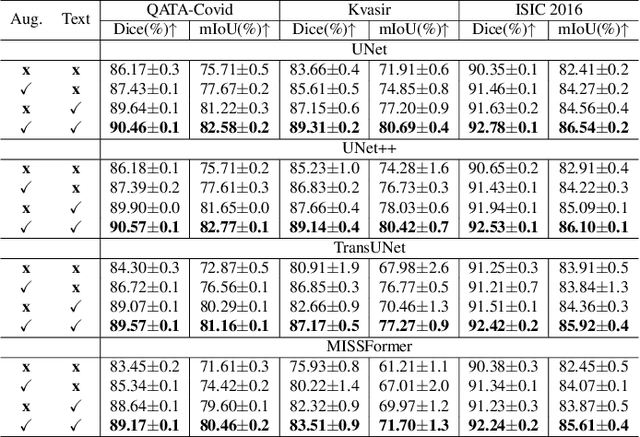
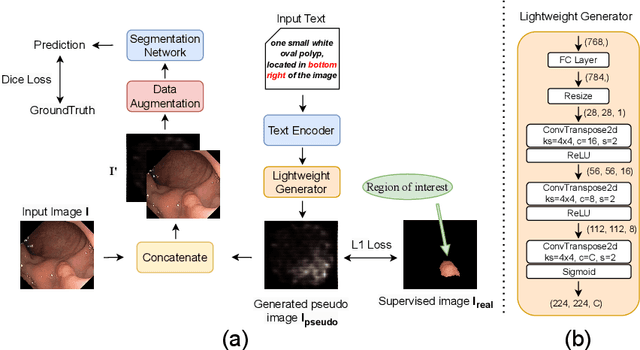

Deep learning relies heavily on data augmentation to mitigate limited data, especially in medical imaging. Recent multimodal learning integrates text and images for segmentation, known as referring or text-guided image segmentation. However, common augmentations like rotation and flipping disrupt spatial alignment between image and text, weakening performance. To address this, we propose an early fusion framework that combines text and visual features before augmentation, preserving spatial consistency. We also design a lightweight generator that projects text embeddings into visual space, bridging semantic gaps. Visualization of generated pseudo-images shows accurate region localization. Our method is evaluated on three medical imaging tasks and four segmentation frameworks, achieving state-of-the-art results. Code is publicly available on GitHub: https://github.com/11yxk/MedSeg_EarlyFusion.
Enhancing Depression Detection with Chain-of-Thought Prompting: From Emotion to Reasoning Using Large Language Models
Feb 09, 2025Depression is one of the leading causes of disability worldwide, posing a severe burden on individuals, healthcare systems, and society at large. Recent advancements in Large Language Models (LLMs) have shown promise in addressing mental health challenges, including the detection of depression through text-based analysis. However, current LLM-based methods often struggle with nuanced symptom identification and lack a transparent, step-by-step reasoning process, making it difficult to accurately classify and explain mental health conditions. To address these challenges, we propose a Chain-of-Thought Prompting approach that enhances both the performance and interpretability of LLM-based depression detection. Our method breaks down the detection process into four stages: (1) sentiment analysis, (2) binary depression classification, (3) identification of underlying causes, and (4) assessment of severity. By guiding the model through these structured reasoning steps, we improve interpretability and reduce the risk of overlooking subtle clinical indicators. We validate our method on the E-DAIC dataset, where we test multiple state-of-the-art large language models. Experimental results indicate that our Chain-of-Thought Prompting technique yields superior performance in both classification accuracy and the granularity of diagnostic insights, compared to baseline approaches.
Ladder Fine-tuning approach for SAM integrating complementary network
Jun 22, 2023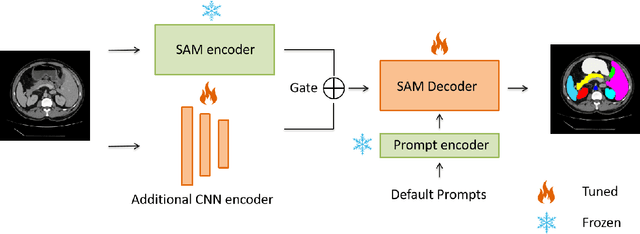

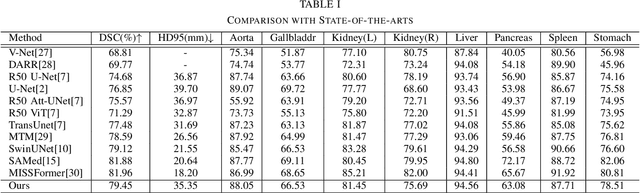
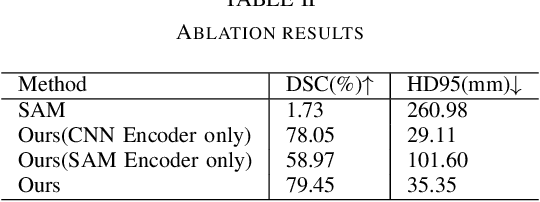
Recently, foundation models have been introduced demonstrating various tasks in the field of computer vision. These models such as Segment Anything Model (SAM) are generalized models trained using huge datasets. Currently, ongoing research focuses on exploring the effective utilization of these generalized models for specific domains, such as medical imaging. However, in medical imaging, the lack of training samples due to privacy concerns and other factors presents a major challenge for applying these generalized models to medical image segmentation task. To address this issue, the effective fine tuning of these models is crucial to ensure their optimal utilization. In this study, we propose to combine a complementary Convolutional Neural Network (CNN) along with the standard SAM network for medical image segmentation. To reduce the burden of fine tuning large foundation model and implement cost-efficient trainnig scheme, we focus only on fine-tuning the additional CNN network and SAM decoder part. This strategy significantly reduces trainnig time and achieves competitive results on publicly available dataset. The code is available at https://github.com/11yxk/SAM-LST.