 Add to Chrome
 Add to Firefox
 Add to Edge
Learning Privacy-Preserving Student Networks via Discriminative-Generative Distillation
Sep 04, 2024
While deep models have proved successful in learning rich knowledge from massive well-annotated data, they may pose a privacy leakage risk in practical deployment. It is necessary to find an effective trade-off between high utility and strong privacy. In this work, we propose a discriminative-generative distillation approach to learn privacy-preserving deep models. Our key idea is taking models as bridge to distill knowledge from private data and then transfer it to learn a student network via two streams. First, discriminative stream trains a baseline classifier on private data and an ensemble of teachers on multiple disjoint private subsets, respectively. Then, generative stream takes the classifier as a fixed discriminator and trains a generator in a data-free manner. After that, the generator is used to generate massive synthetic data which are further applied to train a variational autoencoder (VAE). Among these synthetic data, a few of them are fed into the teacher ensemble to query labels via differentially private aggregation, while most of them are embedded to the trained VAE for reconstructing synthetic data. Finally, a semi-supervised student learning is performed to simultaneously handle two tasks: knowledge transfer from the teachers with distillation on few privately labeled synthetic data, and knowledge enhancement with tangent-normal adversarial regularization on many triples of reconstructed synthetic data. In this way, our approach can control query cost over private data and mitigate accuracy degradation in a unified manner, leading to a privacy-preserving student model. Extensive experiments and analysis clearly show the effectiveness of the proposed approach.

Low-Resolution Object Recognition with Cross-Resolution Relational Contrastive Distillation
Sep 04, 2024Recognizing objects in low-resolution images is a challenging task due to the lack of informative details. Recent studies have shown that knowledge distillation approaches can effectively transfer knowledge from a high-resolution teacher model to a low-resolution student model by aligning cross-resolution representations. However, these approaches still face limitations in adapting to the situation where the recognized objects exhibit significant representation discrepancies between training and testing images. In this study, we propose a cross-resolution relational contrastive distillation approach to facilitate low-resolution object recognition. Our approach enables the student model to mimic the behavior of a well-trained teacher model which delivers high accuracy in identifying high-resolution objects. To extract sufficient knowledge, the student learning is supervised with contrastive relational distillation loss, which preserves the similarities in various relational structures in contrastive representation space. In this manner, the capability of recovering missing details of familiar low-resolution objects can be effectively enhanced, leading to a better knowledge transfer. Extensive experiments on low-resolution object classification and low-resolution face recognition clearly demonstrate the effectiveness and adaptability of our approach.
Low-Resolution Face Recognition via Adaptable Instance-Relation Distillation
Sep 03, 2024Low-resolution face recognition is a challenging task due to the missing of informative details. Recent approaches based on knowledge distillation have proven that high-resolution clues can well guide low-resolution face recognition via proper knowledge transfer. However, due to the distribution difference between training and testing faces, the learned models often suffer from poor adaptability. To address that, we split the knowledge transfer process into distillation and adaptation steps, and propose an adaptable instance-relation distillation approach to facilitate low-resolution face recognition. In the approach, the student distills knowledge from high-resolution teacher in both instance level and relation level, providing sufficient cross-resolution knowledge transfer. Then, the learned student can be adaptable to recognize low-resolution faces with adaptive batch normalization in inference. In this manner, the capability of recovering missing details of familiar low-resolution faces can be effectively enhanced, leading to a better knowledge transfer. Extensive experiments on low-resolution face recognition clearly demonstrate the effectiveness and adaptability of our approach.
Learning Differentially Private Diffusion Models via Stochastic Adversarial Distillation
Aug 27, 2024While the success of deep learning relies on large amounts of training datasets, data is often limited in privacy-sensitive domains. To address this challenge, generative model learning with differential privacy has emerged as a solution to train private generative models for desensitized data generation. However, the quality of the images generated by existing methods is limited due to the complexity of modeling data distribution. We build on the success of diffusion models and introduce DP-SAD, which trains a private diffusion model by a stochastic adversarial distillation method. Specifically, we first train a diffusion model as a teacher and then train a student by distillation, in which we achieve differential privacy by adding noise to the gradients from other models to the student. For better generation quality, we introduce a discriminator to distinguish whether an image is from the teacher or the student, which forms the adversarial training. Extensive experiments and analysis clearly demonstrate the effectiveness of our proposed method.
Learning Natural Consistency Representation for Face Forgery Video Detection
Jul 15, 2024

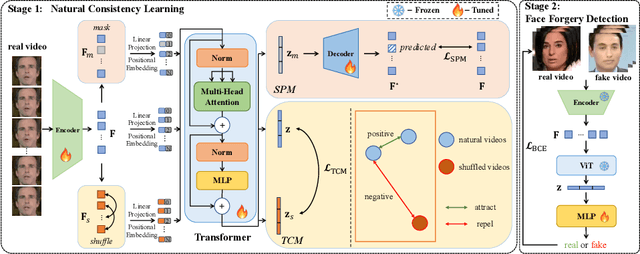

Face Forgery videos have elicited critical social public concerns and various detectors have been proposed. However, fully-supervised detectors may lead to easily overfitting to specific forgery methods or videos, and existing self-supervised detectors are strict on auxiliary tasks, such as requiring audio or multi-modalities, leading to limited generalization and robustness. In this paper, we examine whether we can address this issue by leveraging visual-only real face videos. To this end, we propose to learn the Natural Consistency representation (NACO) of real face videos in a self-supervised manner, which is inspired by the observation that fake videos struggle to maintain the natural spatiotemporal consistency even under unknown forgery methods and different perturbations. Our NACO first extracts spatial features of each frame by CNNs then integrates them into Transformer to learn the long-range spatiotemporal representation, leveraging the advantages of CNNs and Transformer on local spatial receptive field and long-term memory respectively. Furthermore, a Spatial Predictive Module~(SPM) and a Temporal Contrastive Module~(TCM) are introduced to enhance the natural consistency representation learning. The SPM aims to predict random masked spatial features from spatiotemporal representation, and the TCM regularizes the latent distance of spatiotemporal representation by shuffling the natural order to disturb the consistency, which could both force our NACO more sensitive to the natural spatiotemporal consistency. After the representation learning stage, a MLP head is fine-tuned to perform the usual forgery video classification task. Extensive experiments show that our method outperforms other state-of-the-art competitors with impressive generalization and robustness.
DANCE: Dual-View Distribution Alignment for Dataset Condensation
Jun 03, 2024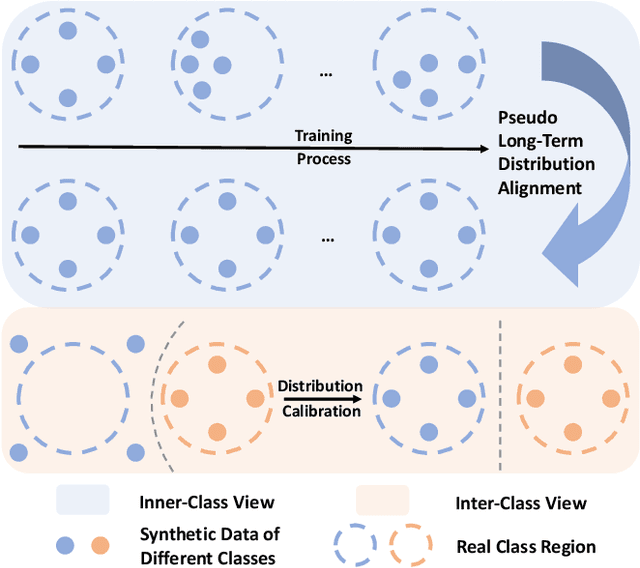
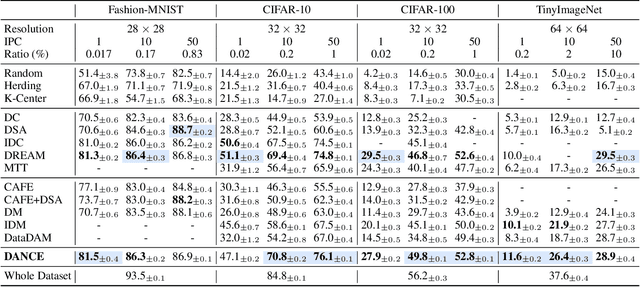
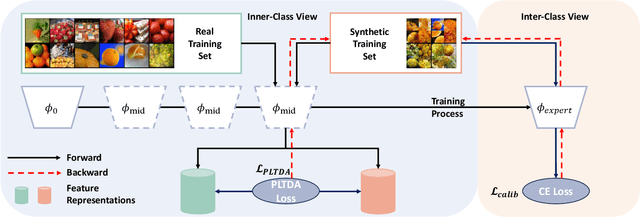
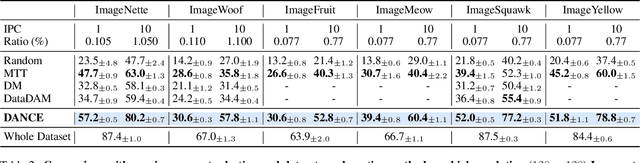
Dataset condensation addresses the problem of data burden by learning a small synthetic training set that preserves essential knowledge from the larger real training set. To date, the state-of-the-art (SOTA) results are often yielded by optimization-oriented methods, but their inefficiency hinders their application to realistic datasets. On the other hand, the Distribution-Matching (DM) methods show remarkable efficiency but sub-optimal results compared to optimization-oriented methods. In this paper, we reveal the limitations of current DM-based methods from the inner-class and inter-class views, i.e., Persistent Training and Distribution Shift. To address these problems, we propose a new DM-based method named Dual-view distribution AligNment for dataset CondEnsation (DANCE), which exploits a few pre-trained models to improve DM from both inner-class and inter-class views. Specifically, from the inner-class view, we construct multiple "middle encoders" to perform pseudo long-term distribution alignment, making the condensed set a good proxy of the real one during the whole training process; while from the inter-class view, we use the expert models to perform distribution calibration, ensuring the synthetic data remains in the real class region during condensing. Experiments demonstrate the proposed method achieves a SOTA performance while maintaining comparable efficiency with the original DM across various scenarios. Source codes are available at https://github.com/Hansong-Zhang/DANCE.
Masked Face Recognition with Generative-to-Discriminative Representations
May 27, 2024
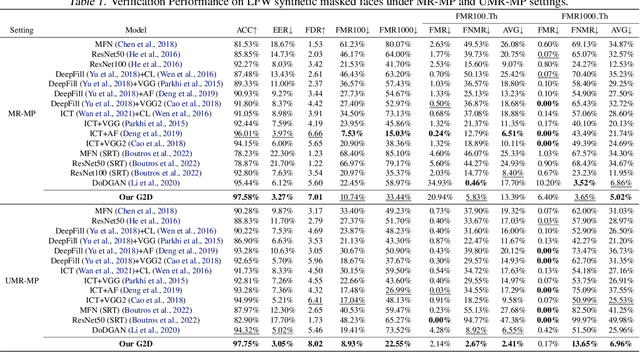

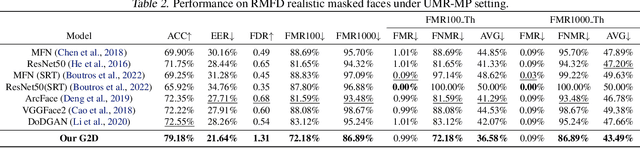
Masked face recognition is important for social good but challenged by diverse occlusions that cause insufficient or inaccurate representations. In this work, we propose a unified deep network to learn generative-to-discriminative representations for facilitating masked face recognition. To this end, we split the network into three modules and learn them on synthetic masked faces in a greedy module-wise pretraining manner. First, we leverage a generative encoder pretrained for face inpainting and finetune it to represent masked faces into category-aware descriptors. Attribute to the generative encoder's ability in recovering context information, the resulting descriptors can provide occlusion-robust representations for masked faces, mitigating the effect of diverse masks. Then, we incorporate a multi-layer convolutional network as a discriminative reformer and learn it to convert the category-aware descriptors into identity-aware vectors, where the learning is effectively supervised by distilling relation knowledge from off-the-shelf face recognition model. In this way, the discriminative reformer together with the generative encoder serves as the pretrained backbone, providing general and discriminative representations towards masked faces. Finally, we cascade one fully-connected layer following by one softmax layer into a feature classifier and finetune it to identify the reformed identity-aware vectors. Extensive experiments on synthetic and realistic datasets demonstrate the effectiveness of our approach in recognizing masked faces.
M3D: Dataset Condensation by Minimizing Maximum Mean Discrepancy
Jan 03, 2024Training state-of-the-art (SOTA) deep models often requires extensive data, resulting in substantial training and storage costs. To address these challenges, dataset condensation has been developed to learn a small synthetic set that preserves essential information from the original large-scale dataset. Nowadays, optimization-oriented methods have been the primary method in the field of dataset condensation for achieving SOTA results. However, the bi-level optimization process hinders the practical application of such methods to realistic and larger datasets. To enhance condensation efficiency, previous works proposed Distribution-Matching (DM) as an alternative, which significantly reduces the condensation cost. Nonetheless, current DM-based methods have yielded less comparable results to optimization-oriented methods due to their focus on aligning only the first moment of the distributions. In this paper, we present a novel DM-based method named M3D for dataset condensation by Minimizing the Maximum Mean Discrepancy between feature representations of the synthetic and real images. By embedding their distributions in a reproducing kernel Hilbert space, we align all orders of moments of the distributions of real and synthetic images, resulting in a more generalized condensed set. Notably, our method even surpasses the SOTA optimization-oriented method IDC on the high-resolution ImageNet dataset. Extensive analysis is conducted to verify the effectiveness of the proposed method.
Coupled Confusion Correction: Learning from Crowds with Sparse Annotations
Dec 26, 2023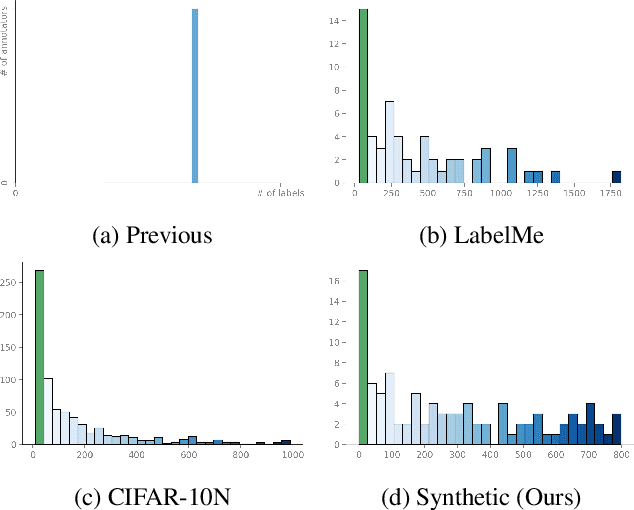
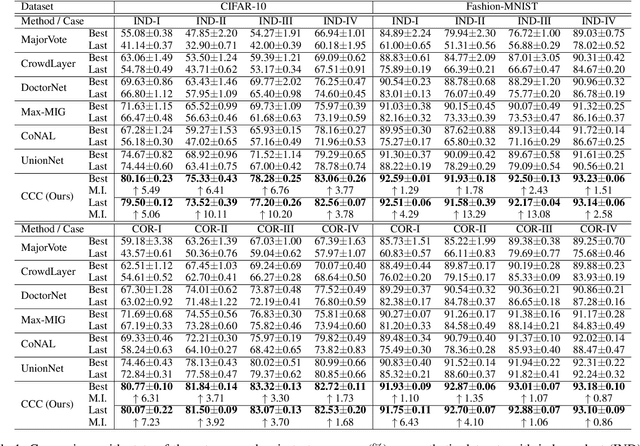
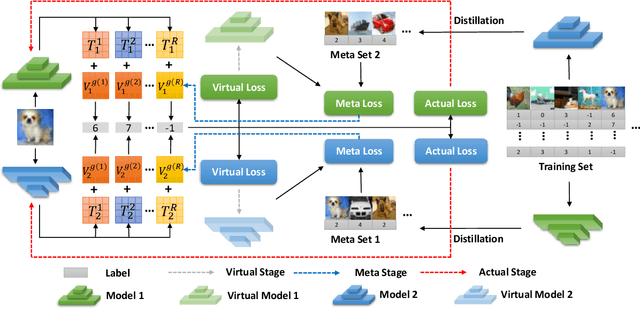
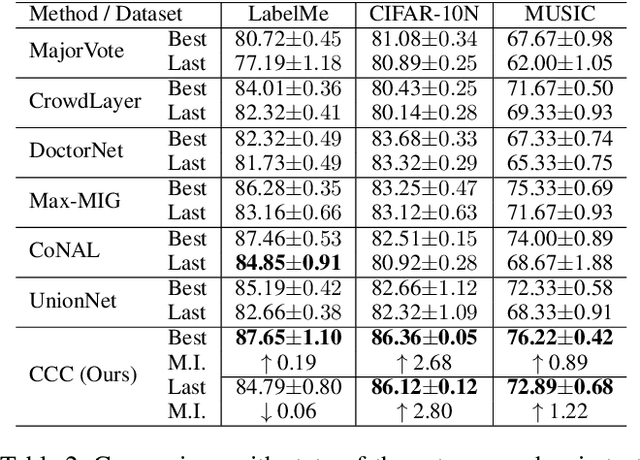
As the size of the datasets getting larger, accurately annotating such datasets is becoming more impractical due to the expensiveness on both time and economy. Therefore, crowd-sourcing has been widely adopted to alleviate the cost of collecting labels, which also inevitably introduces label noise and eventually degrades the performance of the model. To learn from crowd-sourcing annotations, modeling the expertise of each annotator is a common but challenging paradigm, because the annotations collected by crowd-sourcing are usually highly-sparse. To alleviate this problem, we propose Coupled Confusion Correction (CCC), where two models are simultaneously trained to correct the confusion matrices learned by each other. Via bi-level optimization, the confusion matrices learned by one model can be corrected by the distilled data from the other. Moreover, we cluster the ``annotator groups'' who share similar expertise so that their confusion matrices could be corrected together. In this way, the expertise of the annotators, especially of those who provide seldom labels, could be better captured. Remarkably, we point out that the annotation sparsity not only means the average number of labels is low, but also there are always some annotators who provide very few labels, which is neglected by previous works when constructing synthetic crowd-sourcing annotations. Based on that, we propose to use Beta distribution to control the generation of the crowd-sourcing labels so that the synthetic annotations could be more consistent with the real-world ones. Extensive experiments are conducted on two types of synthetic datasets and three real-world datasets, the results of which demonstrate that CCC significantly outperforms state-of-the-art approaches.
Multi-Label Noise Transition Matrix Estimation with Label Correlations: Theory and Algorithm
Sep 22, 2023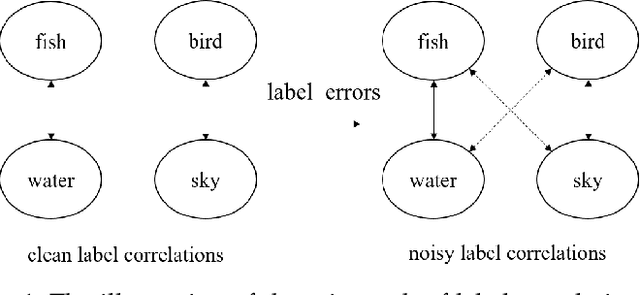


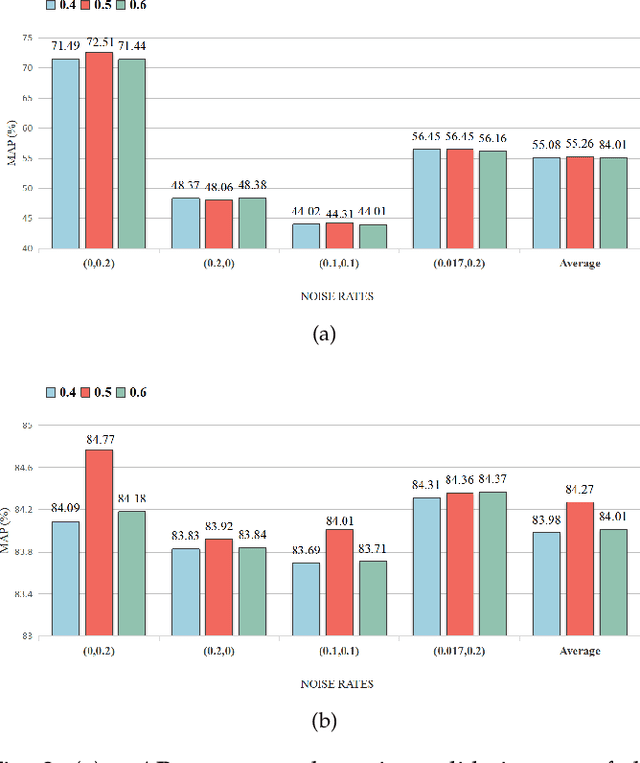
Noisy multi-label learning has garnered increasing attention due to the challenges posed by collecting large-scale accurate labels, making noisy labels a more practical alternative. Motivated by noisy multi-class learning, the introduction of transition matrices can help model multi-label noise and enable the development of statistically consistent algorithms for noisy multi-label learning. However, estimating multi-label noise transition matrices remains a challenging task, as most existing estimators in noisy multi-class learning rely on anchor points and accurate fitting of noisy class posteriors, which is hard to satisfy in noisy multi-label learning. In this paper, we address this problem by first investigating the identifiability of class-dependent transition matrices in noisy multi-label learning. Building upon the identifiability results, we propose a novel estimator that leverages label correlations without the need for anchor points or precise fitting of noisy class posteriors. Specifically, we first estimate the occurrence probability of two noisy labels to capture noisy label correlations. Subsequently, we employ sample selection techniques to extract information implying clean label correlations, which are then used to estimate the occurrence probability of one noisy label when a certain clean label appears. By exploiting the mismatches in label correlations implied by these occurrence probabilities, we demonstrate that the transition matrix becomes identifiable and can be acquired by solving a bilinear decomposition problem. Theoretically, we establish an estimation error bound for our multi-label transition matrix estimator and derive a generalization error bound for our statistically consistent algorithm. Empirically, we validate the effectiveness of our estimator in estimating multi-label noise transition matrices, leading to excellent classification performance.