 Add to Chrome
 Add to Firefox
 Add to Edge
Deciphering Shortcut Learning from an Evolutionary Game Theory Perspective
May 05, 2026
Shortcut learning causes deep learning models to rely on non-essential features within the data. However, its formation in deep neural network training still lacks theoretical understanding. In this paper, we provide a formal definition of core and shortcut features and employ evolutionary game theory to analyze the origins of shortcut bias by modeling data samples as players and their corresponding neural tangent features as strategies, assuming the existence of core and shortcut subnetworks. We find that gradient descent (GD) and stochastic gradient descent (SGD) lead to two distinct stochastically stable states, each corresponding to a different strategy. The former primarily optimizes the shortcut subnetwork, while the latter primarily optimizes the core subnetwork. We investigate the influence of these strategies on shortcut bias through a continuous stochastic differential equation, and reveal the impact of data noise and optimization noise on the formation of shortcut bias. In brief, our work employs evolutionary game theory to characterize the dynamics of shortcut bias formation and provides a theoretical view on its mitigation.

Learning-Based TSP-Solvers Tend to Be Overly Greedy
Feb 02, 2025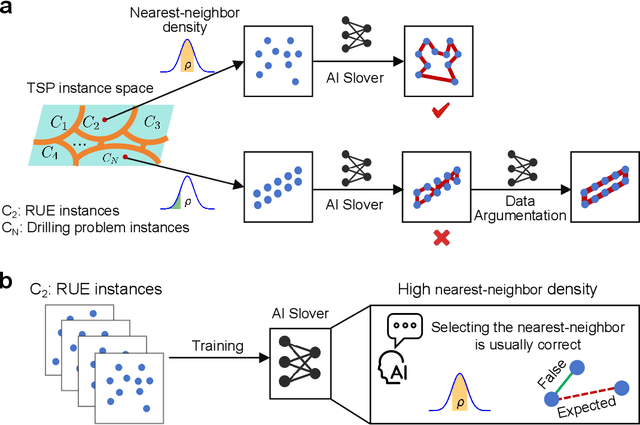
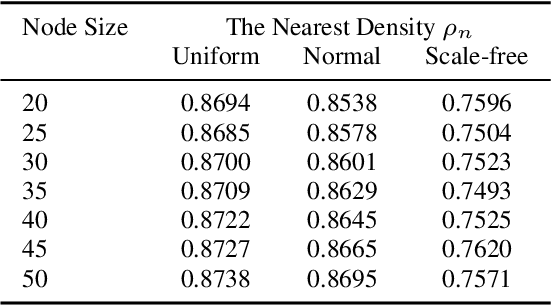
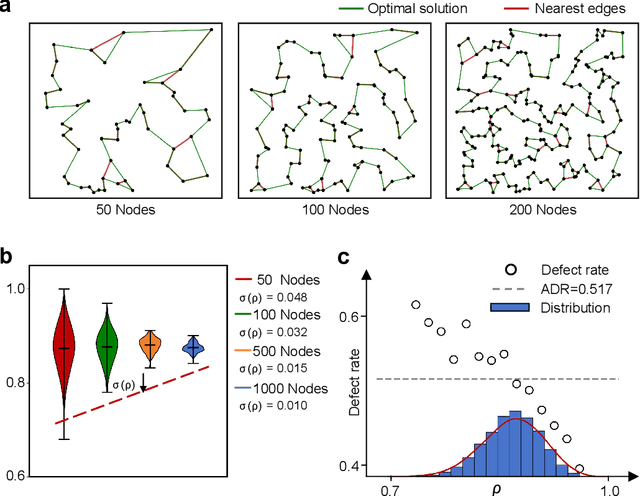
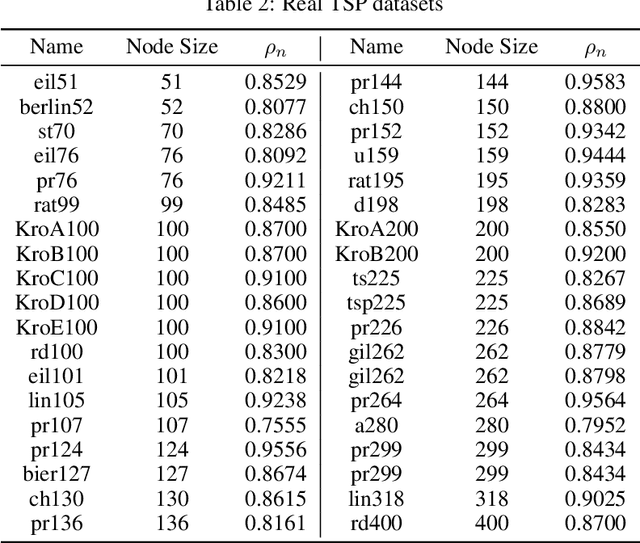
Deep learning has shown significant potential in solving combinatorial optimization problems such as the Euclidean traveling salesman problem (TSP). However, most training and test instances for existing TSP algorithms are generated randomly from specific distributions like uniform distribution. This has led to a lack of analysis and understanding of the performance of deep learning algorithms in out-of-distribution (OOD) generalization scenarios, which has a close relationship with the worst-case performance in the combinatorial optimization field. For data-driven algorithms, the statistical properties of randomly generated datasets are critical. This study constructs a statistical measure called nearest-neighbor density to verify the asymptotic properties of randomly generated datasets and reveal the greedy behavior of learning-based solvers, i.e., always choosing the nearest neighbor nodes to construct the solution path. Based on this statistical measure, we develop interpretable data augmentation methods that rely on distribution shifts or instance perturbations and validate that the performance of the learning-based solvers degenerates much on such augmented data. Moreover, fine-tuning learning-based solvers with augmented data further enhances their generalization abilities. In short, we decipher the limitations of learning-based TSP solvers tending to be overly greedy, which may have profound implications for AI-empowered combinatorial optimization solvers.