 Add to Chrome
 Add to Firefox
 Add to Edge
Mild Over-Parameterization Benefits Asymmetric Tensor PCA
Apr 11, 2026
Asymmetric Tensor PCA (ATPCA) is a prototypical model for studying the trade-offs between sample complexity, computation, and memory. Existing algorithms for this problem typically require at least $d^{\left\lceil\overline{k}/2\right\rceil}$ state memory cost to recover the signal, where $d$ is the vector dimension and $\overline{k}$ is the tensor order. We focus on the setting where $\overline{k} \geq 4$ is even and consider (stochastic) gradient descent-based algorithms under a limited memory budget, which permits only mild over-parameterization of the model. We propose a matrix-parameterized method (in $d^{2}$ state memory cost) using a novel three-phase alternating-update algorithm to address the problem and demonstrate how mild over-parameterization facilitates learning in two key aspects: (i) it improves sample efficiency, allowing our method to achieve \emph{near-optimal} $d^{\overline{k}-2}$ sample complexity in our limited memory setting; and (ii) it enhances adaptivity to problem structure, a previously unrecognized phenomenon, where the required sample size naturally decreases as consecutive vectors become more aligned, and in the symmetric limit attains $d^{\overline{k}/2}$, matching the \emph{best} known polynomial-time complexity. To our knowledge, this is the \emph{first} tractable algorithm for ATPCA with $d^{\overline{k}}$-independent memory costs.

Accelerating Single-Pass SGD for Generalized Linear Prediction
Mar 02, 2026We study generalized linear prediction under a streaming setting, where each iteration uses only one fresh data point for a gradient-level update. While momentum is well-established in deterministic optimization, a fundamental open question is whether it can accelerate such single-pass non-quadratic stochastic optimization. We propose the first algorithm that successfully incorporates momentum via a novel data-dependent proximal method, achieving dual-momentum acceleration. Our derived excess risk bound decomposes into three components: an improved optimization error, a minimax optimal statistical error, and a higher-order model-misspecification error. The proof handles mis-specification via a fine-grained stationary analysis of inner updates, while localizing statistical error through a two-phase outer-loop analysis. As a result, we resolve the open problem posed by Jain et al. [2018a] and demonstrate that momentum acceleration is more effective than variance reduction for generalized linear prediction in the streaming setting.
Scaling Law for Stochastic Gradient Descent in Quadratically Parameterized Linear Regression
Feb 13, 2025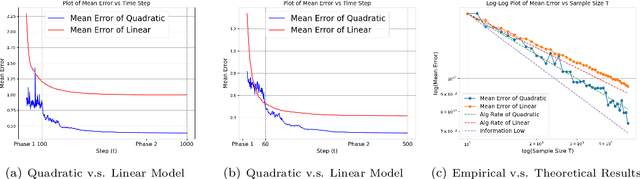
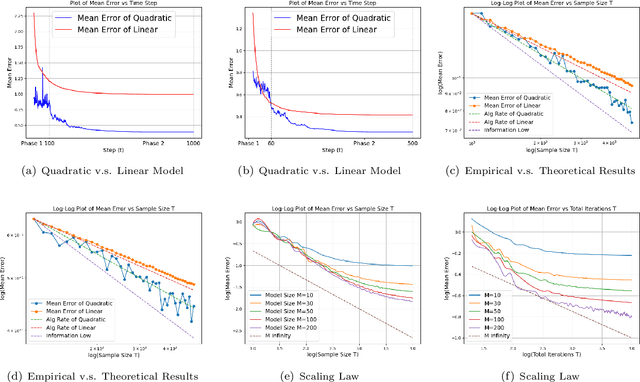
In machine learning, the scaling law describes how the model performance improves with the model and data size scaling up. From a learning theory perspective, this class of results establishes upper and lower generalization bounds for a specific learning algorithm. Here, the exact algorithm running using a specific model parameterization often offers a crucial implicit regularization effect, leading to good generalization. To characterize the scaling law, previous theoretical studies mainly focus on linear models, whereas, feature learning, a notable process that contributes to the remarkable empirical success of neural networks, is regretfully vacant. This paper studies the scaling law over a linear regression with the model being quadratically parameterized. We consider infinitely dimensional data and slope ground truth, both signals exhibiting certain power-law decay rates. We study convergence rates for Stochastic Gradient Descent and demonstrate the learning rates for variables will automatically adapt to the ground truth. As a result, in the canonical linear regression, we provide explicit separations for generalization curves between SGD with and without feature learning, and the information-theoretical lower bound that is agnostic to parametrization method and the algorithm. Our analysis for decaying ground truth provides a new characterization for the learning dynamic of the model.
Provable Particle-based Primal-Dual Algorithm for Mixed Nash Equilibrium
Mar 02, 2023We consider the general nonconvex nonconcave minimax problem over continuous variables. A major challenge for this problem is that a saddle point may not exist. In order to resolve this difficulty, we consider the related problem of finding a Mixed Nash Equilibrium, which is a randomized strategy represented by probability distributions over the continuous variables. We propose a Particle-based Primal-Dual Algorithm (PPDA) for a weakly entropy-regularized min-max optimization procedure over the probability distributions, which employs the stochastic movements of particles to represent the updates of random strategies for the mixed Nash Equilibrium. A rigorous convergence analysis of the proposed algorithm is provided. Compared to previous works that try to update particle weights without movements, PPDA is the first implementable particle-based algorithm with non-asymptotic quantitative convergence results, running time, and sample complexity guarantees. Our framework gives new insights into the design of particle-based algorithms for continuous min-max optimization in the general nonconvex nonconcave setting.