 Add to Chrome
 Add to Firefox
 Add to Edge
4DEquine: Disentangling Motion and Appearance for 4D Equine Reconstruction from Monocular Video
Mar 10, 2026
4D reconstruction of equine family (e.g. horses) from monocular video is important for animal welfare. Previous mainstream 4D animal reconstruction methods require joint optimization of motion and appearance over a whole video, which is time-consuming and sensitive to incomplete observation. In this work, we propose a novel framework called 4DEquine by disentangling the 4D reconstruction problem into two sub-problems: dynamic motion reconstruction and static appearance reconstruction. For motion, we introduce a simple yet effective spatio-temporal transformer with a post-optimization stage to regress smooth and pixel-aligned pose and shape sequences from video. For appearance, we design a novel feed-forward network that reconstructs a high-fidelity, animatable 3D Gaussian avatar from as few as a single image. To assist training, we create a large-scale synthetic motion dataset, VarenPoser, which features high-quality surface motions and diverse camera trajectories, as well as a synthetic appearance dataset, VarenTex, comprising realistic multi-view images generated through multi-view diffusion. While training only on synthetic datasets, 4DEquine achieves state-of-the-art performance on real-world APT36K and AiM datasets, demonstrating the superiority of 4DEquine and our new datasets for both geometry and appearance reconstruction. Comprehensive ablation studies validate the effectiveness of both the motion and appearance reconstruction network. Project page: https://luoxue-star.github.io/4DEquine_Project_Page/.

Monocular Mesh Recovery and Body Measurement of Female Saanen Goats
Feb 23, 2026The lactation performance of Saanen dairy goats, renowned for their high milk yield, is intrinsically linked to their body size, making accurate 3D body measurement essential for assessing milk production potential, yet existing reconstruction methods lack goat-specific authentic 3D data. To address this limitation, we establish the FemaleSaanenGoat dataset containing synchronized eight-view RGBD videos of 55 female Saanen goats (6-18 months). Using multi-view DynamicFusion, we fuse noisy, non-rigid point cloud sequences into high-fidelity 3D scans, overcoming challenges from irregular surfaces and rapid movement. Based on these scans, we develop SaanenGoat, a parametric 3D shape model specifically designed for female Saanen goats. This model features a refined template with 41 skeletal joints and enhanced udder representation, registered with our scan data. A comprehensive shape space constructed from 48 goats enables precise representation of diverse individual variations. With the help of SaanenGoat model, we get high-precision 3D reconstruction from single-view RGBD input, and achieve automated measurement of six critical body dimensions: body length, height, chest width, chest girth, hip width, and hip height. Experimental results demonstrate the superior accuracy of our method in both 3D reconstruction and body measurement, presenting a novel paradigm for large-scale 3D vision applications in precision livestock farming.
AniMer+: Unified Pose and Shape Estimation Across Mammalia and Aves via Family-Aware Transformer
Aug 01, 2025In the era of foundation models, achieving a unified understanding of different dynamic objects through a single network has the potential to empower stronger spatial intelligence. Moreover, accurate estimation of animal pose and shape across diverse species is essential for quantitative analysis in biological research. However, this topic remains underexplored due to the limited network capacity of previous methods and the scarcity of comprehensive multi-species datasets. To address these limitations, we introduce AniMer+, an extended version of our scalable AniMer framework. In this paper, we focus on a unified approach for reconstructing mammals (mammalia) and birds (aves). A key innovation of AniMer+ is its high-capacity, family-aware Vision Transformer (ViT) incorporating a Mixture-of-Experts (MoE) design. Its architecture partitions network layers into taxa-specific components (for mammalia and aves) and taxa-shared components, enabling efficient learning of both distinct and common anatomical features within a single model. To overcome the critical shortage of 3D training data, especially for birds, we introduce a diffusion-based conditional image generation pipeline. This pipeline produces two large-scale synthetic datasets: CtrlAni3D for quadrupeds and CtrlAVES3D for birds. To note, CtrlAVES3D is the first large-scale, 3D-annotated dataset for birds, which is crucial for resolving single-view depth ambiguities. Trained on an aggregated collection of 41.3k mammalian and 12.4k avian images (combining real and synthetic data), our method demonstrates superior performance over existing approaches across a wide range of benchmarks, including the challenging out-of-domain Animal Kingdom dataset. Ablation studies confirm the effectiveness of both our novel network architecture and the generated synthetic datasets in enhancing real-world application performance.
AniMer: Animal Pose and Shape Estimation Using Family Aware Transformer
Dec 01, 2024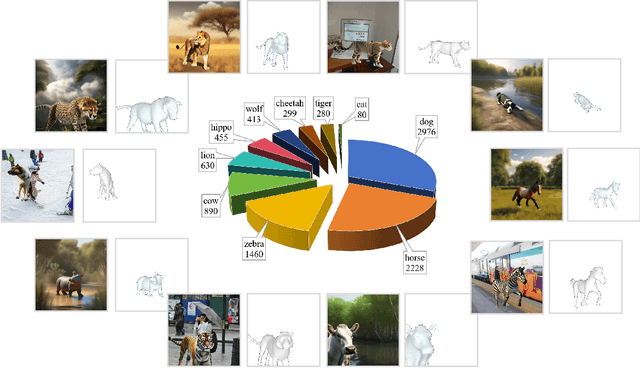

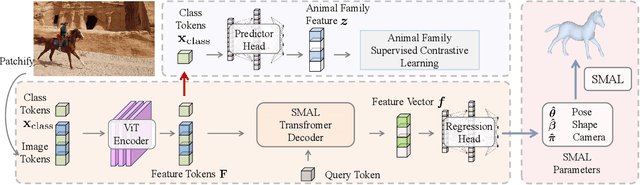
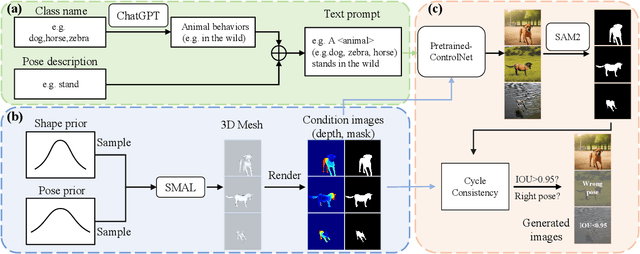
Quantitative analysis of animal behavior and biomechanics requires accurate animal pose and shape estimation across species, and is important for animal welfare and biological research. However, the small network capacity of previous methods and limited multi-species dataset leave this problem underexplored. To this end, this paper presents AniMer to estimate animal pose and shape using family aware Transformer, enhancing the reconstruction accuracy of diverse quadrupedal families. A key insight of AniMer is its integration of a high-capacity Transformer-based backbone and an animal family supervised contrastive learning scheme, unifying the discriminative understanding of various quadrupedal shapes within a single framework. For effective training, we aggregate most available open-sourced quadrupedal datasets, either with 3D or 2D labels. To improve the diversity of 3D labeled data, we introduce CtrlAni3D, a novel large-scale synthetic dataset created through a new diffusion-based conditional image generation pipeline. CtrlAni3D consists of about 10k images with pixel-aligned SMAL labels. In total, we obtain 41.3k annotated images for training and validation. Consequently, the combination of a family aware Transformer network and an expansive dataset enables AniMer to outperform existing methods not only on 3D datasets like Animal3D and CtrlAni3D, but also on out-of-distribution Animal Kingdom dataset. Ablation studies further demonstrate the effectiveness of our network design and CtrlAni3D in enhancing the performance of AniMer for in-the-wild applications. The project page of AniMer is https://luoxue-star.github.io/AniMer_project_page/.