 Add to Chrome
 Add to Firefox
 Add to Edge
LibriheavyMix: A 20,000-Hour Dataset for Single-Channel Reverberant Multi-Talker Speech Separation, ASR and Speaker Diarization
Sep 01, 2024


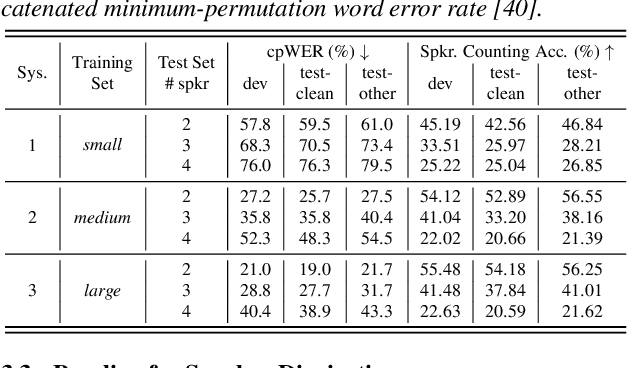
The evolving speech processing landscape is increasingly focused on complex scenarios like meetings or cocktail parties with multiple simultaneous speakers and far-field conditions. Existing methodologies for addressing these challenges fall into two categories: multi-channel and single-channel solutions. Single-channel approaches, notable for their generality and convenience, do not require specific information about microphone arrays. This paper presents a large-scale far-field overlapping speech dataset, crafted to advance research in speech separation, recognition, and speaker diarization. This dataset is a critical resource for decoding ``Who said What and When'' in multi-talker, reverberant environments, a daunting challenge in the field. Additionally, we introduce a pipeline system encompassing speech separation, recognition, and diarization as a foundational benchmark. Evaluations on the WHAMR! dataset validate the broad applicability of the proposed data.

Comparing Discrete and Continuous Space LLMs for Speech Recognition
Sep 01, 2024


This paper investigates discrete and continuous speech representations in Large Language Model (LLM)-based Automatic Speech Recognition (ASR), organizing them by feature continuity and training approach into four categories: supervised and unsupervised for both discrete and continuous types. We further classify LLMs based on their input and autoregressive feedback into continuous and discrete-space models. Using specialized encoders and comparative analysis with a Joint-Training-From-Scratch Language Model (JTFS LM) and pre-trained LLaMA2-7b, we provide a detailed examination of their effectiveness. Our work marks the first extensive comparison of speech representations in LLM-based ASR and explores various modeling techniques. We present an open-sourced achievement of a state-of-the-art Word Error Rate (WER) of 1.69\% on LibriSpeech using a HuBERT encoder, offering valuable insights for advancing ASR and natural language processing (NLP) research.
Advancing Multi-talker ASR Performance with Large Language Models
Aug 30, 2024
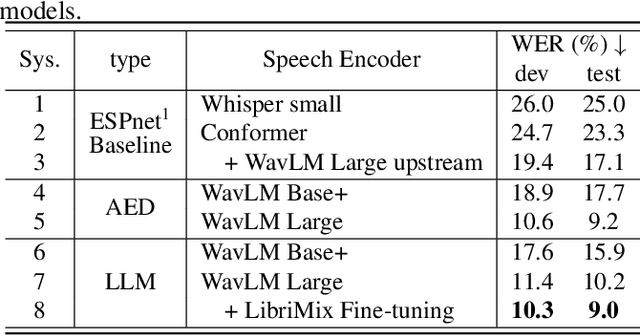

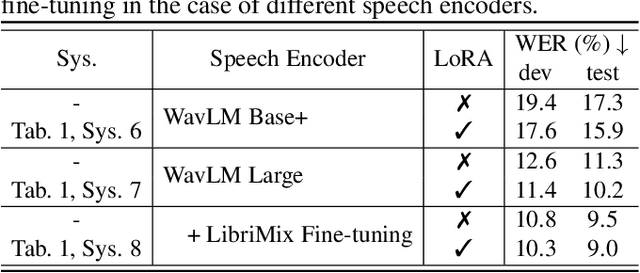
Recognizing overlapping speech from multiple speakers in conversational scenarios is one of the most challenging problem for automatic speech recognition (ASR). Serialized output training (SOT) is a classic method to address multi-talker ASR, with the idea of concatenating transcriptions from multiple speakers according to the emission times of their speech for training. However, SOT-style transcriptions, derived from concatenating multiple related utterances in a conversation, depend significantly on modeling long contexts. Therefore, compared to traditional methods that primarily emphasize encoder performance in attention-based encoder-decoder (AED) architectures, a novel approach utilizing large language models (LLMs) that leverages the capabilities of pre-trained decoders may be better suited for such complex and challenging scenarios. In this paper, we propose an LLM-based SOT approach for multi-talker ASR, leveraging pre-trained speech encoder and LLM, fine-tuning them on multi-talker dataset using appropriate strategies. Experimental results demonstrate that our approach surpasses traditional AED-based methods on the simulated dataset LibriMix and achieves state-of-the-art performance on the evaluation set of the real-world dataset AMI, outperforming the AED model trained with 1000 times more supervised data in previous works.
Multi-Channel Multi-Speaker ASR Using Target Speaker's Solo Segment
Jun 17, 2024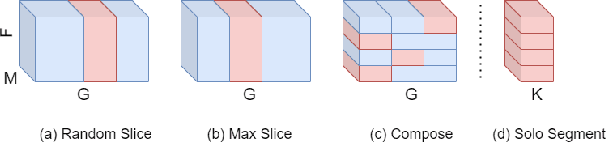
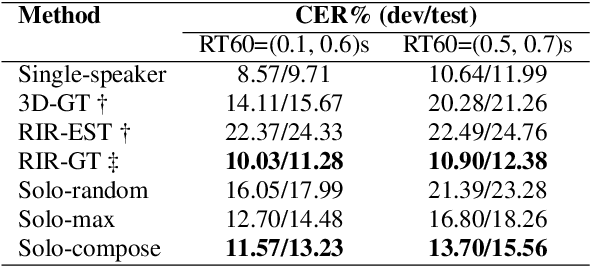
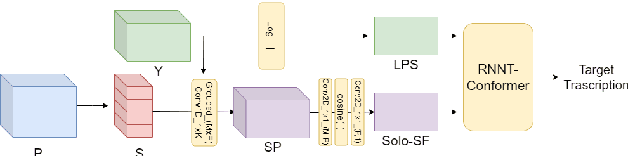
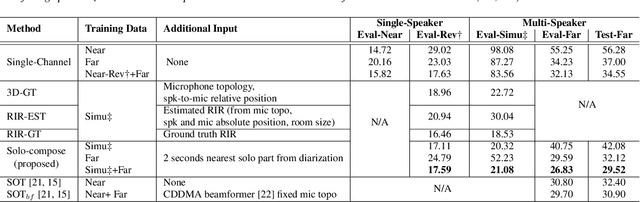
In the field of multi-channel, multi-speaker Automatic Speech Recognition (ASR), the task of discerning and accurately transcribing a target speaker's speech within background noise remains a formidable challenge. Traditional approaches often rely on microphone array configurations and the information of the target speaker's location or voiceprint. This study introduces the Solo Spatial Feature (Solo-SF), an innovative method that utilizes a target speaker's isolated speech segment to enhance ASR performance, thereby circumventing the need for conventional inputs like microphone array layouts. We explore effective strategies for selecting optimal solo segments, a crucial aspect for Solo-SF's success. Through evaluations conducted on the AliMeeting dataset and AISHELL-1 simulations, Solo-SF demonstrates superior performance over existing techniques, significantly lowering Character Error Rates (CER) in various test conditions. Our findings highlight Solo-SF's potential as an effective solution for addressing the complexities of multi-channel, multi-speaker ASR tasks.
RIR-SF: Room Impulse Response Based Spatial Feature for Multi-channel Multi-talker ASR
Oct 31, 2023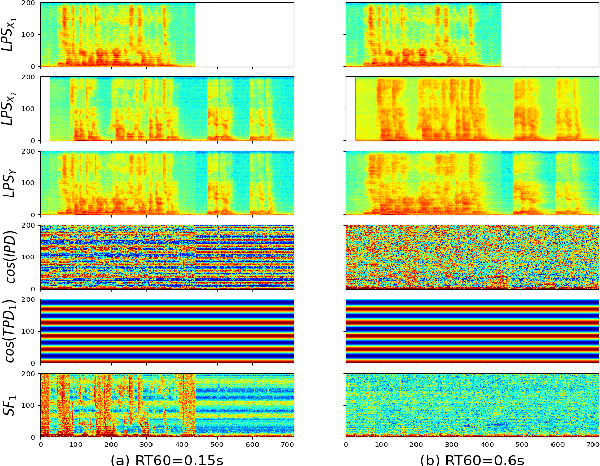
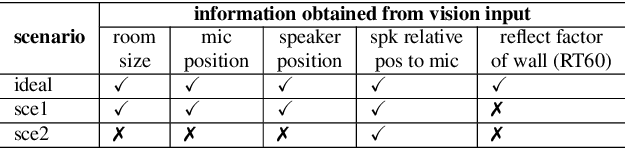
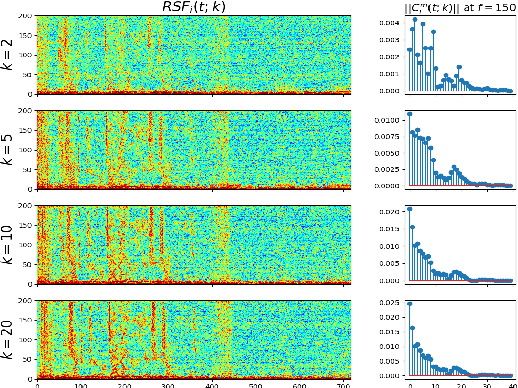
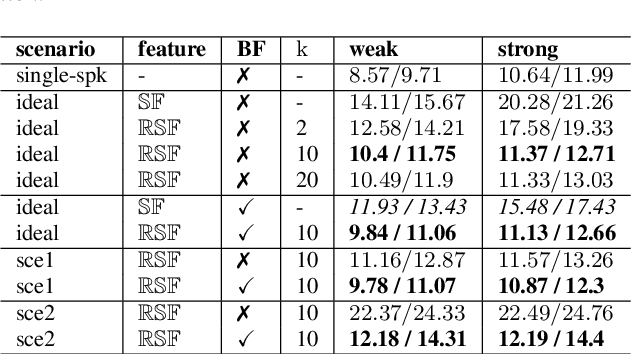
Multi-channel multi-talker automatic speech recognition (ASR) presents ongoing challenges within the speech community, particularly when confronted with significant reverberation effects. In this study, we introduce a novel approach involving the convolution of overlapping speech signals with the room impulse response (RIR) corresponding to the target speaker's transmission to a microphone array. This innovative technique yields a novel spatial feature known as the RIR-SF. Through a comprehensive comparison with the previously established state-of-the-art 3D spatial feature, both theoretical analysis and experimental results substantiate the superiority of our proposed RIR-SF. We demonstrate that the RIR-SF outperforms existing methods, leading to a remarkable 21.3\% relative reduction in the Character Error Rate (CER) in multi-channel multi-talker ASR systems. Importantly, this novel feature exhibits robustness in the face of strong reverberation, surpassing the limitations of previous approaches.
UniX-Encoder: A Universal $X$-Channel Speech Encoder for Ad-Hoc Microphone Array Speech Processing
Oct 25, 2023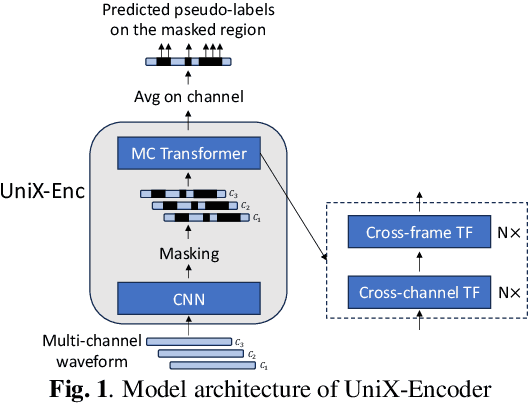
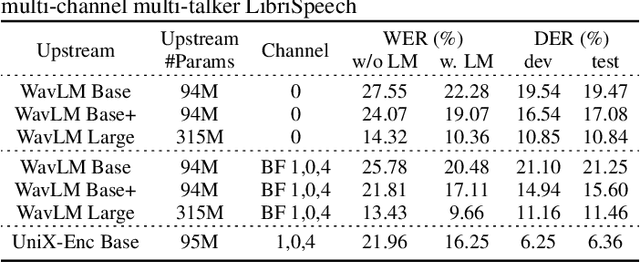
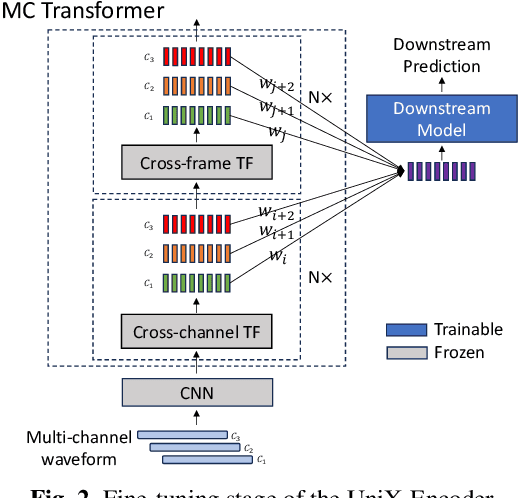
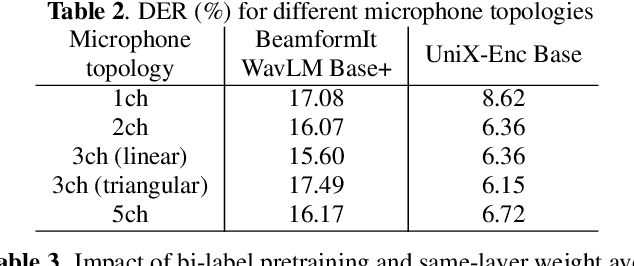
The speech field is evolving to solve more challenging scenarios, such as multi-channel recordings with multiple simultaneous talkers. Given the many types of microphone setups out there, we present the UniX-Encoder. It's a universal encoder designed for multiple tasks, and worked with any microphone array, in both solo and multi-talker environments. Our research enhances previous multi-channel speech processing efforts in four key areas: 1) Adaptability: Contrasting traditional models constrained to certain microphone array configurations, our encoder is universally compatible. 2) Multi-Task Capability: Beyond the single-task focus of previous systems, UniX-Encoder acts as a robust upstream model, adeptly extracting features for diverse tasks including ASR and speaker recognition. 3) Self-Supervised Training: The encoder is trained without requiring labeled multi-channel data. 4) End-to-End Integration: In contrast to models that first beamform then process single-channels, our encoder offers an end-to-end solution, bypassing explicit beamforming or separation. To validate its effectiveness, we tested the UniX-Encoder on a synthetic multi-channel dataset from the LibriSpeech corpus. Across tasks like speech recognition and speaker diarization, our encoder consistently outperformed combinations like the WavLM model with the BeamformIt frontend.
M3-AUDIODEC: Multi-channel multi-speaker multi-spatial audio codec
Sep 23, 2023We introduce M3-AUDIODEC, an innovative neural spatial audio codec designed for efficient compression of multi-channel (binaural) speech in both single and multi-speaker scenarios, while retaining the spatial location information of each speaker. This model boasts versatility, allowing configuration and training tailored to a predetermined set of multi-channel, multi-speaker, and multi-spatial overlapping speech conditions. Key contributions are as follows: 1) Previous neural codecs are extended from single to multi-channel audios. 2) The ability of our proposed model to compress and decode for overlapping speech. 3) A groundbreaking architecture that compresses speech content and spatial cues separately, ensuring the preservation of each speaker's spatial context after decoding. 4) M3-AUDIODEC's proficiency in reducing the bandwidth for compressing two-channel speech by 48% when compared to individual binaural channel compression. Impressively, at a 12.6 kbps operation, it outperforms Opus at 24 kbps and AUDIODEC at 24 kbps by 37% and 52%, respectively. In our assessment, we employed speech enhancement and room acoustic metrics to ascertain the accuracy of clean speech and spatial cue estimates from M3-AUDIODEC. Audio demonstrations and source code are available online at https://github.com/anton-jeran/MULTI-AUDIODEC .
MMCosine: Multi-Modal Cosine Loss Towards Balanced Audio-Visual Fine-Grained Learning
Mar 11, 2023Audio-visual learning helps to comprehensively understand the world by fusing practical information from multiple modalities. However, recent studies show that the imbalanced optimization of uni-modal encoders in a joint-learning model is a bottleneck to enhancing the model's performance. We further find that the up-to-date imbalance-mitigating methods fail on some audio-visual fine-grained tasks, which have a higher demand for distinguishable feature distribution. Fueled by the success of cosine loss that builds hyperspherical feature spaces and achieves lower intra-class angular variability, this paper proposes Multi-Modal Cosine loss, MMCosine. It performs a modality-wise $L_2$ normalization to features and weights towards balanced and better multi-modal fine-grained learning. We demonstrate that our method can alleviate the imbalanced optimization from the perspective of weight norm and fully exploit the discriminability of the cosine metric. Extensive experiments prove the effectiveness of our method and the versatility with advanced multi-modal fusion strategies and up-to-date imbalance-mitigating methods.
3D Neural Beamforming for Multi-channel Speech Separation Against Location Uncertainty
Feb 27, 2023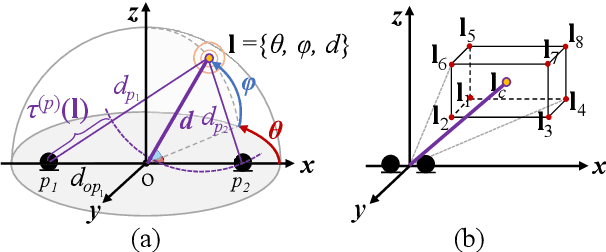
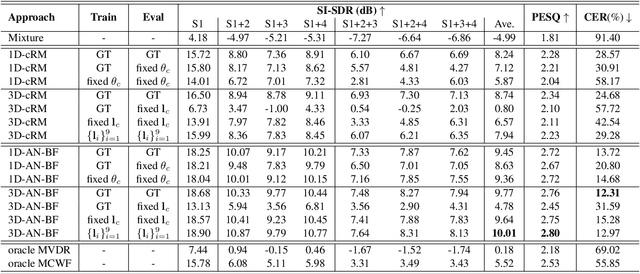
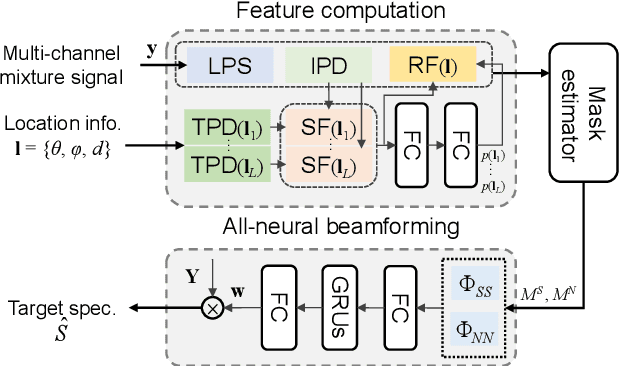
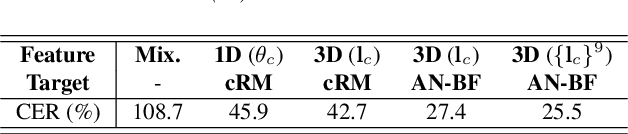
Multi-channel speech separation using speaker's directional information has demonstrated significant gains over blind speech separation. However, it has two limitations. First, substantial performance degradation is observed when the coming directions of two sounds are close. Second, the result highly relies on the precise estimation of the speaker's direction. To overcome these issues, this paper proposes 3D features and an associated 3D neural beamformer for multi-channel speech separation. Previous works in this area are extended in two important directions. First, the traditional 1D directional beam patterns are generalized to 3D. This enables the model to extract speech from any target region in the 3D space. Thus, speakers with similar directions but different elevations or distances become separable. Second, to handle the speaker location uncertainty, previously proposed spatial feature is extended to a new 3D region feature. The proposed 3D region feature and 3D neural beamformer are evaluated under an in-car scenario. Experimental results demonstrated that the combination of 3D feature and 3D beamformer can achieve comparable performance to the separation model with ground truth speaker location as input.
Towards Unified All-Neural Beamforming for Time and Frequency Domain Speech Separation
Dec 24, 2022Recently, frequency domain all-neural beamforming methods have achieved remarkable progress for multichannel speech separation. In parallel, the integration of time domain network structure and beamforming also gains significant attention. This study proposes a novel all-neural beamforming method in time domain and makes an attempt to unify the all-neural beamforming pipelines for time domain and frequency domain multichannel speech separation. The proposed model consists of two modules: separation and beamforming. Both modules perform temporal-spectral-spatial modeling and are trained from end-to-end using a joint loss function. The novelty of this study lies in two folds. Firstly, a time domain directional feature conditioned on the direction of the target speaker is proposed, which can be jointly optimized within the time domain architecture to enhance target signal estimation. Secondly, an all-neural beamforming network in time domain is designed to refine the pre-separated results. This module features with parametric time-variant beamforming coefficient estimation, without explicitly following the derivation of optimal filters that may lead to an upper bound. The proposed method is evaluated on simulated reverberant overlapped speech data derived from the AISHELL-1 corpus. Experimental results demonstrate significant performance improvements over frequency domain state-of-the-arts, ideal magnitude masks and existing time domain neural beamforming methods.