 Add to Chrome
 Add to Firefox
 Add to Edge
Rethinking Positive Pairs in Contrastive Learning
Oct 23, 2024
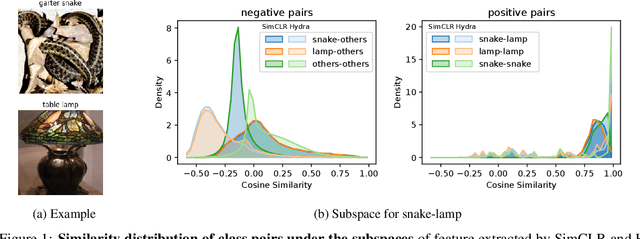
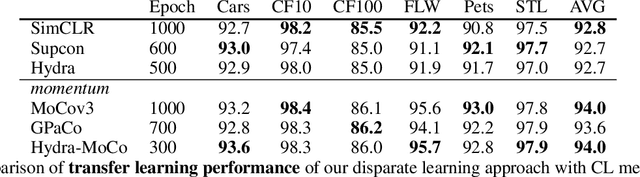
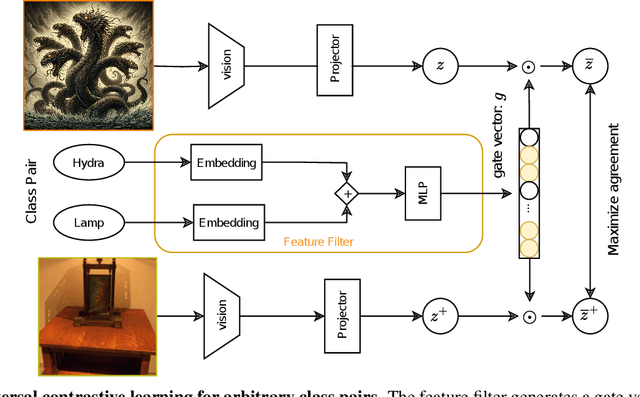
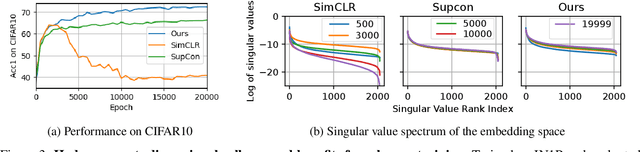
Contrastive learning, a prominent approach to representation learning, traditionally assumes positive pairs are closely related samples (the same image or class) and negative pairs are distinct samples. We challenge this assumption by proposing to learn from arbitrary pairs, allowing any pair of samples to be positive within our framework.The primary challenge of the proposed approach lies in applying contrastive learning to disparate pairs which are semantically distant. Motivated by the discovery that SimCLR can separate given arbitrary pairs (e.g., garter snake and table lamp) in a subspace, we propose a feature filter in the condition of class pairs that creates the requisite subspaces by gate vectors selectively activating or deactivating dimensions. This filter can be optimized through gradient descent within a conventional contrastive learning mechanism. We present Hydra, a universal contrastive learning framework for visual representations that extends conventional contrastive learning to accommodate arbitrary pairs. Our approach is validated using IN1K, where 1K diverse classes compose 500,500 pairs, most of them being distinct. Surprisingly, Hydra achieves superior performance in this challenging setting. Additional benefits include the prevention of dimensional collapse and the discovery of class relationships. Our work highlights the value of learning common features of arbitrary pairs and potentially broadens the applicability of contrastive learning techniques on the sample pairs with weak relationships.

Multi-scale Multi-instance Visual Sound Localization and Segmentation
Aug 31, 2024Visual sound localization is a typical and challenging problem that predicts the location of objects corresponding to the sound source in a video. Previous methods mainly used the audio-visual association between global audio and one-scale visual features to localize sounding objects in each image. Despite their promising performance, they omitted multi-scale visual features of the corresponding image, and they cannot learn discriminative regions compared to ground truths. To address this issue, we propose a novel multi-scale multi-instance visual sound localization framework, namely M2VSL, that can directly learn multi-scale semantic features associated with sound sources from the input image to localize sounding objects. Specifically, our M2VSL leverages learnable multi-scale visual features to align audio-visual representations at multi-level locations of the corresponding image. We also introduce a novel multi-scale multi-instance transformer to dynamically aggregate multi-scale cross-modal representations for visual sound localization. We conduct extensive experiments on VGGSound-Instruments, VGG-Sound Sources, and AVSBench benchmarks. The results demonstrate that the proposed M2VSL can achieve state-of-the-art performance on sounding object localization and segmentation.
MultiMed: Massively Multimodal and Multitask Medical Understanding
Aug 22, 2024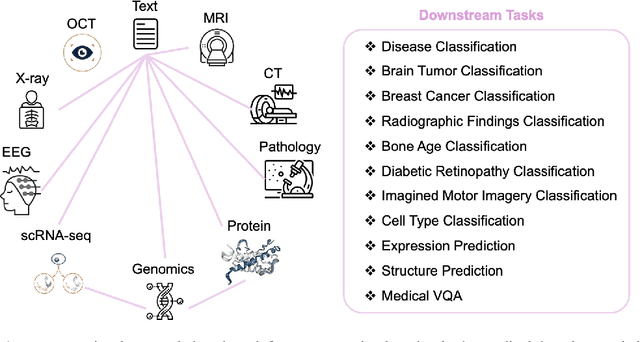

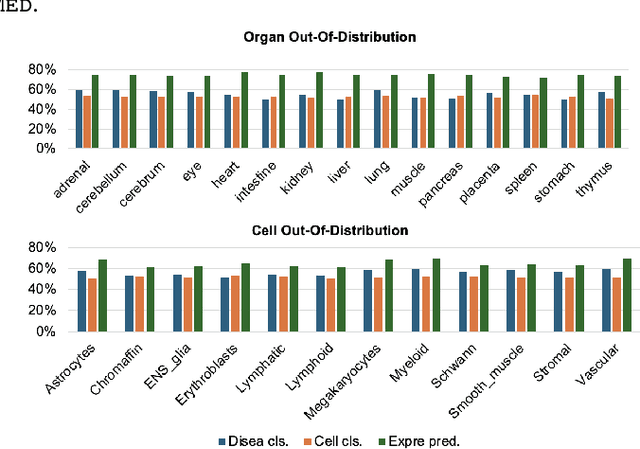
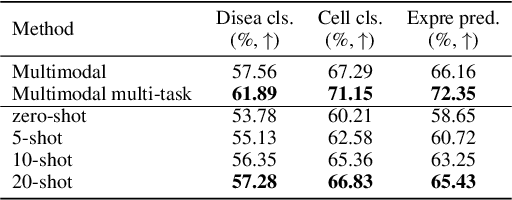
Biomedical data is inherently multimodal, consisting of electronic health records, medical imaging, digital pathology, genome sequencing, wearable sensors, and more. The application of artificial intelligence tools to these multifaceted sensing technologies has the potential to revolutionize the prognosis, diagnosis, and management of human health and disease. However, current approaches to biomedical AI typically only train and evaluate with one or a small set of medical modalities and tasks. This limitation hampers the development of comprehensive tools that can leverage the rich interconnected information across many heterogeneous biomedical sensors. To address this challenge, we present MultiMed, a benchmark designed to evaluate and enable large-scale learning across a wide spectrum of medical modalities and tasks. MultiMed consists of 2.56 million samples across ten medical modalities such as medical reports, pathology, genomics, and protein data, and is structured into eleven challenging tasks, including disease prognosis, protein structure prediction, and medical question answering. Using MultiMed, we conduct comprehensive experiments benchmarking state-of-the-art unimodal, multimodal, and multitask models. Our analysis highlights the advantages of training large-scale medical models across many related modalities and tasks. Moreover, MultiMed enables studies of generalization across related medical concepts, robustness to real-world noisy data and distribution shifts, and novel modality combinations to improve prediction performance. MultiMed will be publicly available and regularly updated and welcomes inputs from the community.
IoT-LM: Large Multisensory Language Models for the Internet of Things
Jul 13, 2024



The Internet of Things (IoT) network integrating billions of smart physical devices embedded with sensors, software, and communication technologies is a critical and rapidly expanding component of our modern world. The IoT ecosystem provides a rich source of real-world modalities such as motion, thermal, geolocation, imaging, depth, sensors, and audio to recognize the states of humans and physical objects. Machine learning presents a rich opportunity to automatically process IoT data at scale, enabling efficient inference for understanding human wellbeing, controlling physical devices, and interconnecting smart cities. To realize this potential, we introduce IoT-LM, an open-source large multisensory language model tailored for the IoT ecosystem. IoT-LM is enabled by two technical contributions: the first is MultiIoT, the most expansive unified IoT dataset to date, encompassing over 1.15 million samples from 12 modalities and 8 tasks prepared for multisensory pre-training and instruction-tuning. The second is a new multisensory multitask adapter layer to condition pre-trained large language models on multisensory IoT data. Not only does IoT-LM yield substantial improvements on 8 supervised IoT classification tasks, but it also demonstrates new interactive question-answering, reasoning, and dialog capabilities conditioned on IoT sensors. We release IoT-LM's data sources and new multisensory language modeling framework.
Semantic Grouping Network for Audio Source Separation
Jul 04, 2024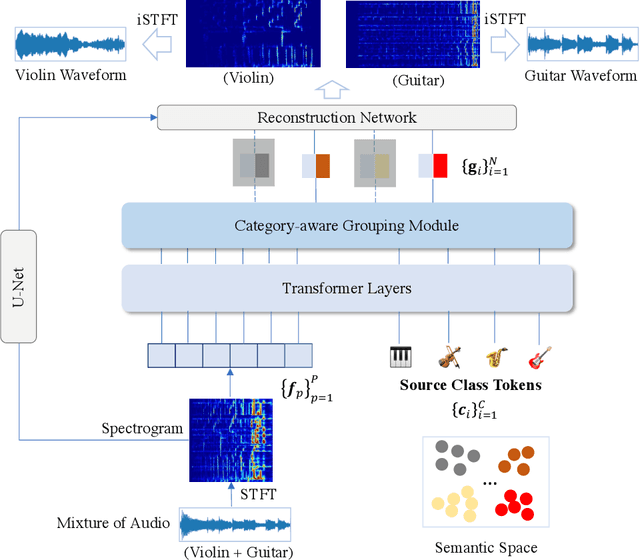
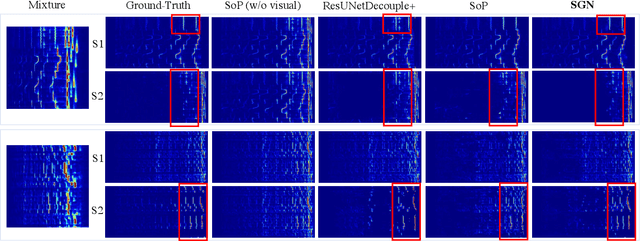
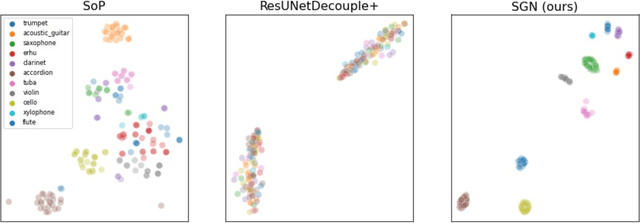

Recently, audio-visual separation approaches have taken advantage of the natural synchronization between the two modalities to boost audio source separation performance. They extracted high-level semantics from visual inputs as the guidance to help disentangle sound representation for individual sources. Can we directly learn to disentangle the individual semantics from the sound itself? The dilemma is that multiple sound sources are mixed together in the original space. To tackle the difficulty, in this paper, we present a novel Semantic Grouping Network, termed as SGN, that can directly disentangle sound representations and extract high-level semantic information for each source from input audio mixture. Specifically, SGN aggregates category-wise source features through learnable class tokens of sounds. Then, the aggregated semantic features can be used as the guidance to separate the corresponding audio sources from the mixture. We conducted extensive experiments on music-only and universal sound separation benchmarks: MUSIC, FUSS, MUSDB18, and VGG-Sound. The results demonstrate that our SGN significantly outperforms previous audio-only methods and audio-visual models without utilizing additional visual cues.
MA-AVT: Modality Alignment for Parameter-Efficient Audio-Visual Transformers
Jun 07, 2024
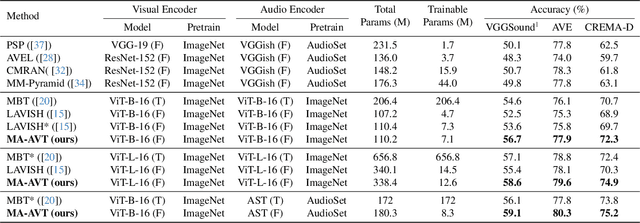


Recent advances in pre-trained vision transformers have shown promise in parameter-efficient audio-visual learning without audio pre-training. However, few studies have investigated effective methods for aligning multimodal features in parameter-efficient audio-visual transformers. In this paper, we propose MA-AVT, a new parameter-efficient audio-visual transformer employing deep modality alignment for corresponding multimodal semantic features. Specifically, we introduce joint unimodal and multimodal token learning for aligning the two modalities with a frozen modality-shared transformer. This allows the model to learn separate representations for each modality, while also attending to the cross-modal relationships between them. In addition, unlike prior work that only aligns coarse features from the output of unimodal encoders, we introduce blockwise contrastive learning to align coarse-to-fine-grain hierarchical features throughout the encoding phase. Furthermore, to suppress the background features in each modality from foreground matched audio-visual features, we introduce a robust discriminative foreground mining scheme. Through extensive experiments on benchmark AVE, VGGSound, and CREMA-D datasets, we achieve considerable performance improvements over SOTA methods.
Efficient 3D Shape Generation via Diffusion Mamba with Bidirectional SSMs
Jun 07, 2024Recent advancements in sequence modeling have led to the development of the Mamba architecture, noted for its selective state space approach, offering a promising avenue for efficient long sequence handling. However, its application in 3D shape generation, particularly at high resolutions, remains underexplored. Traditional diffusion transformers (DiT) with self-attention mechanisms, despite their potential, face scalability challenges due to the cubic complexity of attention operations as input length increases. This complexity becomes a significant hurdle when dealing with high-resolution voxel sizes. To address this challenge, we introduce a novel diffusion architecture tailored for 3D point clouds generation-Diffusion Mamba (DiM-3D). This architecture forgoes traditional attention mechanisms, instead utilizing the inherent efficiency of the Mamba architecture to maintain linear complexity with respect to sequence length. DiM-3D is characterized by fast inference times and substantially lower computational demands, quantified in reduced Gflops, thereby addressing the key scalability issues of prior models. Our empirical results on the ShapeNet benchmark demonstrate that DiM-3D achieves state-of-the-art performance in generating high-fidelity and diverse 3D shapes. Additionally, DiM-3D shows superior capabilities in tasks like 3D point cloud completion. This not only proves the model's scalability but also underscores its efficiency in generating detailed, high-resolution voxels necessary for advanced 3D shape modeling, particularly excelling in environments requiring high-resolution voxel sizes. Through these findings, we illustrate the exceptional scalability and efficiency of the Diffusion Mamba framework in 3D shape generation, setting a new standard for the field and paving the way for future explorations in high-resolution 3D modeling technologies.
DMT-JEPA: Discriminative Masked Targets for Joint-Embedding Predictive Architecture
May 28, 2024
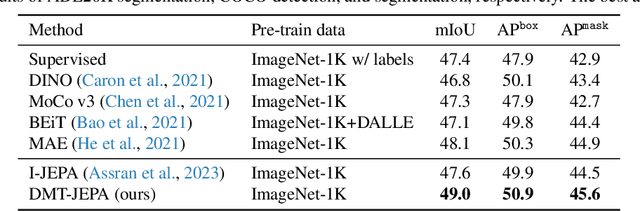

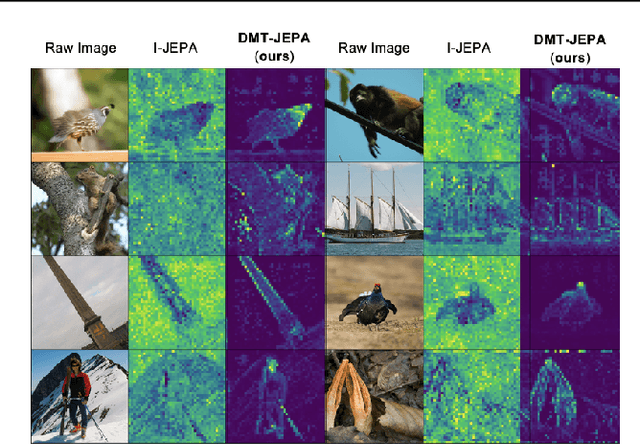
The joint-embedding predictive architecture (JEPA) recently has shown impressive results in extracting visual representations from unlabeled imagery under a masking strategy. However, we reveal its disadvantages, notably its insufficient understanding of local semantics. This deficiency originates from masked modeling in the embedding space, resulting in a reduction of discriminative power and can even lead to the neglect of critical local semantics. To bridge this gap, we introduce DMT-JEPA, a novel masked modeling objective rooted in JEPA, specifically designed to generate discriminative latent targets from neighboring information. Our key idea is simple: we consider a set of semantically similar neighboring patches as a target of a masked patch. To be specific, the proposed DMT-JEPA (a) computes feature similarities between each masked patch and its corresponding neighboring patches to select patches having semantically meaningful relations, and (b) employs lightweight cross-attention heads to aggregate features of neighboring patches as the masked targets. Consequently, DMT-JEPA demonstrates strong discriminative power, offering benefits across a diverse spectrum of downstream tasks. Through extensive experiments, we demonstrate our effectiveness across various visual benchmarks, including ImageNet-1K image classification, ADE20K semantic segmentation, and COCO object detection tasks. Code is available at: \url{https://github.com/DMTJEPA/DMTJEPA}.
Scaling Diffusion Mamba with Bidirectional SSMs for Efficient Image and Video Generation
May 24, 2024In recent developments, the Mamba architecture, known for its selective state space approach, has shown potential in the efficient modeling of long sequences. However, its application in image generation remains underexplored. Traditional diffusion transformers (DiT), which utilize self-attention blocks, are effective but their computational complexity scales quadratically with the input length, limiting their use for high-resolution images. To address this challenge, we introduce a novel diffusion architecture, Diffusion Mamba (DiM), which foregoes traditional attention mechanisms in favor of a scalable alternative. By harnessing the inherent efficiency of the Mamba architecture, DiM achieves rapid inference times and reduced computational load, maintaining linear complexity with respect to sequence length. Our architecture not only scales effectively but also outperforms existing diffusion transformers in both image and video generation tasks. The results affirm the scalability and efficiency of DiM, establishing a new benchmark for image and video generation techniques. This work advances the field of generative models and paves the way for further applications of scalable architectures.
Unified Video-Language Pre-training with Synchronized Audio
May 12, 2024Video-language pre-training is a typical and challenging problem that aims at learning visual and textual representations from large-scale data in a self-supervised way. Existing pre-training approaches either captured the correspondence of image-text pairs or utilized temporal ordering of frames. However, they do not explicitly explore the natural synchronization between audio and the other two modalities. In this work, we propose an enhanced framework for Video-Language pre-training with Synchronized Audio, termed as VLSA, that can learn tri-modal representations in a unified self-supervised transformer. Specifically, our VLSA jointly aggregates embeddings of local patches and global tokens for video, text, and audio. Furthermore, we utilize local-patch masked modeling to learn modality-aware features, and leverage global audio matching to capture audio-guided features for video and text. We conduct extensive experiments on retrieval across text, video, and audio. Our simple model pre-trained on only 0.9M data achieves improving results against state-of-the-art baselines. In addition, qualitative visualizations vividly showcase the superiority of our VLSA in learning discriminative visual-textual representations.