 Add to Chrome
 Add to Firefox
 Add to Edge
The Hidden Evolution of Disguised Visual Context inside the VLM
Jun 18, 2026
Visual tokens enter Large Language Models (LLMs) as raw, foreign signals. How they are transformed into meaningful representations and interact with the language space depends entirely on the integration architecture. Whether by treating visual tokens as in-context prompts within the input sequence or injecting them directly into the LLM's intermediate layers. A controlled comparison and understanding of how these architectural choices affect visual information and its internal transformation to integrate with the LLM remains underexplored. We provide a fair comparison by evaluating in-context and layer-wise injection VLM integration paradigms under identical training conditions across single image, multi-image, and video benchmarks. In doing so, we uncover a hidden evolution where visual tokens enter the LLM as disguised visual context, raw representations lacking linguistic structure, but are progressively reshaped depending on the integration paradigm, each capturing fundamentally different frequency characteristics of the visual signal. We show that this evolution inside the LLM determines what visual features the VLM can utilize effectively, how visual representations align with the language space, and ultimately how each paradigm performs across different tasks. We further demonstrate that attention allocation alone is insufficient, and that performance is driven by the quality of visual representations at each layer.

From Senses to Decisions: The Information Flow of Auditory and Visual Perception in Multimodal LLMs
Jun 08, 2026Multimodal Large Language Models (MLLMs) can listen and see, but how do audio and visual signals actually travel through the network to shape an answer? Despite their growing role in research and real-world applications, the internal pathways through which audio and visual tokens influence the final prediction remain poorly understood. In this study, we examine audio-visual information flow inside Audio-Visual Large Language Models (AVLLMs), tracing how AVLLMs route, utilize, and integrate audio and visual information across two input configurations, audio-visual video and multiple interleaved audio-visual items. We find that for audio-visual video, AVLLMs follow the sequential information flow pathway established for VLMs and VideoLLMs, with audio and visual contribution flowing along this pathway in proportion to the task's reliance on each modality. In settings with multiple interleaved audio-visual items, this routing shifts to different parallel streams. Furthermore, we demonstrate that audio-visual and other token types can be discarded once their information is transferred to LLM, with minimal impact on the model's prediction or even slight improvement, generalizing across multiple tasks and datasets, enabling more efficient inference. These findings hold across multiple models and scales, Qwen2.5-Omni and Video-SALMONN2 Plus at 3B and 7B scales, leading to hypotheses on why these flow structures emerge. Together, these results deliver the first coherent picture of how AVLLMs orchestrate sound and sight inside the network and lay the groundwork for the next wave of interpretability, design, and efficiency advances in audio-visual and broader MLLMs.
Information theoretic underpinning of self-supervised learning by clustering
May 12, 2026Self-supervised learning (SSL) is recognized as an essential tool for building foundation models for Artificial Intelligence applications. The advances in SSL have been made thanks to vigorous arguments about the principles of SSL and through extensive empirical research. The aim of this paper is to contribute to the development of the underpinning theory of SSL, focusing on the deep clustering approach. By analogy to supervised learning, we formulate SSL as K-L divergence optimization. The mode collapse is prevented by imposing an optimisation constraint on the teacher distribution. This leads to normalization using inverse cluster priors. We show that using Jensen inequality this normalization simplifies to the popular batch centering procedure. Distillation and centering are common {heuristics-based} practices in SSL, {but our work underpins them theoretically.} The theoretical model developed not only supports specific existing successful SSL methods, but also suggests directions for future investigations.
See Fair, Speak Truth: Equitable Attention Improves Grounding and Reduces Hallucination in Vision-Language Alignment
Apr 10, 2026Multimodal large language models (MLLMs) frequently hallucinate objects that are absent from the visual input, often because attention during decoding is disproportionately drawn to visually dominant or frequently occurring content. We observe that this inequity in attention allocation is a root cause of object hallucination: when rare, small, or contextually peripheral objects receive insufficient attention, the model fails to ground its generation in the full visual scene. We argue that every object in an image, regardless of its size, frequency or visual salience, deserves equal representational opportunity during decoding. To this end, we propose DOP-OBC, a training-free and architecture-agnostic decoding strategy built on the principle of equitable attention. Two complementary object-aware signals work in tandem: a Dominant Object Penalty (DOP) that softly suppresses attention over-concentration on visually dominant regions, and an Outlier Boost Coefficient (OBC) that amplifies attention toward rare yet confidently detected objects. These signals are injected as per-row logit modulations within the causal attention mask, requiring no weight updates and preserving autoregressive decoding properties. Extensive experiments across image and video MLLMs demonstrate consistent reductions in object hallucination on CHAIR and POPE benchmarks, alongside improvements in GPT-4o assessed captioning quality across correctness, consistency, detail, context and temporal dimensions. DOP-OBC establishes that fairness in attention allocation is not merely a design principle but a practical and effective path toward more faithful multimodal generation.
Domain Adaptation Without the Compute Burden for Efficient Whole Slide Image Analysis
Mar 16, 2026Computational methods on analyzing Whole Slide Images (WSIs) enable early diagnosis and treatments by supporting pathologists in detection and classification of tumors. However, the extremely high resolution of WSIs makes end-to-end training impractical compared to typical image analysis tasks. To address this, most approaches use pre-trained feature extractors to obtain fixed representations of whole slides, which are then combined with Multiple Instance Learning (MIL) for downstream tasks. These feature extractors are typically pre-trained on natural image datasets such as ImageNet, which fail to capture domain-specific characteristics. Although domain-specific pre-training on histopathology data yields more relevant feature representations, it remains computationally expensive and fail to capture task-specific characteristics within the domain. To address the computational cost and lack of task-specificity in domain-specific pre-training, we propose EfficientWSI (eWSI), a careful integration of Parameter-Efficient-Fine-Tuning (PEFT) and Multiple Instance Learning (MIL) that enables end-to-end training on WSI tasks. We evaluate eWSI on seven WSI-level tasks over Camelyon16, TCGA and BRACS datasets. Our results show that eWSI when applied with ImageNet feature extractors yields strong classification performance, matching or outperforming MILs with in-domain feature extractors, alleviating the need for extensive in-domain pre-training. Furthermore, when eWSI is applied with in-domain feature extractors, it further improves classification performance in most cases, demonstrating its ability to capture task-specific information where beneficial. Our findings suggest that eWSI provides a task-targeted, computationally efficient path for WSI tasks, offering a promising direction for task-specific learning in computational pathology.
DC-ViT: Modulating Spatial and Channel Interactions for Multi-Channel Images
Mar 15, 2026Training and evaluation in multi-channel imaging (MCI) remains challenging due to heterogeneous channel configurations arising from varying staining protocols, sensor types, and acquisition settings. This heterogeneity limits the applicability of fixed-channel encoders commonly used in general computer vision. Recent Multi-Channel Vision Transformers (MC-ViTs) address this by enabling flexible channel inputs, typically by jointly encoding patch tokens from all channels within a unified attention space. However, unrestricted token interactions across channels can lead to feature dilution, reducing the ability to preserve channel-specific semantics that are critical in MCI data. To address this, we propose Decoupled Vision Transformer (DC-ViT), which explicitly regulates information sharing using Decoupled Self-Attention (DSA), which decomposes token updates into two complementary pathways: spatial updates that model intra-channel structure, and channel-wise updates that adaptively integrate cross-channel information. This decoupling mitigates informational collapse while allowing selective inter-channel interaction. To further exploit these enhanced channel-specific representations, we introduce Decoupled Aggregation (DAG), which allows the model to learn task-specific channel importances. Extensive experiments across three MCI benchmarks demonstrate consistent improvements over existing MC-ViT approaches.
Channel-Aware Probing for Multi-Channel Imaging
Feb 13, 2026Training and evaluating vision encoders on Multi-Channel Imaging (MCI) data remains challenging as channel configurations vary across datasets, preventing fixed-channel training and limiting reuse of pre-trained encoders on new channel settings. Prior work trains MCI encoders but typically evaluates them via full fine-tuning, leaving probing with frozen pre-trained encoders comparatively underexplored. Existing studies that perform probing largely focus on improving representations, rather than how to best leverage fixed representations for downstream tasks. Although the latter problem has been studied in other domains, directly transferring those strategies to MCI yields weak results, even worse than training from scratch. We therefore propose Channel-Aware Probing (CAP), which exploits the intrinsic inter-channel diversity in MCI datasets by controlling feature flow at both the encoder and probe levels. CAP uses Independent Feature Encoding (IFE) to encode each channel separately, and Decoupled Pooling (DCP) to pool within channels before aggregating across channels. Across three MCI benchmarks, CAP consistently improves probing performance over the default probing protocol, matches fine-tuning from scratch, and largely reduces the gap to full fine-tuning from the same MCI pre-trained checkpoints. Code can be found in https://github.com/umarikkar/CAP.
Dual-Stage Value-Guided Inference with Margin-Based Reward Adjustment for Fast and Faithful VLM Captioning
Jun 18, 2025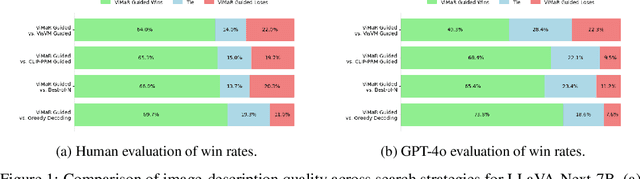
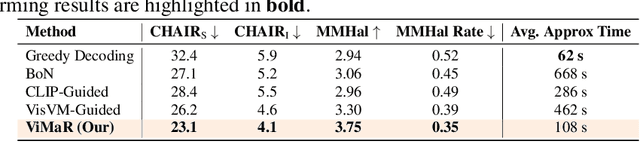
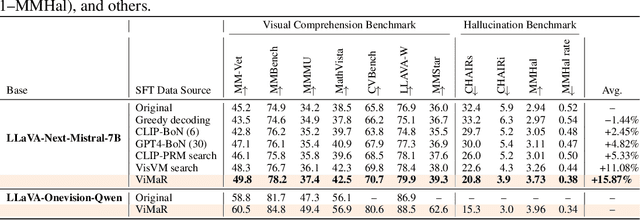

Despite significant advances in inference-time search for vision-language models (VLMs), existing approaches remain both computationally expensive and prone to unpenalized, low-confidence generations which often lead to persistent hallucinations. We introduce \textbf{Value-guided Inference with Margin-based Reward (ViMaR)}, a two-stage inference framework that improves both efficiency and output fidelity by combining a temporal-difference value model with a margin-aware reward adjustment. In the first stage, we perform a single pass to identify the highest-value caption among diverse candidates. In the second stage, we selectively refine only those segments that were overlooked or exhibit weak visual grounding, thereby eliminating frequently rewarded evaluations. A calibrated margin-based penalty discourages low-confidence continuations while preserving descriptive richness. Extensive experiments across multiple VLM architectures demonstrate that ViMaR generates captions that are significantly more reliable, factually accurate, detailed, and explanatory, while achieving over 4$\times$ speedup compared to existing value-guided methods. Specifically, we show that ViMaR trained solely on LLaVA Mistral-7B, \textit{generalizes effectively to guide decoding in a stronger unseen model}. To further validate this, we adapt the ViMaR to steer generation in LLaVA-OneVision-Qwen2-7B, leading to consistent improvements in caption quality and demonstrating robust cross-model guidance. This cross-model generalization highlights ViMaR's flexibility and modularity, positioning it as a scalable and transferable inference-time decoding strategy. Furthermore, when ViMaR-generated captions are used for self-training, the underlying models achieve substantial gains across a broad suite of visual comprehension benchmarks, underscoring the potential of fast, accurate, and self-improving VLM pipelines.
PAL: Probing Audio Encoders via LLMs -- A Study of Information Transfer from Audio Encoders to LLMs
Jun 12, 2025The integration of audio perception capabilities into Large Language Models (LLMs) has enabled significant advances in Audio-LLMs. Although application-focused developments, particularly in curating training data for specific capabilities e.g., audio reasoning, have progressed rapidly, the underlying mechanisms that govern efficient transfer of rich semantic representations from audio encoders to LLMs remain under-explored. We conceptualize effective audio-LLM interaction as the LLM's ability to proficiently probe the audio encoder representations to satisfy textual queries. This paper presents a systematic investigation on how architectural design choices can affect that. Beginning with a standard Pengi/LLaVA-style audio-LLM architecture, we propose and evaluate several modifications guided by hypotheses derived from mechanistic interpretability studies and LLM operational principles. Our experiments demonstrate that: (1) delaying audio integration until the LLM's initial layers establish textual context that enhances its ability to probe the audio representations for relevant information; (2) the LLM can proficiently probe audio representations exclusively through LLM layer's attention submodule, without requiring propagation to its Feed-Forward Network (FFN) submodule; (3) an efficiently integrated ensemble of diverse audio encoders provides richer, complementary representations, thereby broadening the LLM's capacity to probe a wider spectrum of audio information. All hypotheses are evaluated using an identical three-stage training curriculum on a dataset of 5.6 million audio-text pairs, ensuring controlled comparisons. Our final architecture, which incorporates all proposed modifications, achieves relative improvements from 10\% to 60\% over the baseline, validating our approach to optimizing cross-modal information transfer in audio-LLMs. Project page: https://ta012.github.io/PAL/
DeepChest: Dynamic Gradient-Free Task Weighting for Effective Multi-Task Learning in Chest X-ray Classification
May 29, 2025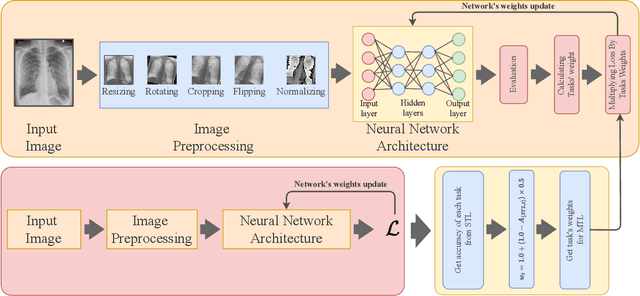
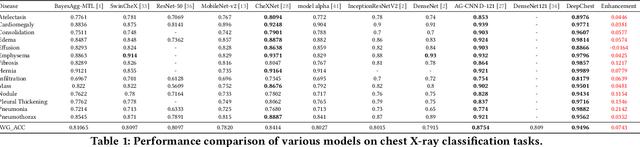
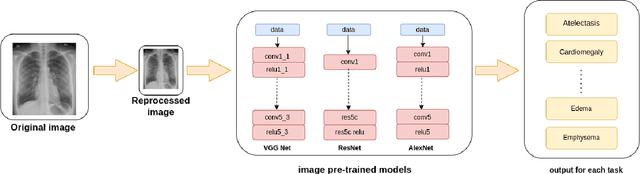
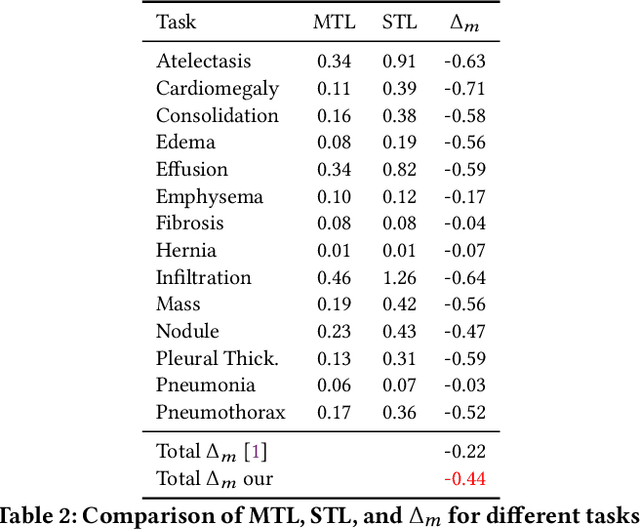
While Multi-Task Learning (MTL) offers inherent advantages in complex domains such as medical imaging by enabling shared representation learning, effectively balancing task contributions remains a significant challenge. This paper addresses this critical issue by introducing DeepChest, a novel, computationally efficient and effective dynamic task-weighting framework specifically designed for multi-label chest X-ray (CXR) classification. Unlike existing heuristic or gradient-based methods that often incur substantial overhead, DeepChest leverages a performance-driven weighting mechanism based on effective analysis of task-specific loss trends. Given a network architecture (e.g., ResNet18), our model-agnostic approach adaptively adjusts task importance without requiring gradient access, thereby significantly reducing memory usage and achieving a threefold increase in training speed. It can be easily applied to improve various state-of-the-art methods. Extensive experiments on a large-scale CXR dataset demonstrate that DeepChest not only outperforms state-of-the-art MTL methods by 7% in overall accuracy but also yields substantial reductions in individual task losses, indicating improved generalization and effective mitigation of negative transfer. The efficiency and performance gains of DeepChest pave the way for more practical and robust deployment of deep learning in critical medical diagnostic applications. The code is publicly available at https://github.com/youssefkhalil320/DeepChest-MTL