 Add to Chrome
 Add to Firefox
 Add to Edge
Admission Without Answers: Label-Free Certification and Experience Learning for LLM-Based Optimization Modeling
Aug 18, 2026
Experience-learning agents for optimization modeling improve by storing verified skills, but existing learners admit knowledge by checking against known answers, which real ticket streams do not provide. The natural label-free alternatives are unreliable: on a 300-problem label-blind stream, admitting every executable model poisons roughly one admission in four, while single-instance agreement accepts models that match at one value but differ elsewhere. We propose AdmitOR, an admission gate built on calibrated external behavioral evidence. Candidates from three model families, prompting strategies, and solver stacks are run on instances resampled from an extracted parameter domain; agreement across the resulting value-function traces is summarized by a cross-family clique, and a calibrated threshold returns accept, abstain, or escalate. The preregistered false-discovery criterion holds on calibration data but not on the wild stream. We report this negative result in full and trace most failures to benchmark texts that do not faithfully encode their labeled instances. Comparing four admission judges on one collection of logs inside a state-of-the-art skill learner, AdmitOR raises admission precision to 0.927, against 0.871 for majority vote and 0.726 for execution success, yielding 3.1x and 8.0x fewer poisoned admissions. Its library is the smallest and attains the highest macro accuracy across five public benchmarks, 58.4 against 54.8 for majority vote and 53.9 for the ground-truth-labeled library. The 3.5-point gain over majority vote is supported by a paired bootstrap and survives correction for a host-side anomaly. To our knowledge, AdmitOR is the first label-free admission mechanism designed around an explicitly calibrated false-discovery target. The transfer failure identifies a necessary condition for extending it to wild streams.

ReLoop: Structured Modeling and Behavioral Verification for Reliable LLM-Based Optimization
Feb 17, 2026Large language models (LLMs) can translate natural language into optimization code, but silent failures pose a critical risk: code that executes and returns solver-feasible solutions may encode semantically incorrect formulations, creating a feasibility-correctness gap of up to 90 percentage points on compositional problems. We introduce ReLoop, addressing silent failures from two complementary directions. Structured generation decomposes code production into a four-stage reasoning chain (understand, formalize, synthesize, verify) that mirrors expert modeling practice, with explicit variable-type reasoning and self-verification to prevent formulation errors at their source. Behavioral verification detects errors that survive generation by testing whether the formulation responds correctly to solver-based parameter perturbation, without requiring ground truth -- an external semantic signal that bypasses the self-consistency problem inherent in LLM-based code review. The two mechanisms are complementary: structured generation dominates on complex compositional problems, while behavioral verification becomes the largest single contributor on problems with localized formulation defects. Together with execution recovery via IIS-enhanced diagnostics, ReLoop raises correctness from 22.6% to 31.1% and execution from 72.1% to 100.0% on the strongest model, with consistent gains across five models spanning three paradigms (foundation, SFT, RL) and three benchmarks. We additionally release RetailOpt-190, 190 compositional retail optimization scenarios targeting the multi-constraint interactions where LLMs most frequently fail.
TwistNet-2D: Learning Second-Order Channel Interactions via Spiral Twisting for Texture Recognition
Feb 06, 2026Second-order feature statistics are central to texture recognition, yet current methods face a fundamental tension: bilinear pooling and Gram matrices capture global channel correlations but collapse spatial structure, while self-attention models spatial context through weighted aggregation rather than explicit pairwise feature interactions. We introduce TwistNet-2D, a lightweight module that computes \emph{local} pairwise channel products under directional spatial displacement, jointly encoding where features co-occur and how they interact. The core component, Spiral-Twisted Channel Interaction (STCI), shifts one feature map along a prescribed direction before element-wise channel multiplication, thereby capturing the cross-position co-occurrence patterns characteristic of structured and periodic textures. Aggregating four directional heads with learned channel reweighting and injecting the result through a sigmoid-gated residual path, \TwistNet incurs only 3.5% additional parameters and 2% additional FLOPs over ResNet-18, yet consistently surpasses both parameter-matched and substantially larger baselines -- including ConvNeXt, Swin Transformer, and hybrid CNN--Transformer architectures -- across four texture and fine-grained recognition benchmarks.
OPAL: Operator-Programmed Algorithms for Landscape-Aware Black-Box Optimization
Dec 14, 2025Black-box optimization often relies on evolutionary and swarm algorithms whose performance is highly problem dependent. We view an optimizer as a short program over a small vocabulary of search operators and learn this operator program separately for each problem instance. We instantiate this idea in Operator-Programmed Algorithms (OPAL), a landscape-aware framework for continuous black-box optimization that uses a small design budget with a standard differential evolution baseline to probe the landscape, builds a $k$-nearest neighbor graph over sampled points, and encodes this trajectory with a graph neural network. A meta-learner then maps the resulting representation to a phase-wise schedule of exploration, restart, and local search operators. On the CEC~2017 test suite, a single meta-trained OPAL policy is statistically competitive with state-of-the-art adaptive differential evolution variants and achieves significant improvements over simpler baselines under nonparametric tests. Ablation studies on CEC~2017 justify the choices for the design phase, the trajectory graph, and the operator-program representation, while the meta-components add only modest wall-clock overhead. Overall, the results indicate that operator-programmed, landscape-aware per-instance design is a practical way forward beyond ad hoc metaphor-based algorithms in black-box optimization.
Time-Fair Benchmarking for Metaheuristics: A Restart-Fair Protocol for Fixed-Time Comparisons
Sep 10, 2025
Numerous purportedly improved metaheuristics claim superior performance based on equivalent function evaluations (FEs), yet often conceal additional computational burdens in more intensive iterations, preprocessing stages, or hyperparameter tuning. This paper posits that wall-clock time, rather than solely FEs, should serve as the principal budgetary constraint for equitable comparisons. We formalize a fixed-time, restart-fair benchmarking protocol wherein each algorithm is allotted an identical wall-clock time budget per problem instance, permitting unrestricted utilization of restarts, early termination criteria, and internal adaptive mechanisms. We advocate for the adoption of anytime performance curves, expected running time (ERT) metrics, and performance profiles that employ time as the cost measure, all aimed at predefined targets. Furthermore, we introduce a concise, reproducible checklist to standardize reporting practices and mitigate undisclosed computational overheads. This approach fosters more credible and practically relevant evaluations of metaheuristic algorithms.
Twisted Convolutional Networks (TCNs): Enhancing Feature Interactions for Non-Spatial Data Classification
Nov 29, 2024Twisted Convolutional Networks (TCNs) are introduced as a novel neural network architecture designed to effectively process one-dimensional data with arbitrary feature order and minimal spatial relationships. Unlike traditional Convolutional Neural Networks (CNNs), which excel at handling structured two-dimensional data like images, TCNs reduce dependency on feature order by combining input features in innovative ways to create new representations. By explicitly enhancing feature interactions and employing diverse feature combinations, TCNs generate richer and more informative representations, making them especially effective for classification tasks on datasets with arbitrary feature arrangements. This paper details the TCN architecture and its feature combination strategy, providing a comprehensive comparison with traditional CNNs, DeepSets, Transformers, and Graph Neural Networks (GNNs). Extensive experiments on benchmark datasets demonstrate that TCNs achieve superior performance, particularly in classification scenarios involving one-dimensional data.
Support Vector Boosting Machine (SVBM): Enhancing Classification Performance with AdaBoost and Residual Connections
Oct 09, 2024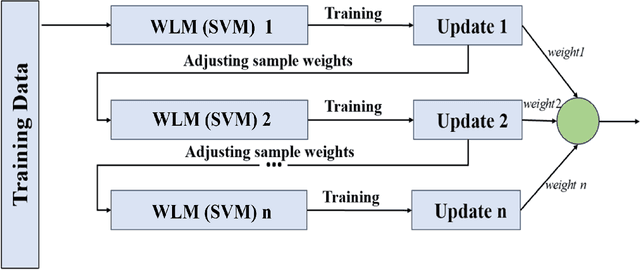
In traditional boosting algorithms, the focus on misclassified training samples emphasizes their importance based on difficulty during the learning process. While using a standard Support Vector Machine (SVM) as a weak learner in an AdaBoost framework can enhance model performance by concentrating on error samples, this approach introduces significant challenges. Specifically, SVMs, characterized by their stability and robustness, may require destabilization to fit the boosting paradigm, which in turn can constrain performance due to reliance on the weighted results from preceding iterations. To address these challenges, we propose the Support Vector Boosting Machine (SVBM), which integrates a novel subsampling process with SVM algorithms and residual connection techniques. This method updates sample weights by considering both the current model's predictions and the outputs from prior rounds, allowing for effective sparsity control. The SVBM framework enhances the ability to form complex decision boundaries, thereby improving classification performance. The MATLAB source code for SVBM can be accessed at https://github.com/junbolian/SVBM.