 Add to Chrome
 Add to Firefox
 Add to Edge
Neural operator learning for collision-aware trajectory planning of spacecraft swarms
Jul 31, 2026
Autonomous spacecraft swarms must plan fuel-efficient, collision-free maneuvers in increasingly congested orbits, yet classical trajectory optimization scales poorly as pairwise safety constraints multiply with swarm size, and learning-based planners rarely transfer across swarm sizes or debris densities. Here we introduce a permutation-equivariant neural operator that maps distributions of spacecraft, targets and debris to collision-aware trajectories for an entire swarm in a single forward pass, paired with a batched Gauss-Newton finish that enforces exact orbital dynamics. The operator is trained without optimal-trajectory labels, combining self-supervised physics objectives with adversarial threats generated against its own rollouts. Trained on ten spacecraft, it generalizes zero-shot to swarms of 1,000 amid more than 11,000 catalogued objects, matching a per-agent optimal-control solver's accuracy, evading worst-case threats that a debris-blind baseline cannot, and reducing proximity within the swarm several-fold. Physics-grounded operator learning thus offers a fast, scalable alternative to optimal control for crowded orbits.

Stress-Sharing: A Bio-Inspired Approach to Decentralized Fault Repair in Modular Spacecraft
Jul 15, 2026Structural damage in modular spacecraft can disrupt mechanical and communication connectivity, reducing system capability. Existing approaches rely on redundancy or preplanned reconfiguration and do not enable autonomous repair under local information and physical constraints. We model the spacecraft as a lattice-constrained graph and introduce a fully decentralized, asynchronous stress-sharing repair policy inspired by biological wound healing: local distress signals guide surviving modules toward damaged regions to close fragmented gaps, after which each displaced module locally retraces its own motions to recover the pre-damage shape, using only local information and no absolute position sensing. We evaluate the policy in PyBullet rigid-body simulation across structures of up to 160 modules, three fault densities (10, 20, 30%), and random and localized damage. The policy consolidates the surviving modules into a single connected body: even in the most severe case tested, where 30% of modules fail at random, it gathers roughly 80% or more of the surviving modules into one connected component, and this fraction improves with assembly size, making the approach well suited as a swarm-scale repair policy for large modular spacecraft.
Multi-Robot Open Adaptive Teaming Across Unseen Environments, Partners, and Scales
Jul 06, 2026Deploying robot teams in the real world requires simultaneous adaptation to unseen environments, unknown partners, and varying team sizes, yet existing approaches often address these challenges in isolation under the closed-world assumption of fixed teammates. We formalize this as open adaptive multi-robot teaming and propose a hypergraphic-form game formulation that captures team-level cooperative relationships beyond pairwise interactions, providing a principled foundation for coordination structure inference when team composition changes dynamically within episodes. Unlike graph neural network architectures, this is a game-theoretic construct for modeling strategic interactions and payoff structures among agents. Building on this formulation, we develop the Hypergraphic Open-ended Learning Algorithm (HOLA), which progressively expands partner and environment diversity during training rather than optimizing for fixed configurations. Evaluated on cooperative pursuit with multi-drone and multi-quadruped platforms, HOLA outperforms all baselines across all three adaptability dimensions. Learned policies transfer directly to physical hardware without fine-tuning, with successful deployments on Crazyflie and Zsibot L1 platforms confirming robust real-world coordination in novel environments with unseen teammates.
DREAM-Chunk: Reactive Action Chunking with Latent World Model
Jun 17, 2026Action chunking has become a common interface for vision-language-action (VLA) models, enabling low-frequency policy inference to drive high-frequency robot execution. However, once an action chunk is committed, its open-loop execution can be brittle under stochastic dynamics, hardware execution errors, and partial observability. We propose DREAM-Chunk, a test-time scaling method that augments chunking-based policies with a lightweight latent world model, without requiring additional policy fine-tuning. At test time, DREAM-Chunk samples multiple candidate action chunks, rolls out their predicted latent futures, and selects actions from the chunk whose predicted state best matches the observed rollout. In this way, DREAM-Chunk uses additional test-time computation to cover multiple plausible stochastic futures and improve reactivity during long-horizon chunk execution. On the Kinetix benchmark, DREAM-Chunk improves robustness under increasing action noise and benefits from larger candidate sample sizes, especially when demonstrations contain corrective behaviors. We further validate DREAM-Chunk on four manipulation tasks across two robot platforms and two VLA policies under various sources of stochasticity. Across simulation and hardware experiments, DREAM-Chunk improves the robustness of action-chunking policies in stochastic dynamics.
Efficient Reinforcement Learning using Linear Koopman Dynamics for Nonlinear Robotic Systems
Apr 21, 2026This paper presents a model-based reinforcement learning (RL) framework for optimal closed-loop control of nonlinear robotic systems. The proposed approach learns linear lifted dynamics through Koopman operator theory and integrates the resulting model into an actor-critic architecture for policy optimization, where the policy represents a parameterized closed-loop controller. To reduce computational cost and mitigate model rollout errors, policy gradients are estimated using one-step predictions of the learned dynamics rather than multi-step propagation. This leads to an online mini-batch policy gradient framework that enables policy improvement from streamed interaction data. The proposed framework is evaluated on several simulated nonlinear control benchmarks and two real-world hardware platforms, including a Kinova Gen3 robotic arm and a Unitree Go1 quadruped. Experimental results demonstrate improved sample efficiency over model-free RL baselines, superior control performance relative to model-based RL baselines, and control performance comparable to classical model-based methods that rely on exact system dynamics.
Online Intention Prediction via Control-Informed Learning
Apr 10, 2026This paper presents an online intention prediction framework for estimating the goal state of autonomous systems in real time, even when intention is time-varying, and system dynamics or objectives include unknown parameters. The problem is formulated as an inverse optimal control / inverse reinforcement learning task, with the intention treated as a parameter in the objective. A shifting horizon strategy discounts outdated information, while online control-informed learning enables efficient gradient computation and online parameter updates. Simulations under varying noise levels and hardware experiments on a quadrotor drone demonstrate that the proposed approach achieves accurate, adaptive intention prediction in complex environments.
Accelerating Sampling-Based Control via Learned Linear Koopman Dynamics
Mar 05, 2026This paper presents an efficient model predictive path integral (MPPI) control framework for systems with complex nonlinear dynamics. To improve the computational efficiency of classic MPPI while preserving control performance, we replace the nonlinear dynamics used for trajectory propagation with a learned linear deep Koopman operator (DKO) model, enabling faster rollout and more efficient trajectory sampling. The DKO dynamics are learned directly from interaction data, eliminating the need for analytical system models. The resulting controller, termed MPPI-DK, is evaluated in simulation on pendulum balancing and surface vehicle navigation tasks, and validated on hardware through reference-tracking experiments on a quadruped robot. Experimental results demonstrate that MPPI-DK achieves control performance close to MPPI with true dynamics while substantially reducing computational cost, enabling efficient real-time control on robotic platforms.
Safe Online Control-Informed Learning
Dec 23, 2025This paper proposes a Safe Online Control-Informed Learning framework for safety-critical autonomous systems. The framework unifies optimal control, parameter estimation, and safety constraints into an online learning process. It employs an extended Kalman filter to incrementally update system parameters in real time, enabling robust and data-efficient adaptation under uncertainty. A softplus barrier function enforces constraint satisfaction during learning and control while eliminating the dependence on high-quality initial guesses. Theoretical analysis establishes convergence and safety guarantees, and the framework's effectiveness is demonstrated on cart-pole and robot-arm systems.
Leveraging Perturbation Robustness to Enhance Out-of-Distribution Detection
Mar 24, 2025Out-of-distribution (OOD) detection is the task of identifying inputs that deviate from the training data distribution. This capability is essential for safely deploying deep computer vision models in open-world environments. In this work, we propose a post-hoc method, Perturbation-Rectified OOD detection (PRO), based on the insight that prediction confidence for OOD inputs is more susceptible to reduction under perturbation than in-distribution (IND) inputs. Based on the observation, we propose an adversarial score function that searches for the local minimum scores near the original inputs by applying gradient descent. This procedure enhances the separability between IND and OOD samples. Importantly, the approach improves OOD detection performance without complex modifications to the underlying model architectures. We conduct extensive experiments using the OpenOOD benchmark~\cite{yang2022openood}. Our approach further pushes the limit of softmax-based OOD detection and is the leading post-hoc method for small-scale models. On a CIFAR-10 model with adversarial training, PRO effectively detects near-OOD inputs, achieving a reduction of more than 10\% on FPR@95 compared to state-of-the-art methods.
Reward-Based Collision-Free Algorithm for Trajectory Planning of Autonomous Robots
Feb 10, 2025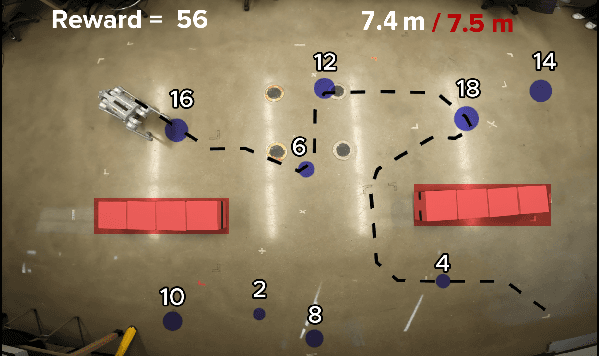
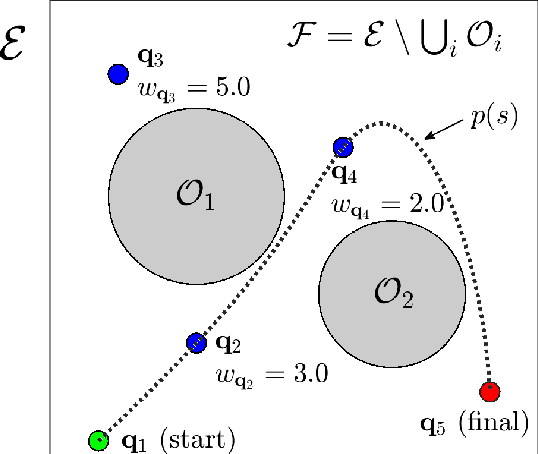
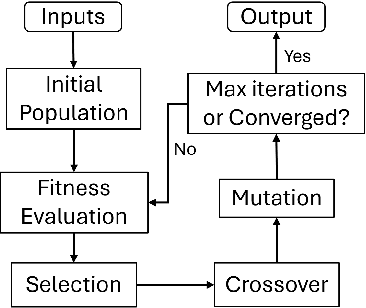
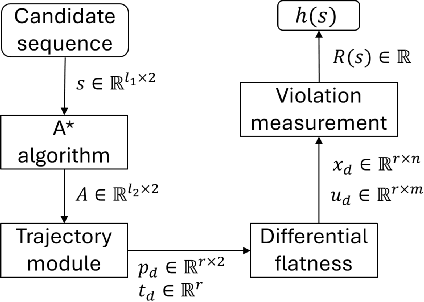
This paper introduces a new mission planning algorithm for autonomous robots that enables the reward-based selection of an optimal waypoint sequence from a predefined set. The algorithm computes a feasible trajectory and corresponding control inputs for a robot to navigate between waypoints while avoiding obstacles, maximizing the total reward, and adhering to constraints on state, input and its derivatives, mission time window, and maximum distance. This also solves a generalized prize-collecting traveling salesman problem. The proposed algorithm employs a new genetic algorithm that evolves solution candidates toward the optimal solution based on a fitness function and crossover. During fitness evaluation, a penalty method enforces constraints, and the differential flatness property with clothoid curves efficiently penalizes infeasible trajectories. The Euler spiral method showed promising results for trajectory parameterization compared to minimum snap and jerk polynomials. Due to the discrete exploration space, crossover is performed using a dynamic time-warping-based method and extended convex combination with projection. A mutation step enhances exploration. Results demonstrate the algorithm's ability to find the optimal waypoint sequence, fulfill constraints, avoid infeasible waypoints, and prioritize high-reward ones. Simulations and experiments with a ground vehicle, quadrotor, and quadruped are presented, complemented by benchmarking and a time-complexity analysis.