 Add to Chrome
 Add to Firefox
 Add to Edge
AD-MIR: Bridging the Gap from Perception to Persuasion in Advertising Video Understanding via Structured Reasoning
Feb 07, 2026
Multimodal understanding of advertising videos is essential for interpreting the intricate relationship between visual storytelling and abstract persuasion strategies. However, despite excelling at general search, existing agents often struggle to bridge the cognitive gap between pixel-level perception and high-level marketing logic. To address this challenge, we introduce AD-MIR, a framework designed to decode advertising intent via a two-stage architecture. First, in the Structure-Aware Memory Construction phase, the system converts raw video into a structured database by integrating semantic retrieval with exact keyword matching. This approach prioritizes fine-grained brand details (e.g., logos, on-screen text) while dynamically filtering out irrelevant background noise to isolate key protagonists. Second, the Structured Reasoning Agent mimics a marketing expert through an iterative inquiry loop, decomposing the narrative to deduce implicit persuasion tactics. Crucially, it employs an evidence-based self-correction mechanism that rigorously validates these insights against specific video frames, automatically backtracking when visual support is lacking. Evaluation on the AdsQA benchmark demonstrates that AD-MIR achieves state-of-the-art performance, surpassing the strongest general-purpose agent, DVD, by 1.8% in strict and 9.5% in relaxed accuracy. These results underscore that effective advertising understanding demands explicitly grounding abstract marketing strategies in pixel-level evidence. The code is available at https://github.com/Little-Fridge/AD-MIR.

Small-Large Collaboration: Training-efficient Concept Personalization for Large VLM using a Meta Personalized Small VLM
Aug 10, 2025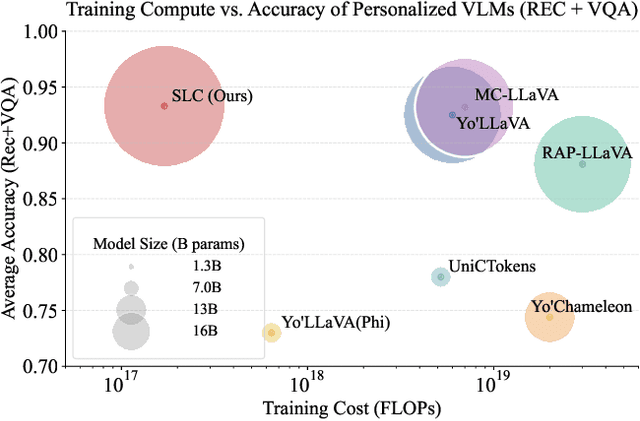

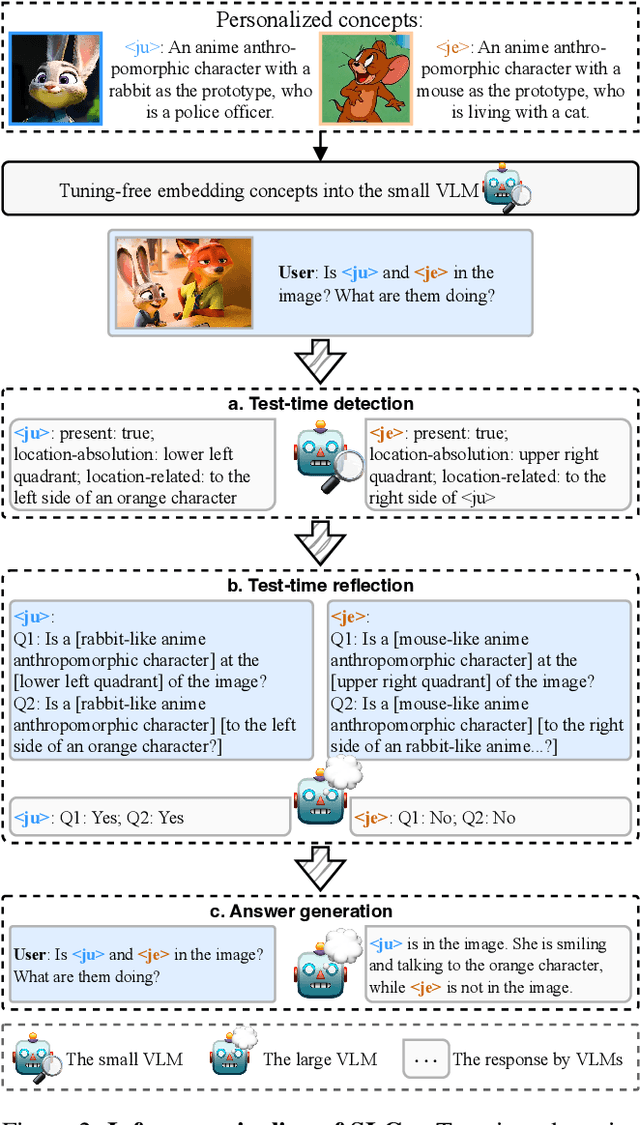
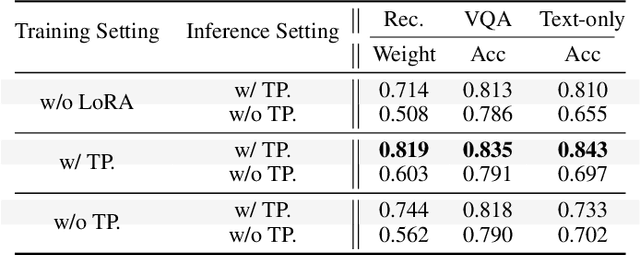
Personalizing Vision-Language Models (VLMs) to transform them into daily assistants has emerged as a trending research direction. However, leading companies like OpenAI continue to increase model size and develop complex designs such as the chain of thought (CoT). While large VLMs are proficient in complex multi-modal understanding, their high training costs and limited access via paid APIs restrict direct personalization. Conversely, small VLMs are easily personalized and freely available, but they lack sufficient reasoning capabilities. Inspired by this, we propose a novel collaborative framework named Small-Large Collaboration (SLC) for large VLM personalization, where the small VLM is responsible for generating personalized information, while the large model integrates this personalized information to deliver accurate responses. To effectively incorporate personalized information, we develop a test-time reflection strategy, preventing the potential hallucination of the small VLM. Since SLC only needs to train a meta personalized small VLM for the large VLMs, the overall process is training-efficient. To the best of our knowledge, this is the first training-efficient framework that supports both open-source and closed-source large VLMs, enabling broader real-world personalized applications. We conduct thorough experiments across various benchmarks and large VLMs to demonstrate the effectiveness of the proposed SLC framework. The code will be released at https://github.com/Hhankyangg/SLC.