 Add to Chrome
 Add to Firefox
 Add to Edge
CARGO-VL: Counterfactual Arbitration with Risk-Constrained Group Optimization for Vision-Language Models
Aug 05, 2026
Vision-language systems combine images with retrieved text, but these sources can disagree or jointly fail to support an answer. Reliable models must identify the trustworthy source and abstain when neither is adequate. Existing post-training objectives score instances independently and therefore do not enforce coherent behavior under counterfactual evidence changes. We introduce CARGO-VL, a group-relative framework that optimizes matched variants covering aligned, image-correct, text-correct, and both-wrong (A/V/T/N) evidence states as one bundle. Its objective couples condition-wise correctness with transition rewards for answer invariance, source equivariance, and answer-to-abstention switching, while a primal-dual controller balances unsafe answers against excessive deferral. We also contribute XMC (eXtended Modal Conflict), a four-condition conflict training resource, and evaluate transfer on CMC-Bench and Modality-Bias. Across multiple seeds, CARGO-VL improves conflict handling, unsupported-answer avoidance, and modality balance over pointwise baselines. Ablations identify complementary benefits from relational transition signals and adaptive risk control, supporting counterfactual consistency as a practical objective for reliable multimodal evidence arbitration.

Not Every Divergence Should Be Suppressed: Counterfactual Recoverability in On-Policy Distillation
Aug 05, 2026On-policy distillation (OPD) supervises student-visited trajectories, yet divergence-based rules cannot determine whether an erroneous prefix remains correctable. We formulate this decision as counterfactual recoverability and replay each error state through budget-matched teacher-continuation and rollback branches. Based on their relative success, states are categorized as recoverable, irreversible-but-avoidable, or ambiguous, and these labels guide whether training retains, rolls back, or conventionally supervises the corresponding trajectory. On AIME branch diagnostics, the mean continuation-minus-rollback effect is 0.185 for recoverable states and -1.000 for irreversible-but-avoidable states, demonstrating opposite intervention preferences. A branch-derived recoverability proxy achieves an AUC of 1.000, substantially outperforming divergence alone at 0.392. Across frozen evaluations, recoverability-aware control achieves the strongest recorded performance, reaching 0.578 success on held-out AIME2025 compared with 0.517 for the best baseline. It also improves AIME2024-2025 average@32 from 0.2656 to 0.3125 and GPQA-Diamond average@32 from 0.2702 to 0.3070. Component ablations further show that retaining teacher-correctable prefixes provides the largest individual contribution. These findings establish recoverability as an outcome-grounded decision variable for selective supervision in OPD.
FAST-GS: Frequency Aware Space-time Gaussian Splatting for Photorealistic Dynamic Novel View Synthesis
Aug 03, 20264D Gaussian Splatting (4DGS) excels in dynamic 3D reconstruction and real-time novel view synthesis via efficient 4D Gaussian representations and parallelizable rendering. However, existing 4DGS approaches rely on a single polynomial to model motion, which limits performance in complex dynamic scenes where high-frequency motion components are prevalent, and fails to ensure long-term stability due to cumulative trajectory drift. To address these issues, we propose a Fourier Motion Modeling module: this paradigm decomposes motion into frequency-based sinusoidal components, capturing both low-frequency global trajectories and high-frequency local details to model complex motion patterns accurately. It retains the real-time rendering capability of 4DGS while improving complex motion fitting and long-term coherence. Additionally, we integrate a motion-aware regularization strategy into the loss function: it uses frequency-dependent weights to suppress high-frequency jitter while preserving low-frequency motion coherence. Extensive experiments on N3V and Google Immersive datasets from multiple scenarios demonstrate the effectiveness of our method.
MTR-DuplexBench: Towards a Comprehensive Evaluation of Multi-Round Conversations for Full-Duplex Speech Language Models
Nov 13, 2025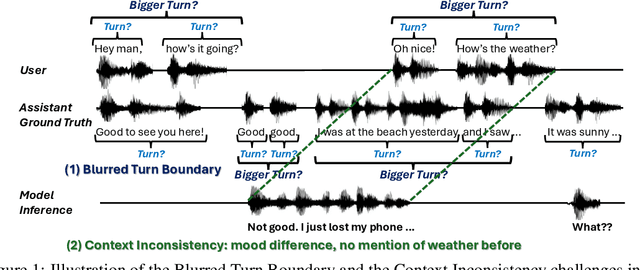
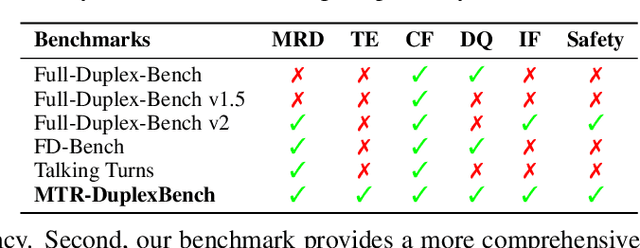
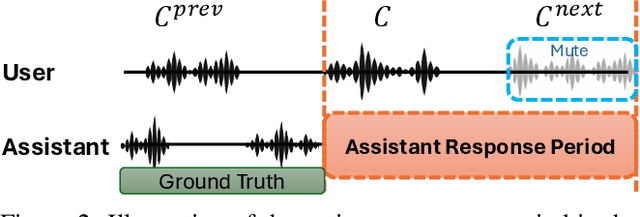

Full-Duplex Speech Language Models (FD-SLMs) enable real-time, overlapping conversational interactions, offering a more dynamic user experience compared to traditional half-duplex models. However, existing benchmarks primarily focus on evaluating single-round interactions and conversational features, neglecting the complexities of multi-round communication and critical capabilities such as instruction following and safety. Evaluating FD-SLMs in multi-round settings poses significant challenges, including blurred turn boundaries in communication and context inconsistency during model inference. To address these gaps, we introduce MTR-DuplexBench, a novel benchmark that segments continuous full-duplex dialogues into discrete turns, enabling comprehensive, turn-by-turn evaluation of FD-SLMs across dialogue quality, conversational dynamics, instruction following, and safety. Experimental results reveal that current FD-SLMs face difficulties in maintaining consistent performance across multiple rounds and evaluation dimensions, highlighting the necessity and effectiveness of our proposed benchmark. The benchmark and code will be available in the future.
In-Hand Re-grasp Manipulation with Passive Dynamic Actions via Imitation Learning
Sep 27, 2023Re-grasp manipulation leverages on ergonomic tools to assist humans in accomplishing diverse tasks. In certain scenarios, humans often employ external forces to effortlessly and precisely re-grasp tools like a hammer. Previous development on controllers for in-grasp sliding motion using passive dynamic actions (e.g.,gravity) relies on apprehension of finger-object contact information, and requires customized design for individual objects with varied geometry and weight distribution. It limits their adaptability to diverse objects. In this paper, we propose an end-to-end sliding motion controller based on imitation learning (IL) that necessitates minimal prior knowledge of object mechanics, relying solely on object position information. To expedite training convergence, we utilize a data glove to collect expert data trajectories and train the policy through Generative Adversarial Imitation Learning (GAIL). Simulation results demonstrate the controller's versatility in performing in-hand sliding tasks with objects of varying friction coefficients, geometric shapes, and masses. By migrating to a physical system using visual position estimation, the controller demonstrated an average success rate of 86%, surpassing the baseline algorithm's success rate of 35% of Behavior Cloning(BC) and 20% of Proximal Policy Optimization (PPO).
Eigen component analysis: A quantum theory incorporated machine learning technique to find linearly maximum separable components
Apr 03, 2020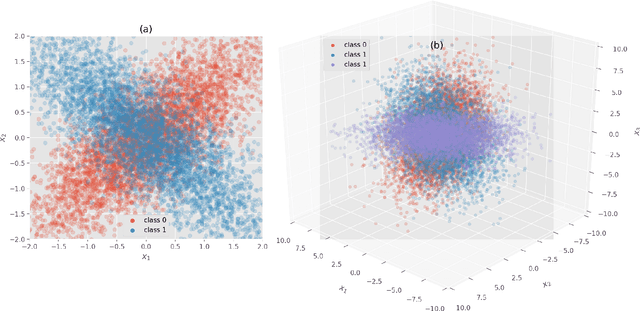
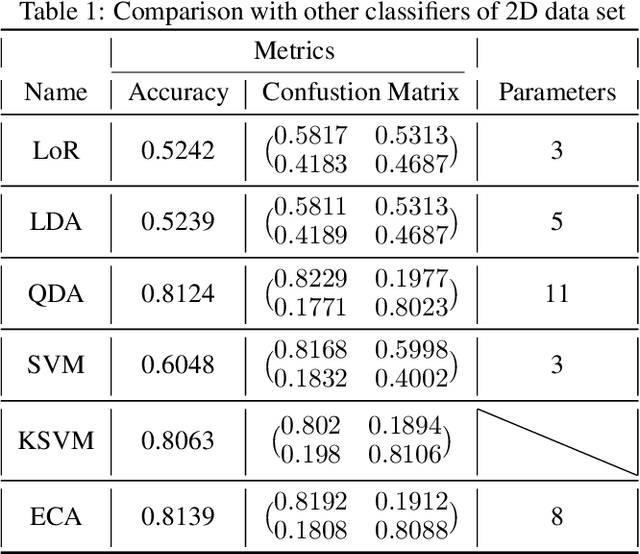

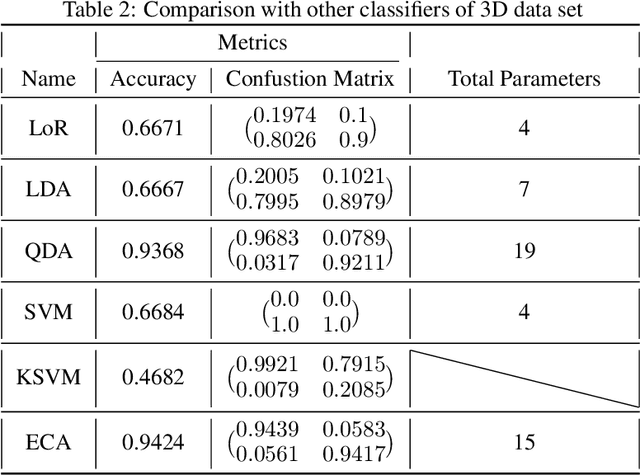
For a linear system, the response to a stimulus is often superposed by its responses to other decomposed stimuli. In quantum mechanics, a state is the superposition of multiple eigenstates. Here, by taking advantage of the phase difference, a common feature as we identified in data sets, we propose eigen component analysis (ECA), an interpretable linear learning model that incorporates the principle of quantum mechanics into the design of algorithm design for feature extraction, classification, dictionary and deep learning, and adversarial generation, etc. The simulation of ECA, possessing a measurable $class\text{-}label$ $\mathcal{H}$, on a classical computer outperforms the existing classical linear models. Eigen component analysis network (ECAN), a network of concatenated ECA models, enhances ECA and gains the potential to be not only integrated with nonlinear models, but also an interface for deep neural networks to implement on a quantum computer, by analogizing a data set as recordings of quantum states. Therefore, ECA and ECAN promise to expand the feasibility of linear learning models, by adopting the strategy of quantum machine learning to replace heavy nonlinear models with succinct linear operations in tackling complexity.