 Add to Chrome
 Add to Firefox
 Add to Edge
Distribution Normalization: An "Effortless" Test-Time Augmentation for Contrastively Learned Visual-language Models
Feb 22, 2023
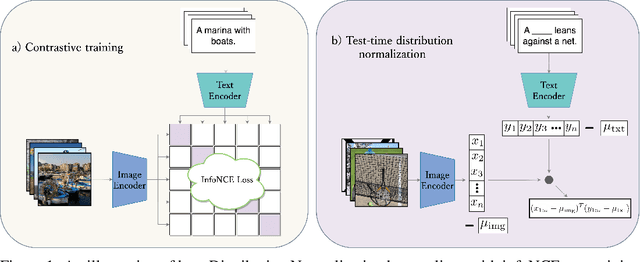
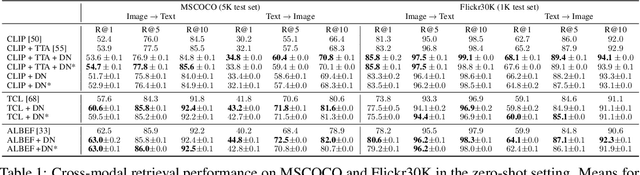
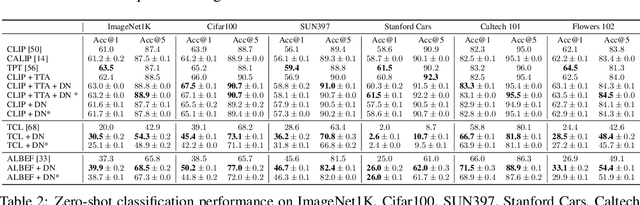
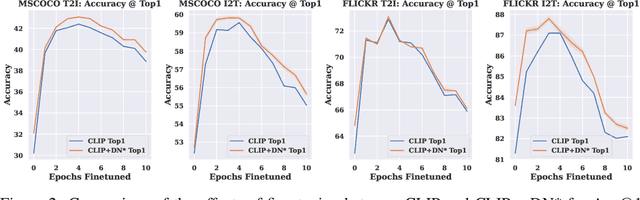
Advances in the field of visual-language contrastive learning have made it possible for many downstream applications to be carried out efficiently and accurately by simply taking the dot product between image and text representations. One of the most representative approaches proposed recently known as CLIP has quickly garnered widespread adoption due to its effectiveness. CLIP is trained with an InfoNCE loss that takes into account both positive and negative samples to help learn a much more robust representation space. This paper however reveals that the common downstream practice of taking a dot product is only a zeroth-order approximation of the optimization goal, resulting in a loss of information during test-time. Intuitively, since the model has been optimized based on the InfoNCE loss, test-time procedures should ideally also be in alignment. The question lies in how one can retrieve any semblance of negative samples information during inference. We propose Distribution Normalization (DN), where we approximate the mean representation of a batch of test samples and use such a mean to represent what would be analogous to negative samples in the InfoNCE loss. DN requires no retraining or fine-tuning and can be effortlessly applied during inference. Extensive experiments on a wide variety of downstream tasks exhibit a clear advantage of DN over the dot product.

Online Backfilling with No Regret for Large-Scale Image Retrieval
Jan 10, 2023Backfilling is the process of re-extracting all gallery embeddings from upgraded models in image retrieval systems. It inevitably requires a prohibitively large amount of computational cost and even entails the downtime of the service. Although backward-compatible learning sidesteps this challenge by tackling query-side representations, this leads to suboptimal solutions in principle because gallery embeddings cannot benefit from model upgrades. We address this dilemma by introducing an online backfilling algorithm, which enables us to achieve a progressive performance improvement during the backfilling process while not sacrificing the final performance of new model after the completion of backfilling. To this end, we first propose a simple distance rank merge technique for online backfilling. Then, we incorporate a reverse transformation module for more effective and efficient merging, which is further enhanced by adopting a metric-compatible contrastive learning approach. These two components help to make the distances of old and new models compatible, resulting in desirable merge results during backfilling with no extra computational overhead. Extensive experiments show the effectiveness of our framework on four standard benchmarks in various settings.
Open Vocabulary Semantic Segmentation with Patch Aligned Contrastive Learning
Dec 09, 2022We introduce Patch Aligned Contrastive Learning (PACL), a modified compatibility function for CLIP's contrastive loss, intending to train an alignment between the patch tokens of the vision encoder and the CLS token of the text encoder. With such an alignment, a model can identify regions of an image corresponding to a given text input, and therefore transfer seamlessly to the task of open vocabulary semantic segmentation without requiring any segmentation annotations during training. Using pre-trained CLIP encoders with PACL, we are able to set the state-of-the-art on the task of open vocabulary zero-shot segmentation on 4 different segmentation benchmarks: Pascal VOC, Pascal Context, COCO Stuff and ADE20K. Furthermore, we show that PACL is also applicable to image-level predictions and when used with a CLIP backbone, provides a general improvement in zero-shot classification accuracy compared to CLIP, across a suite of 12 image classification datasets.
PyTorch Adapt
Nov 28, 2022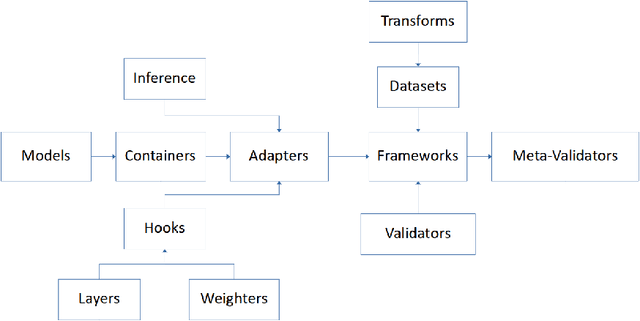
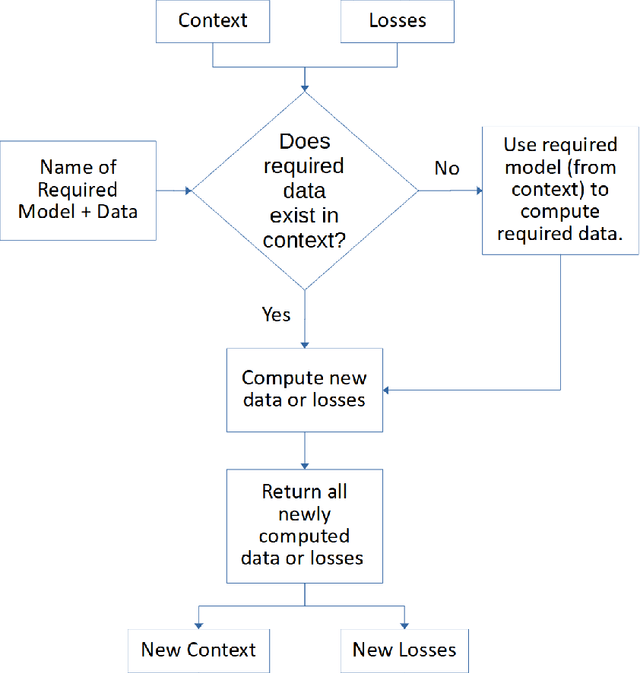
PyTorch Adapt is a library for domain adaptation, a type of machine learning algorithm that re-purposes existing models to work in new domains. It is a fully-featured toolkit, allowing users to create a complete train/test pipeline in a few lines of code. It is also modular, so users can import just the parts they need, and not worry about being locked into a framework. One defining feature of this library is its customizability. In particular, complex training algorithms can be easily modified and combined, thanks to a system of composable, lazily-evaluated hooks. In this technical report, we explain in detail these features and the overall design of the library. Code is available at https://www.github.com/KevinMusgrave/pytorch-adapt
A Unified Model for Tracking and Image-Video Detection Has More Power
Nov 20, 2022


Objection detection (OD) has been one of the most fundamental tasks in computer vision. Recent developments in deep learning have pushed the performance of image OD to new heights by learning-based, data-driven approaches. On the other hand, video OD remains less explored, mostly due to much more expensive data annotation needs. At the same time, multi-object tracking (MOT) which requires reasoning about track identities and spatio-temporal trajectories, shares similar spirits with video OD. However, most MOT datasets are class-specific (e.g., person-annotated only), which constrains a model's flexibility to perform tracking on other objects. We propose TrIVD (Tracking and Image-Video Detection), the first framework that unifies image OD, video OD, and MOT within one end-to-end model. To handle the discrepancies and semantic overlaps across datasets, TrIVD formulates detection/tracking as grounding and reasons about object categories via visual-text alignments. The unified formulation enables cross-dataset, multi-task training, and thus equips TrIVD with the ability to leverage frame-level features, video-level spatio-temporal relations, as well as track identity associations. With such joint training, we can now extend the knowledge from OD data, that comes with much richer object category annotations, to MOT and achieve zero-shot tracking capability. Experiments demonstrate that TrIVD achieves state-of-the-art performances across all image/video OD and MOT tasks.
CNeRV: Content-adaptive Neural Representation for Visual Data
Nov 18, 2022Compression and reconstruction of visual data have been widely studied in the computer vision community, even before the popularization of deep learning. More recently, some have used deep learning to improve or refine existing pipelines, while others have proposed end-to-end approaches, including autoencoders and implicit neural representations, such as SIREN and NeRV. In this work, we propose Neural Visual Representation with Content-adaptive Embedding (CNeRV), which combines the generalizability of autoencoders with the simplicity and compactness of implicit representation. We introduce a novel content-adaptive embedding that is unified, concise, and internally (within-video) generalizable, that compliments a powerful decoder with a single-layer encoder. We match the performance of NeRV, a state-of-the-art implicit neural representation, on the reconstruction task for frames seen during training while far surpassing for frames that are skipped during training (unseen images). To achieve similar reconstruction quality on unseen images, NeRV needs 120x more time to overfit per-frame due to its lack of internal generalization. With the same latent code length and similar model size, CNeRV outperforms autoencoders on reconstruction of both seen and unseen images. We also show promising results for visual data compression. More details can be found in the project pagehttps://haochen-rye.github.io/CNeRV/
$BT^2$: Backward-compatible Training with Basis Transformation
Nov 08, 2022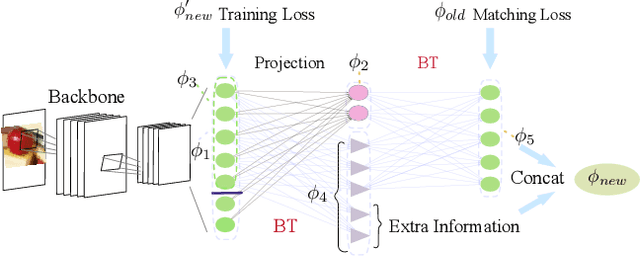
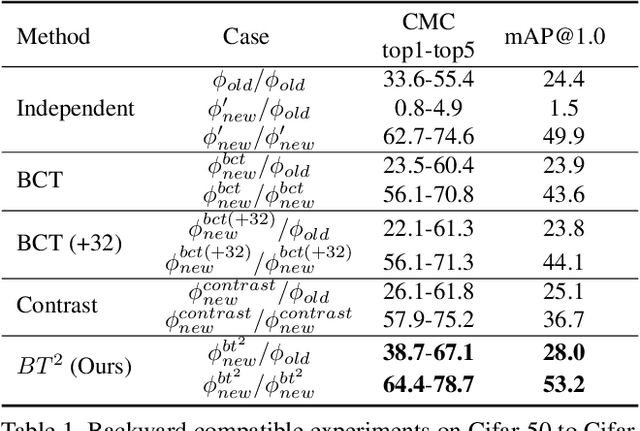
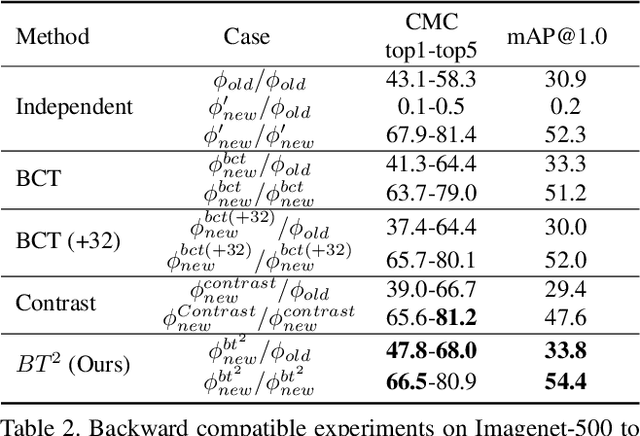
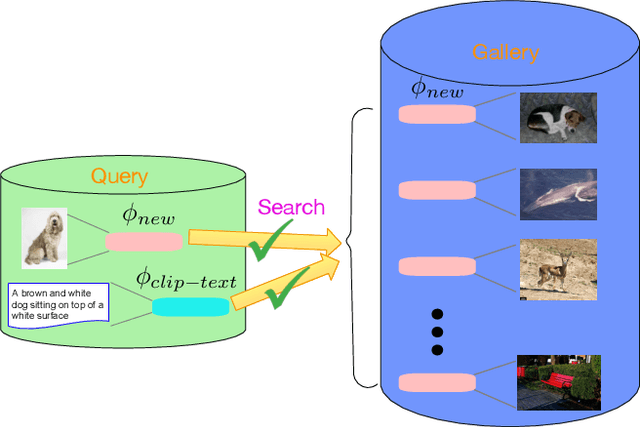
Modern retrieval system often requires recomputing the representation of every piece of data in the gallery when updating to a better representation model. This process is known as backfilling and can be especially costly in the real world where the gallery often contains billions of samples. Recently, researchers have proposed the idea of Backward Compatible Training (BCT) where the new representation model can be trained with an auxiliary loss to make it backward compatible with the old representation. In this way, the new representation can be directly compared with the old representation, in principle avoiding the need for any backfilling. However, followup work shows that there is an inherent tradeoff where a backward compatible representation model cannot simultaneously maintain the performance of the new model itself. This paper reports our ``not-so-surprising'' finding that adding extra dimensions to the representation can help here. However, we also found that naively increasing the dimension of the representation did not work. To deal with this, we propose Backward-compatible Training with a novel Basis Transformation ($BT^2$). A basis transformation (BT) is basically a learnable set of parameters that applies an orthonormal transformation. Such a transformation possesses an important property whereby the original information contained in its input is retained in its output. We show in this paper how a BT can be utilized to add only the necessary amount of additional dimensions. We empirically verify the advantage of $BT^2$ over other state-of-the-art methods in a wide range of settings. We then further extend $BT^2$ to other challenging yet more practical settings, including significant change in model architecture (CNN to Transformers), modality change, and even a series of updates in the model architecture mimicking the evolution of deep learning models.
GAPX: Generalized Autoregressive Paraphrase-Identification X
Oct 05, 2022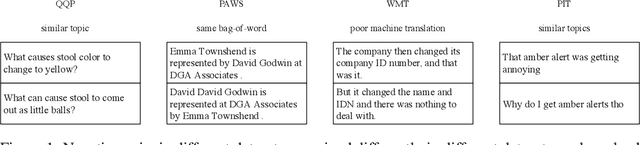
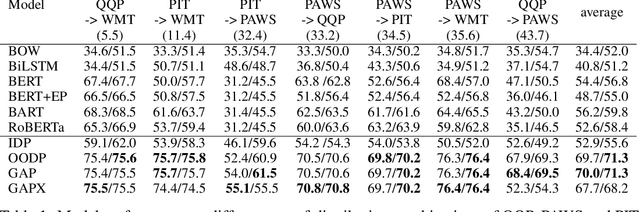
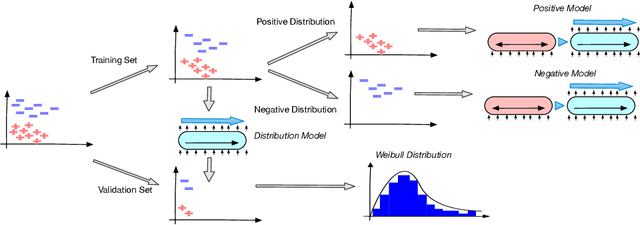
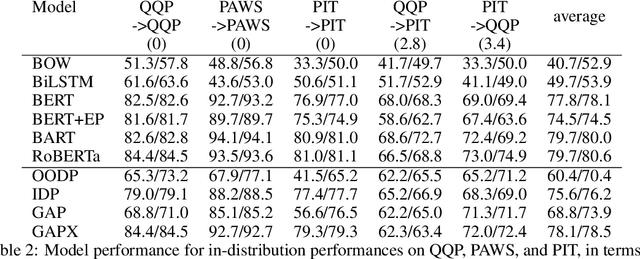
Paraphrase Identification is a fundamental task in Natural Language Processing. While much progress has been made in the field, the performance of many state-of-the-art models often suffer from distribution shift during inference time. We verify that a major source of this performance drop comes from biases introduced by negative examples. To overcome these biases, we propose in this paper to train two separate models, one that only utilizes the positive pairs and the other the negative pairs. This enables us the option of deciding how much to utilize the negative model, for which we introduce a perplexity based out-of-distribution metric that we show can effectively and automatically determine how much weight it should be given during inference. We support our findings with strong empirical results.
Diversified Dynamic Routing for Vision Tasks
Sep 26, 2022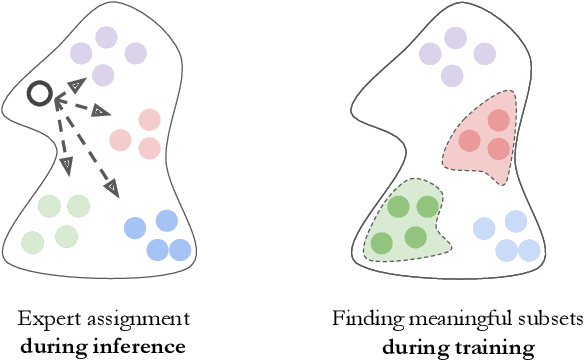
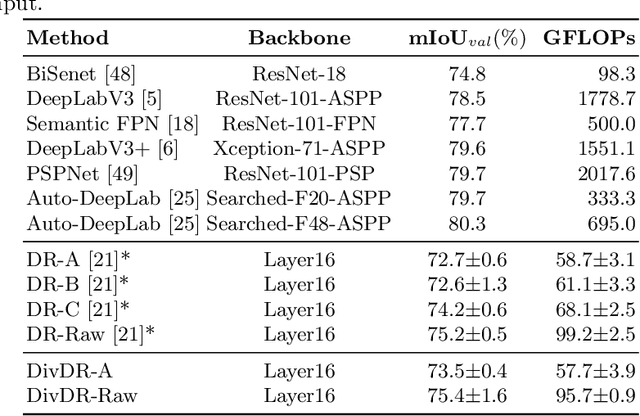
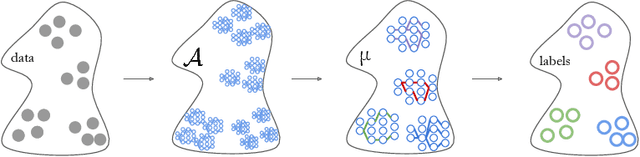
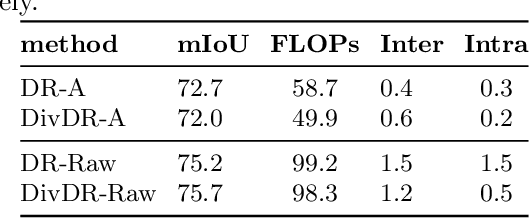
Deep learning models for vision tasks are trained on large datasets under the assumption that there exists a universal representation that can be used to make predictions for all samples. Whereas high complexity models are proven to be capable of learning such representations, a mixture of experts trained on specific subsets of the data can infer the labels more efficiently. However using mixture of experts poses two new problems, namely (i) assigning the correct expert at inference time when a new unseen sample is presented. (ii) Finding the optimal partitioning of the training data, such that the experts rely the least on common features. In Dynamic Routing (DR) a novel architecture is proposed where each layer is composed of a set of experts, however without addressing the two challenges we demonstrate that the model reverts to using the same subset of experts. In our method, Diversified Dynamic Routing (DivDR) the model is explicitly trained to solve the challenge of finding relevant partitioning of the data and assigning the correct experts in an unsupervised approach. We conduct several experiments on semantic segmentation on Cityscapes and object detection and instance segmentation on MS-COCO showing improved performance over several baselines.
Totems: Physical Objects for Verifying Visual Integrity
Sep 26, 2022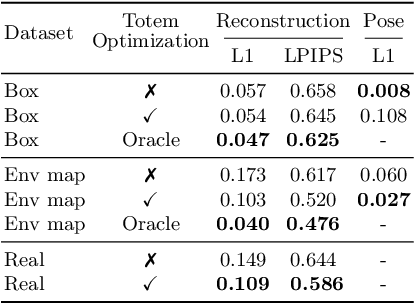
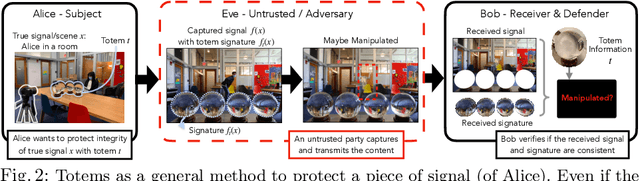
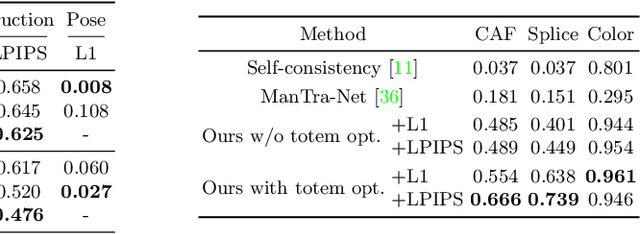
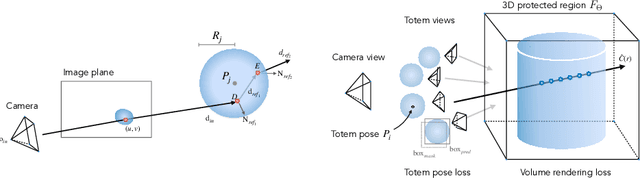
We introduce a new approach to image forensics: placing physical refractive objects, which we call totems, into a scene so as to protect any photograph taken of that scene. Totems bend and redirect light rays, thus providing multiple, albeit distorted, views of the scene within a single image. A defender can use these distorted totem pixels to detect if an image has been manipulated. Our approach unscrambles the light rays passing through the totems by estimating their positions in the scene and using their known geometric and material properties. To verify a totem-protected image, we detect inconsistencies between the scene reconstructed from totem viewpoints and the scene's appearance from the camera viewpoint. Such an approach makes the adversarial manipulation task more difficult, as the adversary must modify both the totem and image pixels in a geometrically consistent manner without knowing the physical properties of the totem. Unlike prior learning-based approaches, our method does not require training on datasets of specific manipulations, and instead uses physical properties of the scene and camera to solve the forensics problem.