 Add to Chrome
 Add to Firefox
 Add to Edge
RoboPCA: Pose-centered Affordance Learning from Human Demonstrations for Robot Manipulation
Mar 08, 2026
Understanding spatial affordances -- comprising the contact regions of object interaction and the corresponding contact poses -- is essential for robots to effectively manipulate objects and accomplish diverse tasks. However, existing spatial affordance prediction methods mainly focus on locating the contact regions while delegating the pose to independent pose estimation approaches, which can lead to task failures due to inconsistencies between predicted contact regions and candidate poses. In this work, we propose RoboPCA, a pose-centered affordance prediction framework that jointly predicts task-appropriate contact regions and poses conditioned on instructions. To enable scalable data collection for pose-centered affordance learning, we devise Human2Afford, a data curation pipeline that automatically recovers scene-level 3D information and infers pose-centered affordance annotations from human demonstrations. With Human2Afford, scene depth and the interaction object's mask are extracted to provide 3D context and object localization, while pose-centered affordance annotations are obtained by tracking object points within the contact region and analyzing hand-object interaction patterns to establish a mapping from the 3D hand mesh to the robot end-effector orientation. By integrating geometry-appearance cues through an RGB-D encoder and incorporating mask-enhanced features to emphasize task-relevant object regions into the diffusion-based framework, RoboPCA outperforms baseline methods on image datasets, simulation, and real robots, and exhibits strong generalization across tasks and categories.

Robotic Programmer: Video Instructed Policy Code Generation for Robotic Manipulation
Jan 08, 2025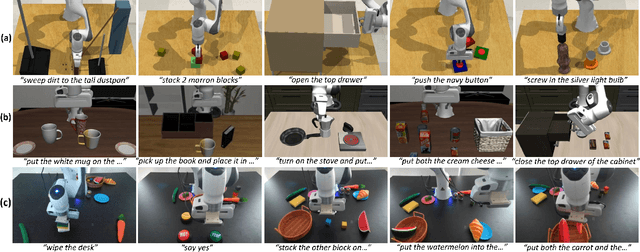
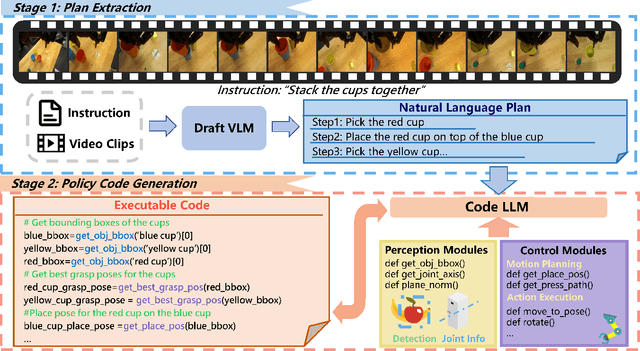
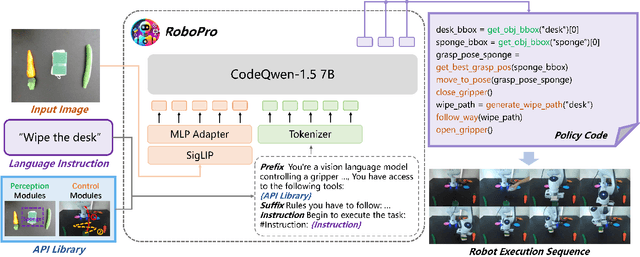
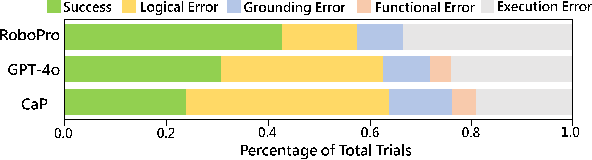
Zero-shot generalization across various robots, tasks and environments remains a significant challenge in robotic manipulation. Policy code generation methods use executable code to connect high-level task descriptions and low-level action sequences, leveraging the generalization capabilities of large language models and atomic skill libraries. In this work, we propose Robotic Programmer (RoboPro), a robotic foundation model, enabling the capability of perceiving visual information and following free-form instructions to perform robotic manipulation with policy code in a zero-shot manner. To address low efficiency and high cost in collecting runtime code data for robotic tasks, we devise Video2Code to synthesize executable code from extensive videos in-the-wild with off-the-shelf vision-language model and code-domain large language model. Extensive experiments show that RoboPro achieves the state-of-the-art zero-shot performance on robotic manipulation in both simulators and real-world environments. Specifically, the zero-shot success rate of RoboPro on RLBench surpasses the state-of-the-art model GPT-4o by 11.6%, which is even comparable to a strong supervised training baseline. Furthermore, RoboPro is robust to variations on API formats and skill sets.