 Add to Chrome
 Add to Firefox
 Add to Edge
AuricularWorld: Hierarchical Action-Guided World Modeling for Fine-Grained Auricular Structure Segmentation from CT Scans
Jul 30, 2026
Fine-grained segmentation of auricular structures in CT is challenging because the ear occupies a small image region, cartilage boundaries are highly irregular, and interfaces between cartilage and surrounding soft tissues are often ambiguous. Clinical annotations may also include both composite structures containing cartilage and adjacent skin and their corresponding cartilage-only regions, producing nested and overlapping labels. We propose a world-model-based segmentation framework that enables iterative anatomical reasoning beyond conventional feed-forward prediction. Built on an encoder-decoder architecture, the framework introduces a deterministic recurrent state-space model into the intermediate latent space. Multi-scale encoder features and partially decoded representations are fused to form a structural observation that initializes the latent dynamics. During inference, the model performs a three-step latent rollout without ground-truth guidance. Hierarchical anatomical actions update the recurrent state and progressively refine the latent representation. The resulting latent trajectory is projected back into the decoder and combined with high-resolution features to produce the final segmentation. To learn reliable latent transitions, we introduce a balanced hierarchical action objective that addresses foreground sparsity, missing anatomical groups, and imbalance between add and remove operations. Extensive experiments show that the proposed framework consistently improves segmentation accuracy and reduces HD95 by more than 43% for small, irregular, and overlapping auricular structures in CT. These results demonstrate the effectiveness of latent world-model reasoning for challenging medical image segmentation.

Costal Cartilage Segmentation with Topology Guided Deformable Mamba: Method and Benchmark
Aug 14, 2024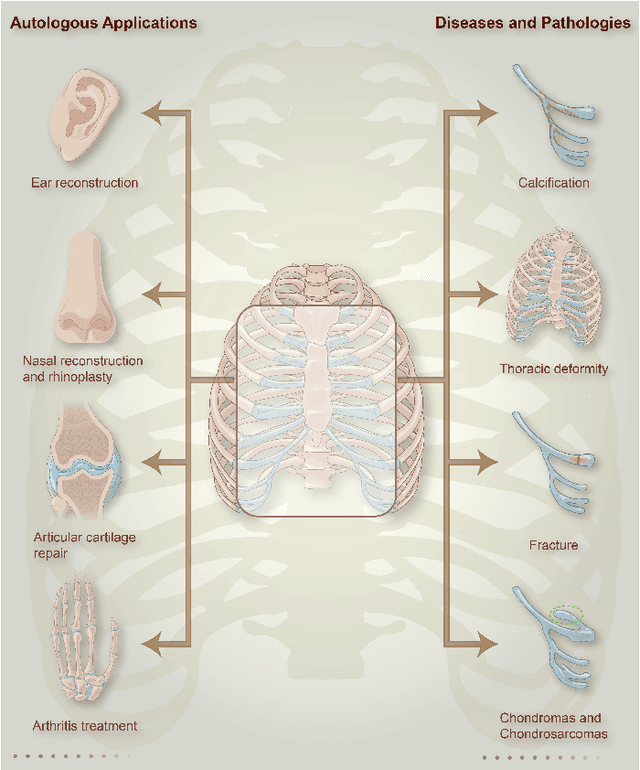


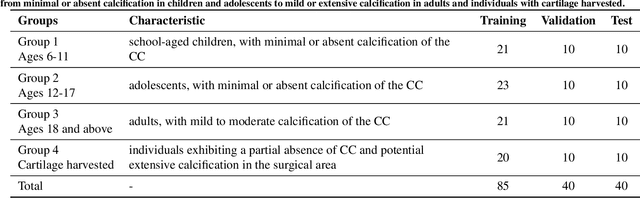
Costal cartilage segmentation is crucial to various medical applications, necessitating precise and reliable techniques due to its complex anatomy and the importance of accurate diagnosis and surgical planning. We propose a novel deep learning-based approach called topology-guided deformable Mamba (TGDM) for costal cartilage segmentation. The TGDM is tailored to capture the intricate long-range costal cartilage relationships. Our method leverages a deformable model that integrates topological priors to enhance the adaptability and accuracy of the segmentation process. Furthermore, we developed a comprehensive benchmark that contains 165 cases for costal cartilage segmentation. This benchmark sets a new standard for evaluating costal cartilage segmentation techniques and provides a valuable resource for future research. Extensive experiments conducted on both in-domain benchmarks and out-of domain test sets demonstrate the superiority of our approach over existing methods, showing significant improvements in segmentation precision and robustness.
Exploring RNN-Transducer for Chinese Speech Recognition
Nov 13, 2018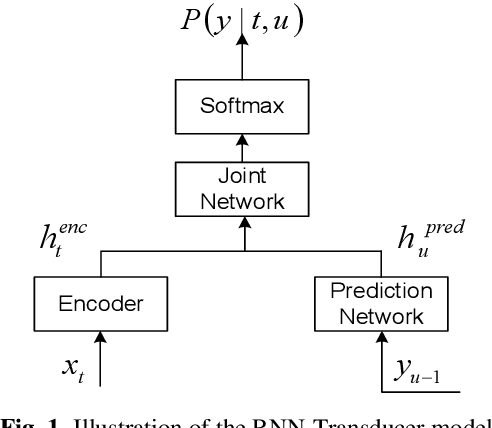
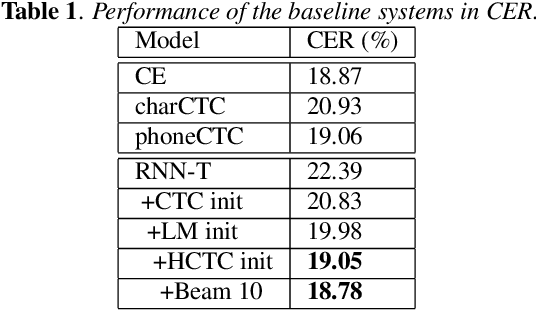
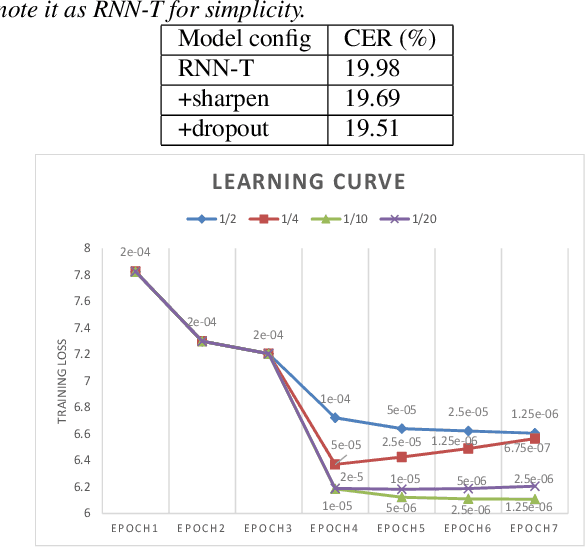
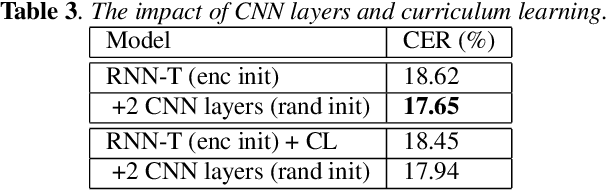
End-to-end approaches have drawn much attention recently for significantly simplifying the construction of an automatic speech recognition (ASR) system. RNN transducer (RNN-T) is one of the popular end-to-end methods. Previous studies have shown that RNN-T is difficult to train and a very complex training process is needed for a reasonable performance. In this paper, we explore RNN-T for a Chinese large vocabulary continuous speech recognition (LVCSR) task and aim to simplify the training process while maintaining performance. First, a new strategy of learning rate decay is proposed to accelerate the model convergence. Second, we find that adding convolutional layers at the beginning of the network and using ordered data can discard the pre-training process of the encoder without loss of performance. Besides, we design experiments to find a balance among the usage of GPU memory, training circle and model performance. Finally, we achieve 16.9% character error rate (CER) on our test set which is 2% absolute improvement from a strong BLSTM CE system with language model trained on the same text corpus.