 Add to Chrome
 Add to Firefox
 Add to Edge
From Dyad to Triad: Eliciting XAI Requirements in Stroke Rehabilitation
Jul 28, 2026
Eliciting explainable AI (XAI) requirements from stroke survivors presents a methodological challenge with direct implications for the design of trustworthy brain-computer interfaces for rehabilitation. How can patients and caregivers articulate preferences about algorithmic transparency when they lack conceptual frameworks for explainability, and when standard elicitation approaches are structurally inadequate for users with acquired communication disorders? We present a video-based scaffolding protocol for XAI requirements elicitation, developed and piloted in a rehabilitation context. In a formative study with three stroke survivors (two with moderate-to-severe aphasia) and three caregivers, facilitators employed four scaffolding approaches alongside the videos: 1) analogical bridging mapping AI states to familiar systems, 2) projective personas depersonalising sensitive topics, 3) binary forcing reducing cognitive load, and 4) extended response time. These approaches successfully surfaced heterogeneous, sometimes conflicting XAI needs across participants. Reflexive analysis additionally revealed three systematic facilitation biases, namely, normative bias, hypothesis confirmation bias, and presence effect, where scaffolding inadvertently shaped responses. We present these as protocol risk guidelines for practitioners. Together, the protocol and guidelines constitute a reusable methodological contribution for eliciting patient-facing XAI requirements in rehabilitation, arguing that such elicitation is a necessary prerequisite for trustworthy human-machine systems design, not an optional preliminary.

EEGForceFusion: Joint Tokenised-Continuous Representation Learning for Subject-Independent Grasp Force Decoding
Jul 27, 2026Brain-machine interfaces provide a link between neural activity and external devices, enabling restoration of motor function and advancing human-machine interaction using non-invasive electroencephalography (EEG). However, continuous grasp force decoding remains challenging due to complex temporal dynamics, high inter-subject variability, and limited generalisation of existing approaches. To address this, we propose a hybrid EEG decoding framework that jointly models continuous and tokenised representations, enabling capture of both fine-grained neural structure and long-range temporal dependencies. The proposed approach integrates convolutional-recurrent representation learning, quantisation-based tokenisation, and transformer-based temporal modelling within a unified fusion-based regression architecture. Experimental evaluation on the WAY-EEG-GAL dataset under strict leave-one-subject-out conditions achieves $R^2$ = 0.817 in offline settings and $R^2$ = 0.793 in simulated real-time evaluation, with latency suitable for real-time deployment. These results demonstrate strong cross-subject generalisation and highlight the practicality of hybrid continuous-tokenised representations for real-time EEG-based force decoding in assistive robotics, neuro-rehabilitation, and human-machine interaction.
SwitchBraidNet: Quantisation-Aware Lightweight Architecture for Hybrid Brain-Computer Interface
Jun 17, 2026Hybrid brain-computer interfaces (BCIs) that integrate motor imagery (MI) and steady-state visual evoked potentials (SSVEP) provide high-dimensional neural decoding but typically exceed the computational limits of embedded hardware. To address this, we propose SwitchBraidNet, a compact EEG classification architecture designed for low-power deployment. The model employs a dual-path temporal braid to extract multiscale oscillatory features, an adaptive squeeze-and-excitation spatial switch for electrode gating, and a log-variance readout layer for direct band-power encoding. Furthermore, through systematic quantisation-aware training on the OpenBMI dataset, we compared SwitchBraidNet against four established baselines across FP32, FP16, and INT8 precisions. Experimental results demonstrate superior efficiency and performance, achieving MI accuracy of 69.49% (FP16), SSVEP accuracy of 93.48% (FP32), and a hybrid information transfer rate of 64.82 bits/min (FP16). With an INT8 footprint of only 3.03 KB, SwitchBraidNet maintains high accuracy across varying numerical precisions, demonstrating its suitability for low-power embedded BCI deployment.
RL-ACRGNet: Reinforcement Learning-Based Chest Radiology Report Generation Network
Jun 01, 2026Medical imaging interpretation is a foundational pillar of modern clinical diagnostics, yet the manual generation of radiology reports remains a time-consuming process prone to interpretation inconsistencies. Within the field of medical AI, automating these descriptions through deep learning promises to streamline clinical workflows and standardise diagnostic output. However, accurate disease detection and precise report generation remain significant challenges due to limitations in capturing fine-grained visual features and ensuring clinical coherence. To address these issues, we propose RL-ACRGNet, an improved encoder-decoder model that integrates a pre-trained DenseNet encoder with a multilevel LSTM decoder within an off-policy reinforcement learning framework. Using a dual-network approach to refine visual-semantic embeddings through a metric-based reward mechanism, we demonstrate that RL-ACRGNet consistently outperforms state-of-the-art baselines on the IU-Xray dataset, achieving quantitative improvements in BLEU-4 (0.47%), METEOR (0.17%) and ROUGE-L (0.518). Furthermore, comprehensive evaluations on the large-scale MIMIC-CXR data set confirm the robust generalisation of the model and its ability to generate high-quality, clinically relevant reports
A Domain-Informed Multi-Objective Framework for EEG Channel Selection in Motor Imagery BCIs
May 28, 2026Motor imagery (MI) classification using electroencephalography (EEG) signals is essential for advancing brain-computer interfaces (BCIs). Traditional EEG channel selection methods often face limitations, such as dependency on single-objective criteria and susceptibility to local optima. To address these challenges, this work proposes a multi-objective optimisation framework that employs non-dominated sorting genetic algorithm, multiple-objective particle swarm optimisation, and a multi-objective evolutionary algorithm based on decomposition. Our approach effectively balances spatial relevance, using a Gaussian kernel, and functional discriminability, which assesses intratrial task-related desynchronisation, thereby improving performance. We evaluated this framework on four EEG datasets: Physionet, OpenBMI, HighGamma, and BCIIV-2A. The proposed approach successfully identifies compact, relevant channel subsets concentrated around sensorimotor cortex regions linked to MI activity, addressing the prevalent challenges of dimensionality and complexity inherent to traditional techniques. Furthermore, the framework achieved classification performance of 87%, 71%, 75%, and 65% on the Physionet, OpenBMI, HighGamma, and BCIIV-2A datasets, respectively. By outperforming existing single-objective and accuracy-based methods, and those relying on fixed subsets, these findings demonstrate that this new multi-objective optimisation framework can enhance MI-based BCI performance while facilitating compact channel configurations with reduced computational complexity, making them better suited for wearable, portable, and real-time BCI applications.
SkeySpot: Automating Service Key Detection for Digital Electrical Layout Plans in the Construction Industry
Aug 14, 2025Legacy floor plans, often preserved only as scanned documents, remain essential resources for architecture, urban planning, and facility management in the construction industry. However, the lack of machine-readable floor plans render large-scale interpretation both time-consuming and error-prone. Automated symbol spotting offers a scalable solution by enabling the identification of service key symbols directly from floor plans, supporting workflows such as cost estimation, infrastructure maintenance, and regulatory compliance. This work introduces a labelled Digitised Electrical Layout Plans (DELP) dataset comprising 45 scanned electrical layout plans annotated with 2,450 instances across 34 distinct service key classes. A systematic evaluation framework is proposed using pretrained object detection models for DELP dataset. Among the models benchmarked, YOLOv8 achieves the highest performance with a mean Average Precision (mAP) of 82.5\%. Using YOLOv8, we develop SkeySpot, a lightweight, open-source toolkit for real-time detection, classification, and quantification of electrical symbols. SkeySpot produces structured, standardised outputs that can be scaled up for interoperable building information workflows, ultimately enabling compatibility across downstream applications and regulatory platforms. By lowering dependency on proprietary CAD systems and reducing manual annotation effort, this approach makes the digitisation of electrical layouts more accessible to small and medium-sized enterprises (SMEs) in the construction industry, while supporting broader goals of standardisation, interoperability, and sustainability in the built environment.
Quantifying Spatial Domain Explanations in BCI using Earth Mover's Distance
May 02, 2024
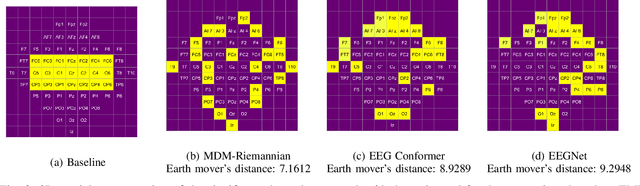


Brain-computer interface (BCI) systems facilitate unique communication between humans and computers, benefiting severely disabled individuals. Despite decades of research, BCIs are not fully integrated into clinical and commercial settings. It's crucial to assess and explain BCI performance, offering clear explanations for potential users to avoid frustration when it doesn't work as expected. This work investigates the efficacy of different deep learning and Riemannian geometry-based classification models in the context of motor imagery (MI) based BCI using electroencephalography (EEG). We then propose an optimal transport theory-based approach using earth mover's distance (EMD) to quantify the comparison of the feature relevance map with the domain knowledge of neuroscience. For this, we utilized explainable AI (XAI) techniques for generating feature relevance in the spatial domain to identify important channels for model outcomes. Three state-of-the-art models are implemented - 1) Riemannian geometry-based classifier, 2) EEGNet, and 3) EEG Conformer, and the observed trend in the model's accuracy across different architectures on the dataset correlates with the proposed feature relevance metrics. The models with diverse architectures perform significantly better when trained on channels relevant to motor imagery than data-driven channel selection. This work focuses attention on the necessity for interpretability and incorporating metrics beyond accuracy, underscores the value of combining domain knowledge and quantifying model interpretations with data-driven approaches in creating reliable and robust Brain-Computer Interfaces (BCIs).
MultiFusionNet: Multilayer Multimodal Fusion of Deep Neural Networks for Chest X-Ray Image Classification
Jan 01, 2024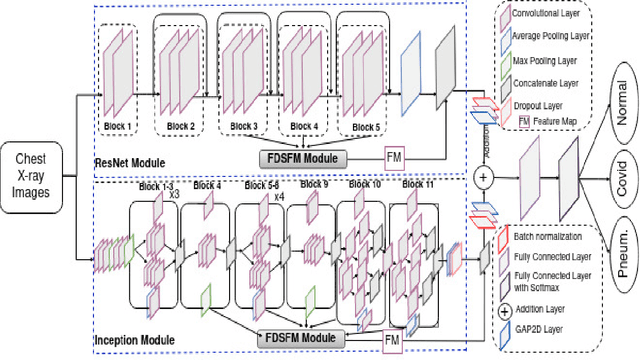
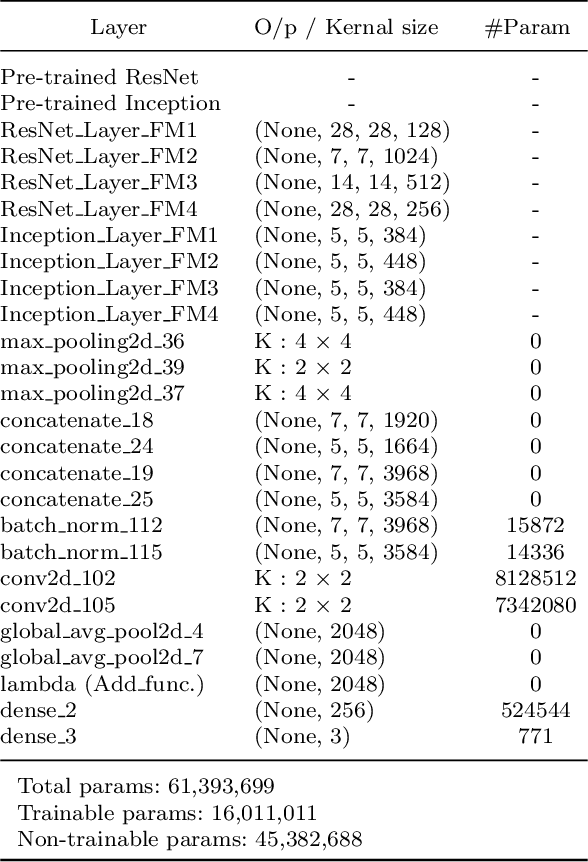


Chest X-ray imaging is a critical diagnostic tool for identifying pulmonary diseases. However, manual interpretation of these images is time-consuming and error-prone. Automated systems utilizing convolutional neural networks (CNNs) have shown promise in improving the accuracy and efficiency of chest X-ray image classification. While previous work has mainly focused on using feature maps from the final convolution layer, there is a need to explore the benefits of leveraging additional layers for improved disease classification. Extracting robust features from limited medical image datasets remains a critical challenge. In this paper, we propose a novel deep learning-based multilayer multimodal fusion model that emphasizes extracting features from different layers and fusing them. Our disease detection model considers the discriminatory information captured by each layer. Furthermore, we propose the fusion of different-sized feature maps (FDSFM) module to effectively merge feature maps from diverse layers. The proposed model achieves a significantly higher accuracy of 97.21% and 99.60% for both three-class and two-class classifications, respectively. The proposed multilayer multimodal fusion model, along with the FDSFM module, holds promise for accurate disease classification and can also be extended to other disease classifications in chest X-ray images.
Explainable artificial intelligence approaches for brain-computer interfaces: a review and design space
Dec 20, 2023This review paper provides an integrated perspective of Explainable Artificial Intelligence techniques applied to Brain-Computer Interfaces. BCIs use predictive models to interpret brain signals for various high-stake applications. However, achieving explainability in these complex models is challenging as it compromises accuracy. The field of XAI has emerged to address the need for explainability across various stakeholders, but there is a lack of an integrated perspective in XAI for BCI (XAI4BCI) literature. It is necessary to differentiate key concepts like explainability, interpretability, and understanding in this context and formulate a comprehensive framework. To understand the need of XAI for BCI, we pose six key research questions for a systematic review and meta-analysis, encompassing its purposes, applications, usability, and technical feasibility. We employ the PRISMA methodology -- preferred reporting items for systematic reviews and meta-analyses to review (n=1246) and analyze (n=84) studies published in 2015 and onwards for key insights. The results highlight that current research primarily focuses on interpretability for developers and researchers, aiming to justify outcomes and enhance model performance. We discuss the unique approaches, advantages, and limitations of XAI4BCI from the literature. We draw insights from philosophy, psychology, and social sciences. We propose a design space for XAI4BCI, considering the evolving need to visualize and investigate predictive model outcomes customised for various stakeholders in the BCI development and deployment lifecycle. This paper is the first to focus solely on reviewing XAI4BCI research articles. This systematic review and meta-analysis findings with the proposed design space prompt important discussions on establishing standards for BCI explanations, highlighting current limitations, and guiding the future of XAI in BCI.