 Add to Chrome
 Add to Firefox
 Add to Edge
Open3DTrack: Towards Open-Vocabulary 3D Multi-Object Tracking
Oct 02, 2024
3D multi-object tracking plays a critical role in autonomous driving by enabling the real-time monitoring and prediction of multiple objects' movements. Traditional 3D tracking systems are typically constrained by predefined object categories, limiting their adaptability to novel, unseen objects in dynamic environments. To address this limitation, we introduce open-vocabulary 3D tracking, which extends the scope of 3D tracking to include objects beyond predefined categories. We formulate the problem of open-vocabulary 3D tracking and introduce dataset splits designed to represent various open-vocabulary scenarios. We propose a novel approach that integrates open-vocabulary capabilities into a 3D tracking framework, allowing for generalization to unseen object classes. Our method effectively reduces the performance gap between tracking known and novel objects through strategic adaptation. Experimental results demonstrate the robustness and adaptability of our method in diverse outdoor driving scenarios. To the best of our knowledge, this work is the first to address open-vocabulary 3D tracking, presenting a significant advancement for autonomous systems in real-world settings. Code, trained models, and dataset splits are available publicly.

CDChat: A Large Multimodal Model for Remote Sensing Change Description
Sep 24, 2024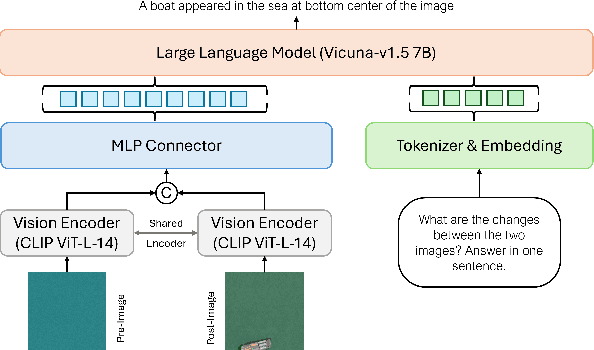
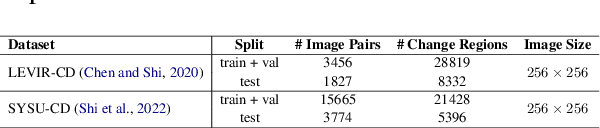
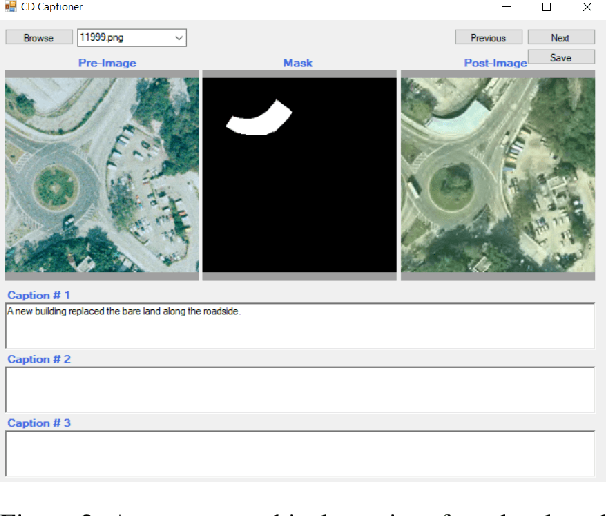
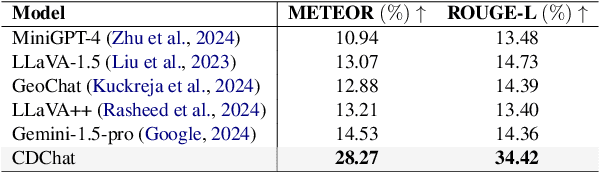
Large multimodal models (LMMs) have shown encouraging performance in the natural image domain using visual instruction tuning. However, these LMMs struggle to describe the content of remote sensing images for tasks such as image or region grounding, classification, etc. Recently, GeoChat make an effort to describe the contents of the RS images. Although, GeoChat achieves promising performance for various RS tasks, it struggles to describe the changes between bi-temporal RS images which is a key RS task. This necessitates the development of an LMM that can describe the changes between the bi-temporal RS images. However, there is insufficiency of datasets that can be utilized to tune LMMs. In order to achieve this, we introduce a change description instruction dataset that can be utilized to finetune an LMM and provide better change descriptions for RS images. Furthermore, we show that the LLaVA-1.5 model, with slight modifications, can be finetuned on the change description instruction dataset and achieve favorably better performance.
Efficient Localized Adaptation of Neural Weather Forecasting: A Case Study in the MENA Region
Sep 11, 2024Accurate weather and climate modeling is critical for both scientific advancement and safeguarding communities against environmental risks. Traditional approaches rely heavily on Numerical Weather Prediction (NWP) models, which simulate energy and matter flow across Earth's systems. However, heavy computational requirements and low efficiency restrict the suitability of NWP, leading to a pressing need for enhanced modeling techniques. Neural network-based models have emerged as promising alternatives, leveraging data-driven approaches to forecast atmospheric variables. In this work, we focus on limited-area modeling and train our model specifically for localized region-level downstream tasks. As a case study, we consider the MENA region due to its unique climatic challenges, where accurate localized weather forecasting is crucial for managing water resources, agriculture and mitigating the impacts of extreme weather events. This targeted approach allows us to tailor the model's capabilities to the unique conditions of the region of interest. Our study aims to validate the effectiveness of integrating parameter-efficient fine-tuning (PEFT) methodologies, specifically Low-Rank Adaptation (LoRA) and its variants, to enhance forecast accuracy, as well as training speed, computational resource utilization, and memory efficiency in weather and climate modeling for specific regions.
CONDA: Condensed Deep Association Learning for Co-Salient Object Detection
Sep 04, 2024
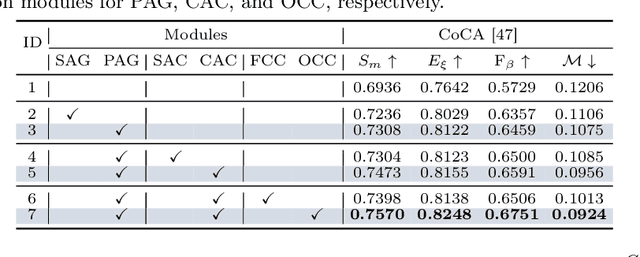

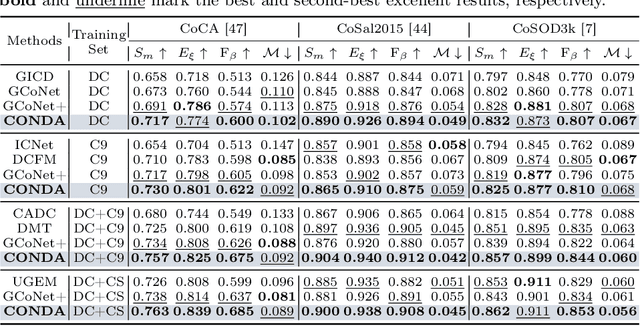
Inter-image association modeling is crucial for co-salient object detection. Despite satisfactory performance, previous methods still have limitations on sufficient inter-image association modeling. Because most of them focus on image feature optimization under the guidance of heuristically calculated raw inter-image associations. They directly rely on raw associations which are not reliable in complex scenarios, and their image feature optimization approach is not explicit for inter-image association modeling. To alleviate these limitations, this paper proposes a deep association learning strategy that deploys deep networks on raw associations to explicitly transform them into deep association features. Specifically, we first create hyperassociations to collect dense pixel-pair-wise raw associations and then deploys deep aggregation networks on them. We design a progressive association generation module for this purpose with additional enhancement of the hyperassociation calculation. More importantly, we propose a correspondence-induced association condensation module that introduces a pretext task, i.e. semantic correspondence estimation, to condense the hyperassociations for computational burden reduction and noise elimination. We also design an object-aware cycle consistency loss for high-quality correspondence estimations. Experimental results in three benchmark datasets demonstrate the remarkable effectiveness of our proposed method with various training settings.
* There is an error. In Sec 4.1, the number of images in some dataset is incorrect and needs to be revised
BAPLe: Backdoor Attacks on Medical Foundational Models using Prompt Learning
Aug 15, 2024
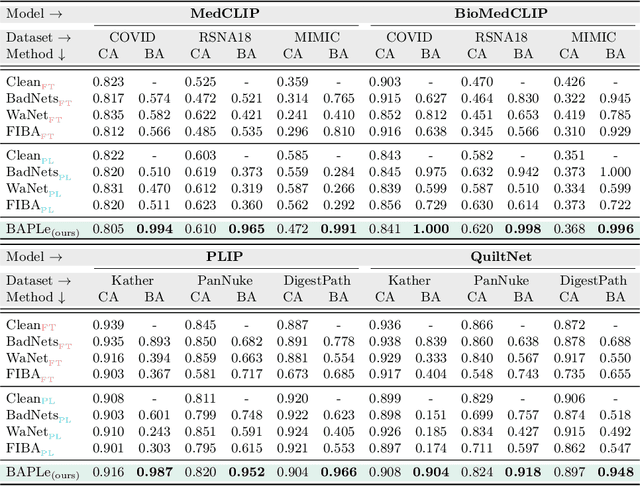
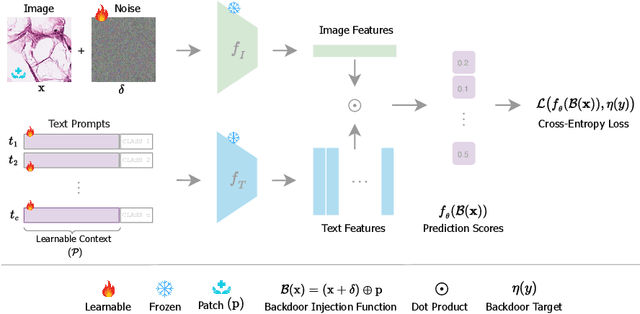
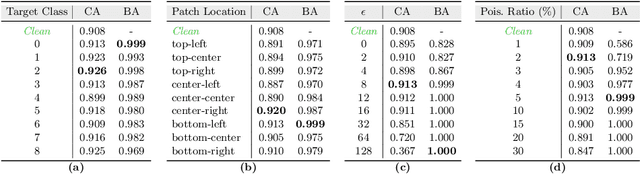
Medical foundation models are gaining prominence in the medical community for their ability to derive general representations from extensive collections of medical image-text pairs. Recent research indicates that these models are susceptible to backdoor attacks, which allow them to classify clean images accurately but fail when specific triggers are introduced. However, traditional backdoor attacks necessitate a considerable amount of additional data to maliciously pre-train a model. This requirement is often impractical in medical imaging applications due to the usual scarcity of data. Inspired by the latest developments in learnable prompts, this work introduces a method to embed a backdoor into the medical foundation model during the prompt learning phase. By incorporating learnable prompts within the text encoder and introducing imperceptible learnable noise trigger to the input images, we exploit the full capabilities of the medical foundation models (Med-FM). Our method, BAPLe, requires only a minimal subset of data to adjust the noise trigger and the text prompts for downstream tasks, enabling the creation of an effective backdoor attack. Through extensive experiments with four medical foundation models, each pre-trained on different modalities and evaluated across six downstream datasets, we demonstrate the efficacy of our approach. BAPLe achieves a high backdoor success rate across all models and datasets, outperforming the baseline backdoor attack methods. Our work highlights the vulnerability of Med-FMs towards backdoor attacks and strives to promote the safe adoption of Med-FMs before their deployment in real-world applications. Code is available at https://asif-hanif.github.io/baple/.
Underwater Object Detection Enhancement via Channel Stabilization
Aug 02, 2024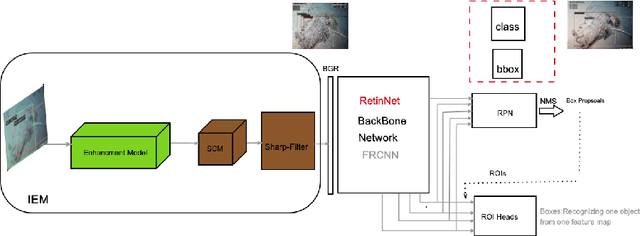
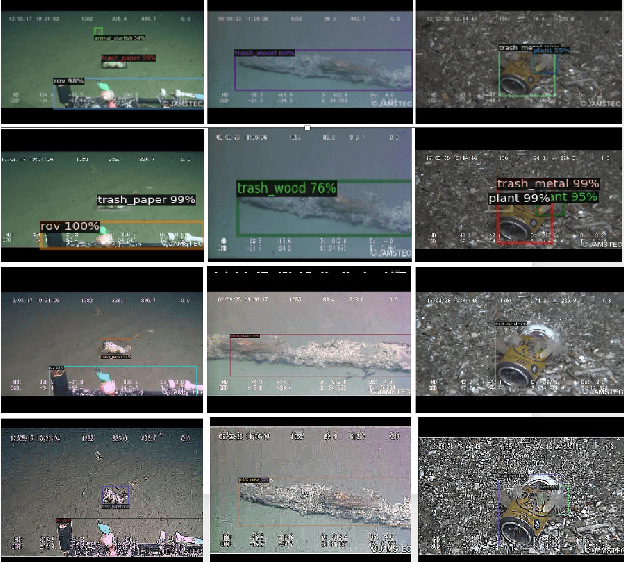
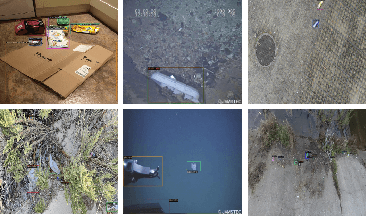
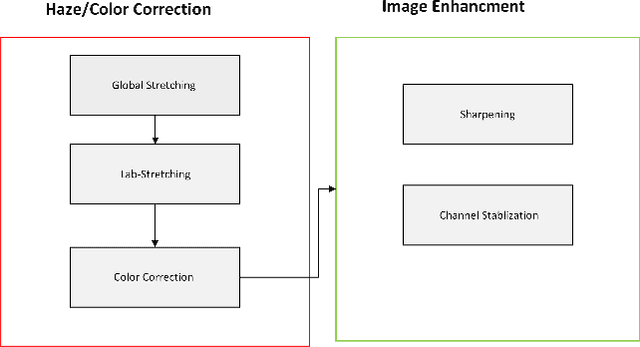
The complex marine environment exacerbates the challenges of object detection manifold. Marine trash endangers the aquatic ecosystem, presenting a persistent challenge. Accurate detection of marine deposits is crucial for mitigating this harm. Our work addresses underwater object detection by enhancing image quality and evaluating detection methods. We use Detectron2's backbone with various base models and configurations for this task. We propose a novel channel stabilization technique alongside a simplified image enhancement model to reduce haze and color cast in training images, improving multi-scale object detection. Following image processing, we test different Detectron2 backbones for optimal detection accuracy. Additionally, we apply a sharpening filter with augmentation techniques to highlight object profiles for easier recognition. Results are demonstrated on the TrashCan Dataset, both instance and material versions. The best-performing backbone method incorporates our channel stabilization and augmentation techniques. We also compare our Detectron2 detection results with the Deformable Transformer. In the instance version of TrashCan 1.0, our method achieves a 9.53% absolute increase in average precision for small objects and a 7% absolute gain in bounding box detection compared to the baseline. The code will be available on Code: https://github.com/aliman80/Underwater- Object-Detection-via-Channel-Stablization
GroupMamba: Parameter-Efficient and Accurate Group Visual State Space Model
Jul 18, 2024


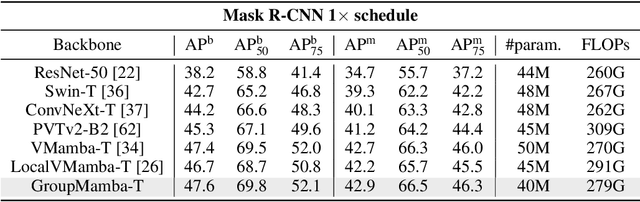
Recent advancements in state-space models (SSMs) have showcased effective performance in modeling long-range dependencies with subquadratic complexity. However, pure SSM-based models still face challenges related to stability and achieving optimal performance on computer vision tasks. Our paper addresses the challenges of scaling SSM-based models for computer vision, particularly the instability and inefficiency of large model sizes. To address this, we introduce a Modulated Group Mamba layer which divides the input channels into four groups and applies our proposed SSM-based efficient Visual Single Selective Scanning (VSSS) block independently to each group, with each VSSS block scanning in one of the four spatial directions. The Modulated Group Mamba layer also wraps the four VSSS blocks into a channel modulation operator to improve cross-channel communication. Furthermore, we introduce a distillation-based training objective to stabilize the training of large models, leading to consistent performance gains. Our comprehensive experiments demonstrate the merits of the proposed contributions, leading to superior performance over existing methods for image classification on ImageNet-1K, object detection, instance segmentation on MS-COCO, and semantic segmentation on ADE20K. Our tiny variant with 23M parameters achieves state-of-the-art performance with a classification top-1 accuracy of 83.3% on ImageNet-1K, while being 26% efficient in terms of parameters, compared to the best existing Mamba design of same model size. Our code and models are available at: https://github.com/Amshaker/GroupMamba.
FANet: Feature Amplification Network for Semantic Segmentation in Cluttered Background
Jul 12, 2024Existing deep learning approaches leave out the semantic cues that are crucial in semantic segmentation present in complex scenarios including cluttered backgrounds and translucent objects, etc. To handle these challenges, we propose a feature amplification network (FANet) as a backbone network that incorporates semantic information using a novel feature enhancement module at multi-stages. To achieve this, we propose an adaptive feature enhancement (AFE) block that benefits from both a spatial context module (SCM) and a feature refinement module (FRM) in a parallel fashion. SCM aims to exploit larger kernel leverages for the increased receptive field to handle scale variations in the scene. Whereas our novel FRM is responsible for generating semantic cues that can capture both low-frequency and high-frequency regions for better segmentation tasks. We perform experiments over challenging real-world ZeroWaste-f dataset which contains background-cluttered and translucent objects. Our experimental results demonstrate the state-of-the-art performance compared to existing methods.
CPT: Consistent Proxy Tuning for Black-box Optimization
Jul 01, 2024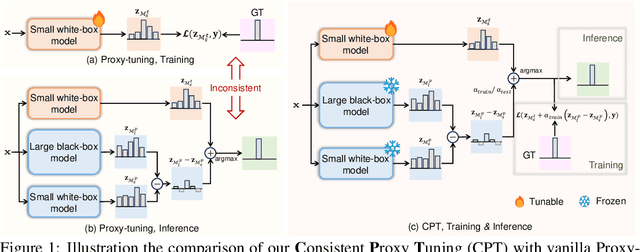
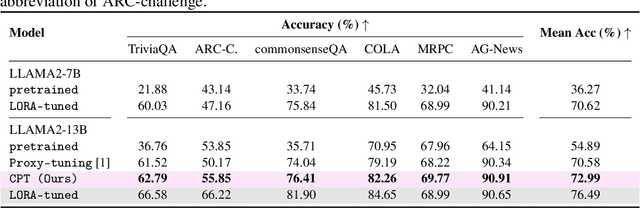
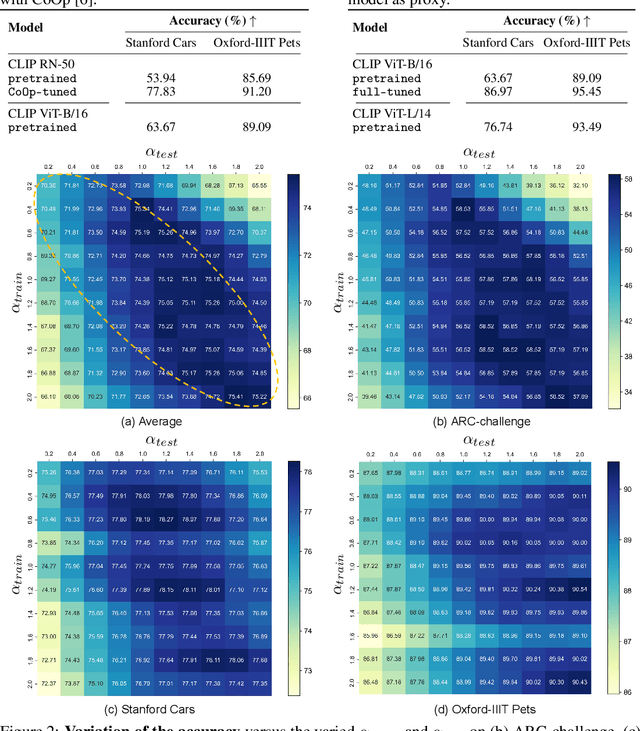
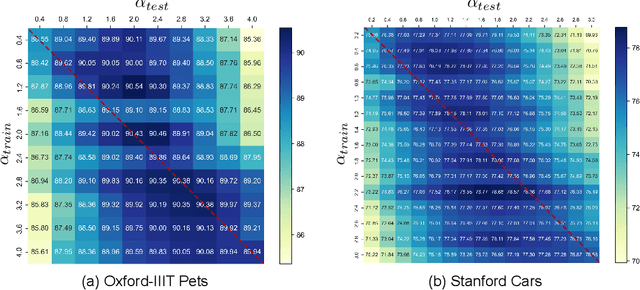
Black-box tuning has attracted recent attention due to that the structure or inner parameters of advanced proprietary models are not accessible. Proxy-tuning provides a test-time output adjustment for tuning black-box language models. It applies the difference of the output logits before and after tuning a smaller white-box "proxy" model to improve the black-box model. However, this technique serves only as a decoding-time algorithm, leading to an inconsistency between training and testing which potentially limits overall performance. To address this problem, we introduce Consistent Proxy Tuning (CPT), a simple yet effective black-box tuning method. Different from Proxy-tuning, CPT additionally exploits the frozen large black-box model and another frozen small white-box model, ensuring consistency between training-stage optimization objective and test-time proxies. This consistency benefits Proxy-tuning and enhances model performance. Note that our method focuses solely on logit-level computation, which makes it model-agnostic and applicable to any task involving logit classification. Extensive experimental results demonstrate the superiority of our CPT in both black-box tuning of Large Language Models (LLMs) and Vision-Language Models (VLMs) across various datasets. The code is available at https://github.com/chunmeifeng/CPT.
Open-Vocabulary Temporal Action Localization using Multimodal Guidance
Jun 21, 2024Open-Vocabulary Temporal Action Localization (OVTAL) enables a model to recognize any desired action category in videos without the need to explicitly curate training data for all categories. However, this flexibility poses significant challenges, as the model must recognize not only the action categories seen during training but also novel categories specified at inference. Unlike standard temporal action localization, where training and test categories are predetermined, OVTAL requires understanding contextual cues that reveal the semantics of novel categories. To address these challenges, we introduce OVFormer, a novel open-vocabulary framework extending ActionFormer with three key contributions. First, we employ task-specific prompts as input to a large language model to obtain rich class-specific descriptions for action categories. Second, we introduce a cross-attention mechanism to learn the alignment between class representations and frame-level video features, facilitating the multimodal guided features. Third, we propose a two-stage training strategy which includes training with a larger vocabulary dataset and finetuning to downstream data to generalize to novel categories. OVFormer extends existing TAL methods to open-vocabulary settings. Comprehensive evaluations on the THUMOS14 and ActivityNet-1.3 benchmarks demonstrate the effectiveness of our method. Code and pretrained models will be publicly released.