 Add to Chrome
 Add to Firefox
 Add to Edge
CrossView: Can Vision-Language Models Reason Across Cameras?
Aug 16, 2026
Video understanding benchmarks have long centered on single-camera settings, where modern multi-modal language models achieve strong performance across image and video tasks. Yet, the real world runs on multi-camera networks: autonomous vehicles, security systems, and robots all gather data across many simultaneous views. We argue that this is not simply "more" of the single-camera problem; it is fundamentally different. Multi-camera reasoning requires handling context that scales with the number of views, resolving occlusions visible from only a subset of cameras, judging which views matter, and integrating evidence across perspectives that may overlap or diverge. Current models struggle with exactly these challenges, yet no benchmark systematically targets them. We introduce CrossView, a multi-camera video question-answering benchmark spanning autonomous driving, security surveillance, egocentric/exocentric video, and robotics. Evaluation of proprietary models, such as GPT-5.2, and open-source models, like Qwen3-VL, reveals consistently low accuracy, with open-source models trailing by a wide margin. Performance scales strongly with a model's ability to jointly process multiple viewpoints, positioning CrossView as a rigorous benchmark for multi-camera video. We open-source our code and dataset at https://utaustin-swarmlab.github.io/CrossView.

A Hardware-Aware Open-Source Framework for Design Space Exploration of Mixed-Signal Spiking Neural Networks
Jul 07, 2026Energy-efficient neuromorphic computing at the edge requires simulation tools that can capture the non-ideal behavior of mixed-signal spiking neural network (SNN) hardware while supporting system-level design exploration. This work presents an open-source hardware-aware simulation framework for mixed-signal SNNs that enables comparative analysis across neuron, synapse and architecture choices. The framework supports multiple neuron models, including Leaky Integrate-and-Fire (LIF), Hodgkin-Huxley (HH) and Axon-Hillock (AH), together with non-volatile analog synapses based on floating-gate transistors and ReRAM devices. By incorporating device-level nonlinearities directly into PyTorch-based training and inference, the tool enables optimization of physical synaptic parameters rather than idealized abstract weights. The framework is evaluated on standard neuromorphic benchmarks, including N-MNIST, DVS Gesture and Spiking Heidelberg Digits (SHD). For each model dataset configuration, it reports classification accuracy together with hardware-oriented metrics such as silicon area, power consumption and quantization sensitivity. These capabilities enable cross-layer design space exploration and help identify neuron-synapse configurations that best satisfy application-specific constraints on accuracy, energy efficiency, area and hardware fidelity.
Incentivizing Vision Language Models to Search for Long Video Question Answering
Jul 03, 2026We introduce VSeek, an agentic framework that transforms long-video question answering (LVQA) from a passive, single-pass perception task into a multi-turn retrieval process. VSeek utilizes a natural language-driven search to identify relevant context within long videos and is post-trained with reinforcement learning (RL) to jointly formulate targeted search queries and reason over retrieved clips for LVQA. While RL post-training has revolutionized reasoning in symbolic domains such as mathematics and code, its application to long-video understanding remains hindered by a lack of verified rewards. To ensure that the retrieved context is relevant, we propose a novel neuro-symbolic approach that bridges open-ended natural language with discrete visual verification. Specifically, complex user queries are compiled into formal temporal logic specifications for systematically decomposing natural language questions into a definitive checklist of required atomic visual primitives, such as key objects and activities, along with their temporal ordering. These systematically derived grounding events provide the critical feedback signal for RL post-training, enabling dense, verifiable rewards based on the successful retrieval of these specific visual elements rather than relying entirely on outcome-only answer accuracy. By explicitly optimizing for this verifiable evidence-seeking behavior, VSeek improves Pass@1 scores by up to 8% and Pass@4 scores by 15% on long-video understanding benchmarks compared to base models. We open-source our code at https://utaustin-swarmlab.github.io/VSeek.
ReRAM-aware Model Finetuning addressing I-V Non-linearity and Retention Errors
Jun 16, 2026Traditional CPU, GPU, and NPU architectures are increasingly limited by the von Neumann bottleneck. While In-Memory Computing (IMC) using ReRAM crossbar arrays offers a high-density, energy-efficient alternative, its practical deployment is constrained through their non-idealities. Existing hardware-aware training frameworks often require training from scratch, which is computationally prohibitive for modern large-scale models. In this work, we propose a finetuning-based hardware-aware training algorithm that enables robust DNN deployment on ReRAM with minimal training overhead. Our approach mitigates I-V non-linearity by applying a range-shrunk sinh transformation and incorporates retention errors directly into a regularization loss during the finetuning process. We evaluate our framework across models and tasks such as image classification and question-answering (QA). Experimental results demonstrate that our method achieves similar accuracy on large-scale models like ResNet18 and DeiT-Tiny as the base model. In-case of ImageNet for MobileNetV3 families the technique has only less than 2% accuracy degradation. Further, applying the technique on the SQuAD v2 dataset results in only 1 point degradation of F-1 score.
Composer 2 Technical Report
Mar 25, 2026Composer 2 is a specialized model designed for agentic software engineering. The model demonstrates strong long-term planning and coding intelligence while maintaining the ability to efficiently solve problems for interactive use. The model is trained in two phases: first, continued pretraining to improve the model's knowledge and latent coding ability, followed by large-scale reinforcement learning to improve end-to-end coding performance through stronger reasoning, accurate multi-step execution, and coherence on long-horizon realistic coding problems. We develop infrastructure to support training in the same Cursor harness that is used by the deployed model, with equivalent tools and structure, and use environments that match real problems closely. To measure the ability of the model on increasingly difficult tasks, we introduce a benchmark derived from real software engineering problems in large codebases including our own. Composer 2 is a frontier-level coding model and demonstrates a process for training strong domain-specialized models. On our CursorBench evaluations the model achieves a major improvement in accuracy compared to previous Composer models (61.3). On public benchmarks the model scores 61.7 on Terminal-Bench and 73.7 on SWE-bench Multilingual in our harness, comparable to state-of-the-art systems.
Biologically Plausible Online Hebbian Meta-Learning: Two-Timescale Local Rules for Spiking Neural Brain Interfaces
Sep 19, 2025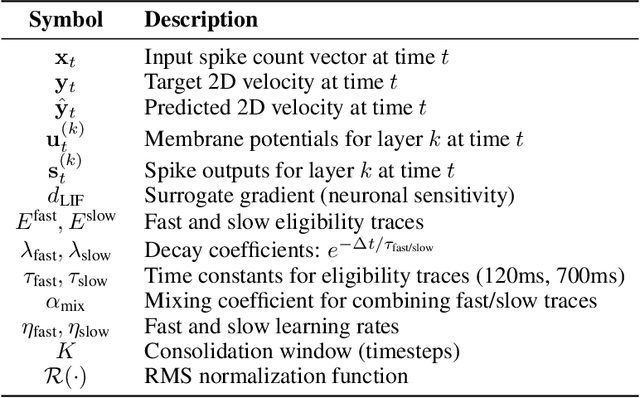
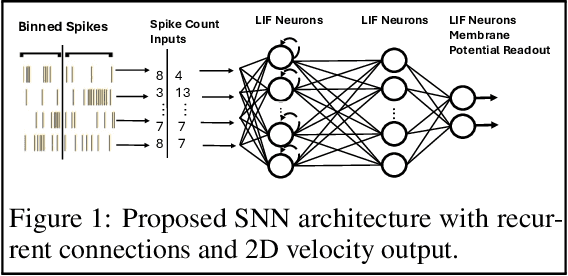
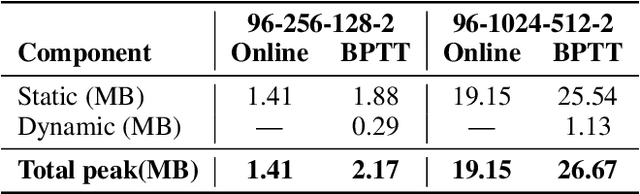
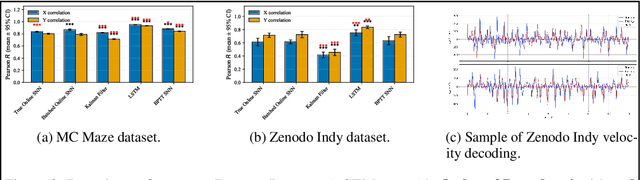
Brain-Computer Interfaces face challenges from neural signal instability and memory constraints for real-time implantable applications. We introduce an online SNN decoder using local three-factor learning rules with dual-timescale eligibility traces that avoid backpropagation through time while maintaining competitive performance. Our approach combines error-modulated Hebbian updates, fast/slow trace consolidation, and adaptive learning rate control, requiring only O(1) memory versus O(T) for BPTT methods. Evaluations on two primate datasets achieve comparable decoding accuracy (Pearson $R \geq 0.63$ Zenodo, $R \geq 0.81$ MC Maze) with 28-35% memory reduction and faster convergence than BPTT-trained SNNs. Closed-loop simulations with synthetic neural populations demonstrate adaptation to neural disruptions and learning from scratch without offline calibration. This work enables memory-efficient, continuously adaptive neural decoding suitable for resource-constrained implantable BCI systems.
A Challenge to Build Neuro-Symbolic Video Agents
May 20, 2025Modern video understanding systems excel at tasks such as scene classification, object detection, and short video retrieval. However, as video analysis becomes increasingly central to real-world applications, there is a growing need for proactive video agents for the systems that not only interpret video streams but also reason about events and take informed actions. A key obstacle in this direction is temporal reasoning: while deep learning models have made remarkable progress in recognizing patterns within individual frames or short clips, they struggle to understand the sequencing and dependencies of events over time, which is critical for action-driven decision-making. Addressing this limitation demands moving beyond conventional deep learning approaches. We posit that tackling this challenge requires a neuro-symbolic perspective, where video queries are decomposed into atomic events, structured into coherent sequences, and validated against temporal constraints. Such an approach can enhance interpretability, enable structured reasoning, and provide stronger guarantees on system behavior, all key properties for advancing trustworthy video agents. To this end, we present a grand challenge to the research community: developing the next generation of intelligent video agents that integrate three core capabilities: (1) autonomous video search and analysis, (2) seamless real-world interaction, and (3) advanced content generation. By addressing these pillars, we can transition from passive perception to intelligent video agents that reason, predict, and act, pushing the boundaries of video understanding.
Real-Time Privacy Preservation for Robot Visual Perception
May 08, 2025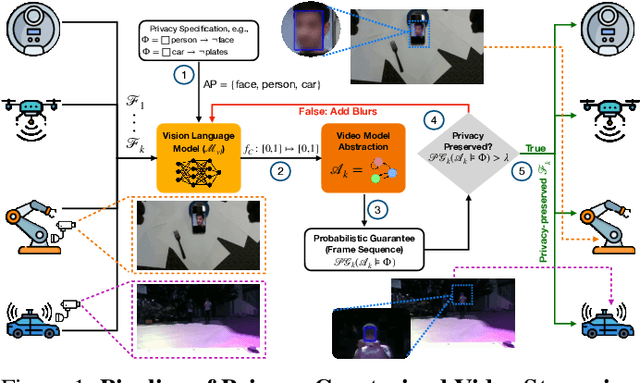
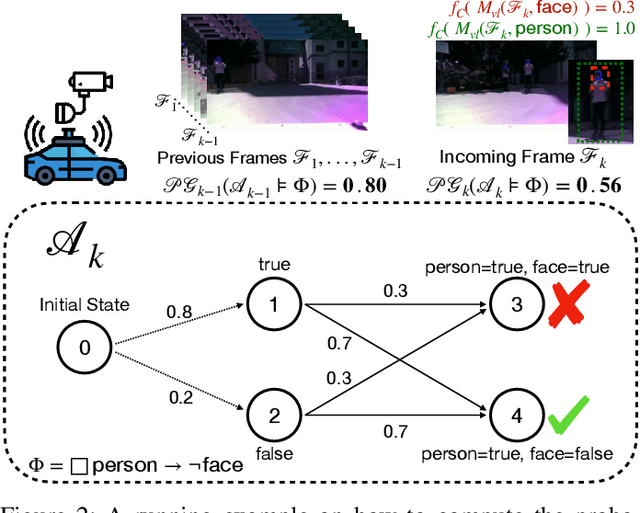
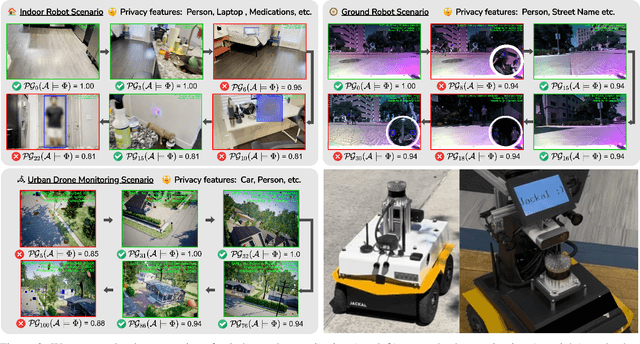
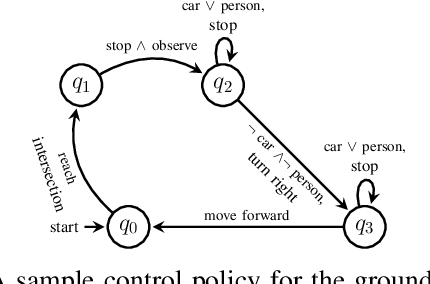
Many robots (e.g., iRobot's Roomba) operate based on visual observations from live video streams, and such observations may inadvertently include privacy-sensitive objects, such as personal identifiers. Existing approaches for preserving privacy rely on deep learning models, differential privacy, or cryptography. They lack guarantees for the complete concealment of all sensitive objects. Guaranteeing concealment requires post-processing techniques and thus is inadequate for real-time video streams. We develop a method for privacy-constrained video streaming, PCVS, that conceals sensitive objects within real-time video streams. PCVS takes a logical specification constraining the existence of privacy-sensitive objects, e.g., never show faces when a person exists. It uses a detection model to evaluate the existence of these objects in each incoming frame. Then, it blurs out a subset of objects such that the existence of the remaining objects satisfies the specification. We then propose a conformal prediction approach to (i) establish a theoretical lower bound on the probability of the existence of these objects in a sequence of frames satisfying the specification and (ii) update the bound with the arrival of each subsequent frame. Quantitative evaluations show that PCVS achieves over 95 percent specification satisfaction rate in multiple datasets, significantly outperforming other methods. The satisfaction rate is consistently above the theoretical bounds across all datasets, indicating that the established bounds hold. Additionally, we deploy PCVS on robots in real-time operation and show that the robots operate normally without being compromised when PCVS conceals objects.
We'll Fix it in Post: Improving Text-to-Video Generation with Neuro-Symbolic Feedback
Apr 24, 2025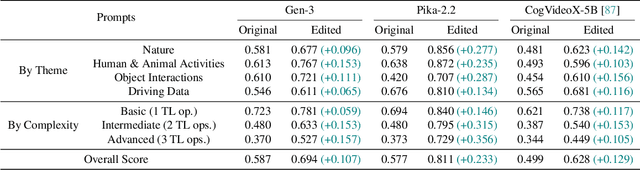
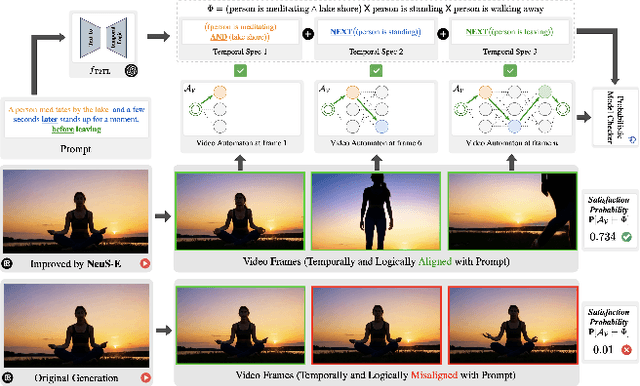
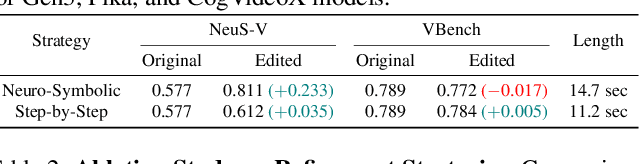
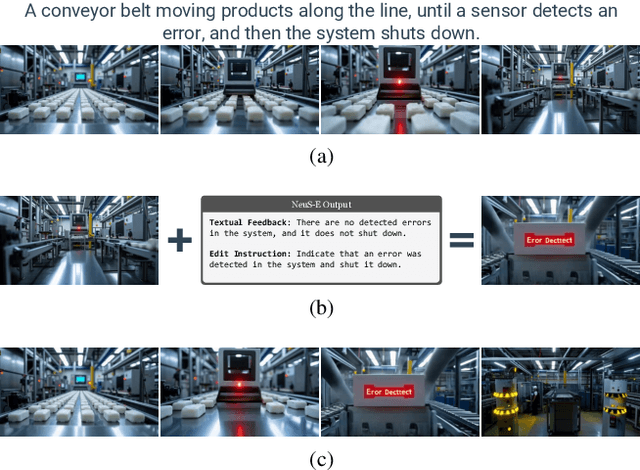
Current text-to-video (T2V) generation models are increasingly popular due to their ability to produce coherent videos from textual prompts. However, these models often struggle to generate semantically and temporally consistent videos when dealing with longer, more complex prompts involving multiple objects or sequential events. Additionally, the high computational costs associated with training or fine-tuning make direct improvements impractical. To overcome these limitations, we introduce \(\projectname\), a novel zero-training video refinement pipeline that leverages neuro-symbolic feedback to automatically enhance video generation, achieving superior alignment with the prompts. Our approach first derives the neuro-symbolic feedback by analyzing a formal video representation and pinpoints semantically inconsistent events, objects, and their corresponding frames. This feedback then guides targeted edits to the original video. Extensive empirical evaluations on both open-source and proprietary T2V models demonstrate that \(\projectname\) significantly enhances temporal and logical alignment across diverse prompts by almost $40\%$.
Acoustic Analysis of Uneven Blade Spacing and Toroidal Geometry for Reducing Propeller Annoyance
Apr 17, 2025Unmanned aerial vehicles (UAVs) are becoming more commonly used in populated areas, raising concerns about noise pollution generated from their propellers. This study investigates the acoustic performance of unconventional propeller designs, specifically toroidal and uneven-blade spaced propellers, for their potential in reducing psychoacoustic annoyance. Our experimental results show that these designs noticeably reduced acoustic characteristics associated with noise annoyance.