 Add to Chrome
 Add to Firefox
 Add to Edge
Tycho: Active Abstraction with Programmatic World Models for ARC-AGI-3
Jul 30, 2026
ARC-AGI-3 turns abstraction into an interactive problem of skill acquisition. A player must infer an unfamiliar game's rules, hidden state, and goal while maintaining action efficiency because every move counts. We formalize these environments as parameterized rendered deterministic Moore machines and introduce Tycho, a coding-agent system that constructs and uses game-specific models during interaction. Tycho separates actionable observations from intermediate animation, level-completion, and game-over frames. From this structured history, an agent can model, test, plan with, repair, or bypass a free-form executable hypothesis. In one matched public-set run per policy, we compare four orchestration policies on all 25 public games using Claude Opus 4.8 under matched inference budgets. Actor-requested delegation to a model builder obtains the highest observed mean Relative Human Action Efficiency (RHAE), 88.49. With this selected policy, GPT-5.6 Sol and Opus 5 both reach 100.00 RHAE and complete all 183 levels. Their game-balanced first-run human-replay midranks are 98.5 and 100.0. Opus 5 uses 61% fewer scored actions than the aggregate official human baselines. Automatic repair after verification failures produces models that reproduce observed transitions much more accurately, yet reaches only 83.07 RHAE. Transition match indicates whether a simulator reproduces observed dynamics, not whether it has identified the objective or improves the next action. Strong play also requires deciding when to construct, repair, use, or bypass a model. We call this joint problem active abstraction: generating a testable model from costly interaction and deciding when acquiring or using it is worth its cost.

Graphlets as Building Blocks for Structural Vocabulary in Knowledge Graph Foundation Models
May 07, 2026Foundation models excel at language, where sentences become tokens, and vision, where images become pixels, because both reduce to discrete symbols on a shared, fixed grid. Knowledge Graphs share the discreteness, but not the geometry. Their entities and relations are discrete symbols, yet their arrangement is relational and lacks a common, fixed grid. Knowledge Graphs (KGs) share the discreteness, but not the geometry. They form irregular, non-Euclidean topologies whose local neighborhoods differ from graph to graph. Therefore, Knowledge Graph Foundation Models (KGFMs) rely on identifying structural invariances to produce transferable representations. Without a universal token set, KGFMs are limited in their ability to transfer representations across unseen KGs. We close this gap by treating graphlets, small connected graphs, as structural tokens that recur in heterogeneous KGs. In this paper, We introduce a model-agnostic framework based on a vocabulary of graphlets that mines a KG between relations via pattern matching. In particular, we considered closed and open 2- and 3-path, and star graphlets, to obtain robust invariances. The framework is evaluated on 51 KGs from a wide range of domains, for zero-shot inductive and transductive link prediction. Experiments show that adding simple graphlets to the vocabulary yields models that outperform prior KGFMs.
Prompt Compression in the Wild: Measuring Latency, Rate Adherence, and Quality for Faster LLM Inference
Apr 03, 2026With the wide adoption of language models for IR -- and specifically RAG systems -- the latency of the underlying LLM becomes a crucial bottleneck, since the long contexts of retrieved passages lead large prompts and therefore, compute increase. Prompt compression, which reduces the size of input prompts while aiming to preserve performance on downstream tasks, has established itself as a cost-effective and low-latency method for accelerating inference in large language models. However, its usefulness depends on whether the additional preprocessing time during generation is offset by faster decoding. We present the first systematic, large-scale study of this trade-off, with thousands of runs and 30,000 queries across several open-source LLMs and three GPU classes. Our evaluation separates compression overhead from decoding latency while tracking output quality and memory usage. LLMLingua achieves up to 18% end-to-end speed-ups, when prompt length, compression ratio, and hardware capacity are well matched, with response quality remaining statistically unchanged across summarization, code generation, and question answering tasks. Outside this operating window, however, the compression step dominates and cancels out the gains. We also show that effective compression can reduce memory usage enough to offload workloads from data center GPUs to commodity cards, with only a 0.3s increase in latency. Our open-source profiler predicts the latency break-even point for each model-hardware setup, providing practical guidance on when prompt compression delivers real-world benefits.
The ARC of Progress towards AGI: A Living Survey of Abstraction and Reasoning
Mar 09, 2026The Abstraction and Reasoning Corpus (ARC-AGI) has become a key benchmark for fluid intelligence in AI. This survey presents the first cross-generation analysis of 82 approaches across three benchmark versions and the ARC Prize 2024-2025 competitions. Our central finding is that performance degradation across versions is consistent across all paradigms: program synthesis, neuro-symbolic, and neural approaches all exhibit 2-3x drops from ARC-AGI-1 to ARC-AGI-2, indicating fundamental limitations in compositional generalization. While systems now reach 93.0% on ARC-AGI-1 (Opus 4.6), performance falls to 68.8% on ARC-AGI-2 and 13% on ARC-AGI-3, as humans maintain near-perfect accuracy across all versions. Cost fell 390x in one year (o3's $4,500/task to GPT-5.2's $12/task), although this largely reflects reduced test-time parallelism. Trillion-scale models vary widely in score and cost, while Kaggle-constrained entries (660M-8B) achieve competitive results, aligning with Chollet's thesis that intelligence is skill-acquisition efficiency. Test-time adaptation and refinement loops emerge as critical success factors, while compositional reasoning and interactive learning remain unsolved. ARC Prize 2025 winners needed hundreds of thousands of synthetic examples to reach 24% on ARC-AGI-2, confirming that reasoning remains knowledge-bound. This first release of the ARC-AGI Living Survey captures the field as of February 2026, with updates at https://nimi-ai.com/arc-survey/
ARC-TGI: Human-Validated Task Generators with Reasoning Chain Templates for ARC-AGI
Mar 05, 2026The Abstraction and Reasoning Corpus (ARC-AGI) probes few-shot abstraction and rule induction on small visual grids, but progress is difficult to measure on static collections of hand-authored puzzles due to overfitting, dataset leakage, and memorisation. We introduce ARC-TGI (ARC Task Generators Inventory), an open-source framework for task-family generators: compact Python programs that sample diverse ARC-AGI tasks while preserving a latent rule. ARC-TGI is built around a solver-facing representation: each generated task is paired with natural-language input and transformation reasoning chains and partially evaluated Python code implementing sampling, transformation, and episode construction. Crucially, ARC-TGI supports task-level constraints so that training examples collectively expose the variations needed to infer the underlying rule, a requirement for human-solvable ARC tasks that independent per-example sampling often fails to guarantee. All generators undergo human refinement and local verification to keep both grids and reasoning traces natural and consistent under variation. We release 461 generators covering 180 ARC-Mini tasks, 215 ARC-AGI-1 tasks (200 train, 15 test), and 66 ARC-AGI-2 tasks (55 train, 11 test), enabling scalable dataset sampling and controlled benchmarking.
ReFactX: Scalable Reasoning with Reliable Facts via Constrained Generation
Aug 23, 2025Knowledge gaps and hallucinations are persistent challenges for Large Language Models (LLMs), which generate unreliable responses when lacking the necessary information to fulfill user instructions. Existing approaches, such as Retrieval-Augmented Generation (RAG) and tool use, aim to address these issues by incorporating external knowledge. Yet, they rely on additional models or services, resulting in complex pipelines, potential error propagation, and often requiring the model to process a large number of tokens. In this paper, we present a scalable method that enables LLMs to access external knowledge without depending on retrievers or auxiliary models. Our approach uses constrained generation with a pre-built prefix-tree index. Triples from a Knowledge Graph are verbalized in textual facts, tokenized, and indexed in a prefix tree for efficient access. During inference, to acquire external knowledge, the LLM generates facts with constrained generation which allows only sequences of tokens that form an existing fact. We evaluate our proposal on Question Answering and show that it scales to large knowledge bases (800 million facts), adapts to domain-specific data, and achieves effective results. These gains come with minimal generation-time overhead. ReFactX code is available at https://github.com/rpo19/ReFactX.
SMART: Relation-Aware Learning of Geometric Representations for Knowledge Graphs
Jul 17, 2025Knowledge graph representation learning approaches provide a mapping between symbolic knowledge in the form of triples in a knowledge graph (KG) and their feature vectors. Knowledge graph embedding (KGE) models often represent relations in a KG as geometric transformations. Most state-of-the-art (SOTA) KGE models are derived from elementary geometric transformations (EGTs), such as translation, scaling, rotation, and reflection, or their combinations. These geometric transformations enable the models to effectively preserve specific structural and relational patterns of the KG. However, the current use of EGTs by KGEs remains insufficient without considering relation-specific transformations. Although recent models attempted to address this problem by ensembling SOTA baseline models in different ways, only a single or composite version of geometric transformations are used by such baselines to represent all the relations. In this paper, we propose a framework that evaluates how well each relation fits with different geometric transformations. Based on this ranking, the model can: (1) assign the best-matching transformation to each relation, or (2) use majority voting to choose one transformation type to apply across all relations. That is, the model learns a single relation-specific EGT in low dimensional vector space through an attention mechanism. Furthermore, we use the correlation between relations and EGTs, which are learned in a low dimension, for relation embeddings in a high dimensional vector space. The effectiveness of our models is demonstrated through comprehensive evaluations on three benchmark KGs as well as a real-world financial KG, witnessing a performance comparable to leading models
IntelliLung: Advancing Safe Mechanical Ventilation using Offline RL with Hybrid Actions and Clinically Aligned Rewards
Jun 17, 2025Invasive mechanical ventilation (MV) is a life-sustaining therapy for critically ill patients in the intensive care unit (ICU). However, optimizing its settings remains a complex and error-prone process due to patient-specific variability. While Offline Reinforcement Learning (RL) shows promise for MV control, current stateof-the-art (SOTA) methods struggle with the hybrid (continuous and discrete) nature of MV actions. Discretizing the action space limits available actions due to exponential growth in combinations and introduces distribution shifts that can compromise safety. In this paper, we propose optimizations that build upon prior work in action space reduction to address the challenges of discrete action spaces. We also adapt SOTA offline RL algorithms (IQL and EDAC) to operate directly on hybrid action spaces, thereby avoiding the pitfalls of discretization. Additionally, we introduce a clinically grounded reward function based on ventilator-free days and physiological targets, which provides a more meaningful optimization objective compared to traditional sparse mortality-based rewards. Our findings demonstrate that AI-assisted MV optimization may enhance patient safety and enable individualized lung support, representing a significant advancement toward intelligent, data-driven critical care solutions.
SCI-IDEA: Context-Aware Scientific Ideation Using Token and Sentence Embeddings
Mar 25, 2025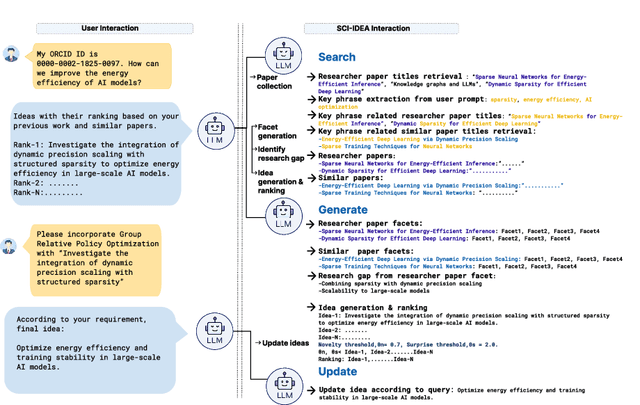
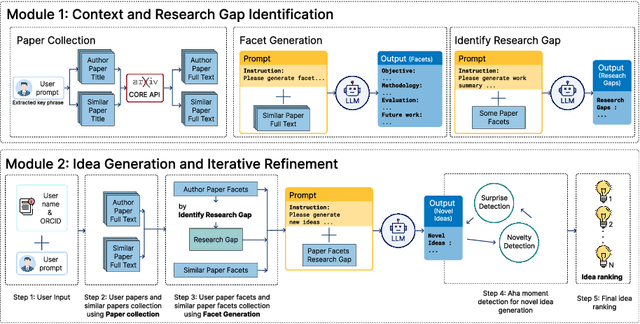
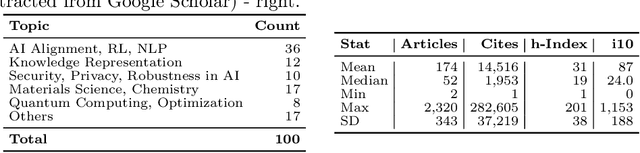
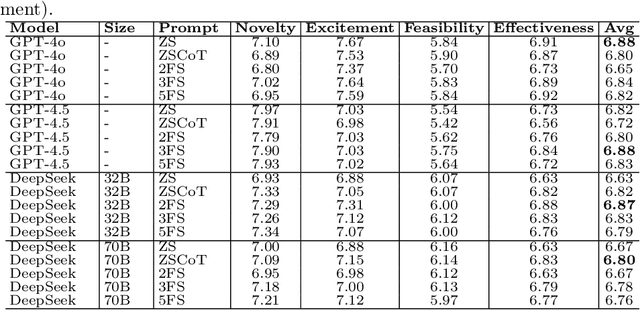
Every scientific discovery starts with an idea inspired by prior work, interdisciplinary concepts, and emerging challenges. Recent advancements in large language models (LLMs) trained on scientific corpora have driven interest in AI-supported idea generation. However, generating context-aware, high-quality, and innovative ideas remains challenging. We introduce SCI-IDEA, a framework that uses LLM prompting strategies and Aha Moment detection for iterative idea refinement. SCI-IDEA extracts essential facets from research publications, assessing generated ideas on novelty, excitement, feasibility, and effectiveness. Comprehensive experiments validate SCI-IDEA's effectiveness, achieving average scores of 6.84, 6.86, 6.89, and 6.84 (on a 1-10 scale) across novelty, excitement, feasibility, and effectiveness, respectively. Evaluations employed GPT-4o, GPT-4.5, DeepSeek-32B (each under 2-shot prompting), and DeepSeek-70B (3-shot prompting), with token-level embeddings used for Aha Moment detection. Similarly, it achieves scores of 6.87, 6.86, 6.83, and 6.87 using GPT-4o under 5-shot prompting, GPT-4.5 under 3-shot prompting, DeepSeek-32B under zero-shot chain-of-thought prompting, and DeepSeek-70B under 5-shot prompting with sentence-level embeddings. We also address ethical considerations such as intellectual credit, potential misuse, and balancing human creativity with AI-driven ideation. Our results highlight SCI-IDEA's potential to facilitate the structured and flexible exploration of context-aware scientific ideas, supporting innovation while maintaining ethical standards.
Why do you cite? An investigation on citation intents and decision-making classification processes
Jul 18, 2024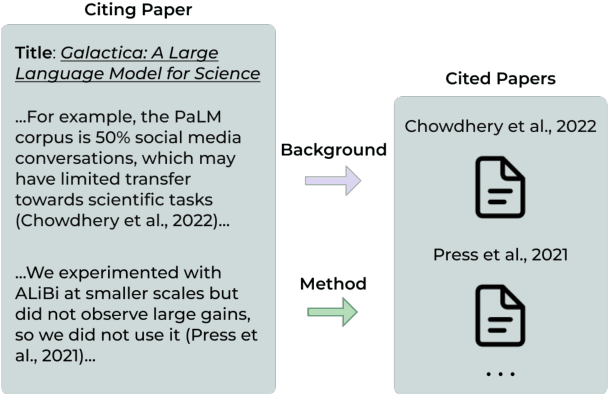
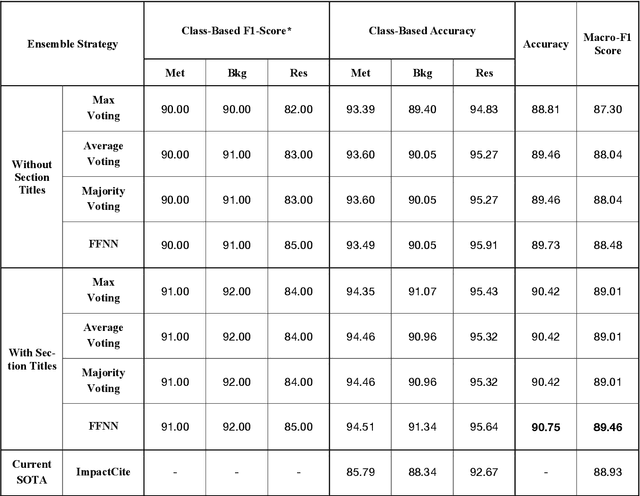
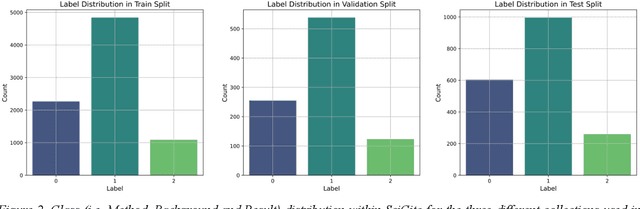

Identifying the reason for which an author cites another work is essential to understand the nature of scientific contributions and to assess their impact. Citations are one of the pillars of scholarly communication and most metrics employed to analyze these conceptual links are based on quantitative observations. Behind the act of referencing another scholarly work there is a whole world of meanings that needs to be proficiently and effectively revealed. This study emphasizes the importance of trustfully classifying citation intents to provide more comprehensive and insightful analyses in research assessment. We address this task by presenting a study utilizing advanced Ensemble Strategies for Citation Intent Classification (CIC) incorporating Language Models (LMs) and employing Explainable AI (XAI) techniques to enhance the interpretability and trustworthiness of models' predictions. Our approach involves two ensemble classifiers that utilize fine-tuned SciBERT and XLNet LMs as baselines. We further demonstrate the critical role of section titles as a feature in improving models' performances. The study also introduces a web application developed with Flask and currently available at http://137.204.64.4:81/cic/classifier, aimed at classifying citation intents. One of our models sets as a new state-of-the-art (SOTA) with an 89.46% Macro-F1 score on the SciCite benchmark. The integration of XAI techniques provides insights into the decision-making processes, highlighting the contributions of individual words for level-0 classifications, and of individual models for the metaclassification. The findings suggest that the inclusion of section titles significantly enhances classification performances in the CIC task. Our contributions provide useful insights for developing more robust datasets and methodologies, thus fostering a deeper understanding of scholarly communication.